
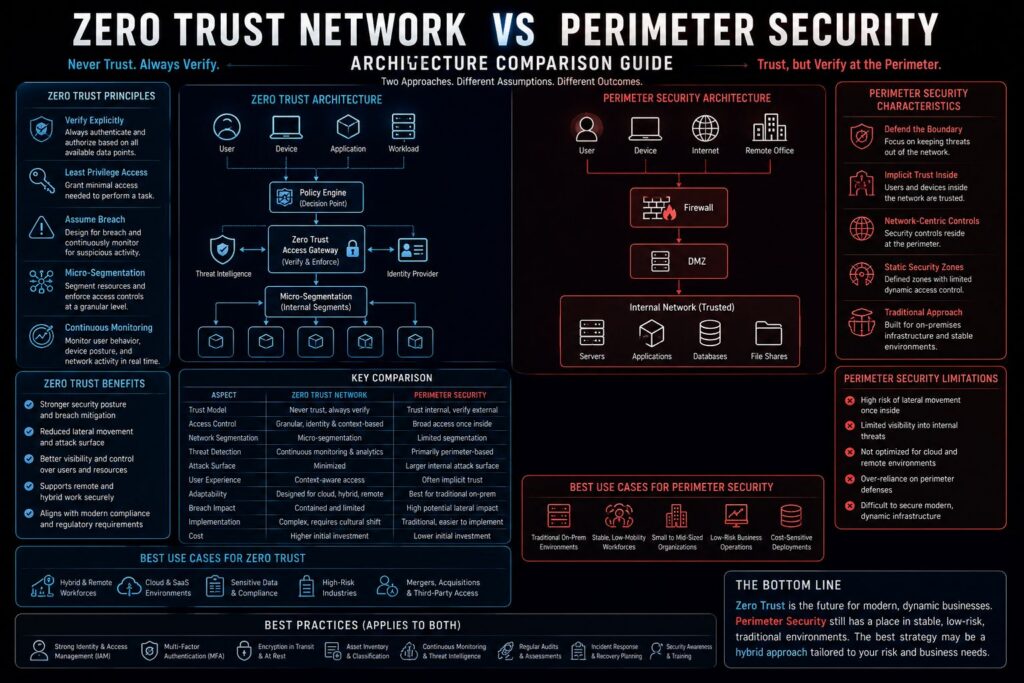
- Zero Trust operates on a “never trust, always verify” principle — every access request is authenticated and validated, whether it originates inside or outside your network.
- Traditional perimeter security leaves organizations exposed once an attacker breaches the outer boundary, giving them near-unrestricted internal access.
- Zero Trust is built for modern environments — cloud infrastructure, remote workforces, and IoT devices have made the concept of a fixed network perimeter obsolete.
- Implementation doesn’t have to happen overnight — organizations can adopt a phased approach using frameworks like NIST and CISA’s Zero Trust Maturity Model.
- The five core pillars of Zero Trust — Identity, Devices, Networks, Applications, and Data — each require specific security controls to build a complete architecture.
Zero Trust vs. Perimeter Security: Why This Comparison Matters Now
The way organizations defend their networks has fundamentally changed — and the security model you choose today will determine how exposed you are tomorrow.
For decades, perimeter security was the gold standard. The idea was simple: build a strong wall around your network, and everything inside is safe. But that assumption crumbled as cloud adoption exploded, remote work became the norm, and sophisticated attackers learned to bypass — or simply walk through — those walls using stolen credentials or insider access.
Object First, a leader in data security and backup infrastructure, provides context on this shift well: the traditional model essentially hands over the keys to the entire castle once someone clears the front gate. Zero Trust architecture was built specifically to eliminate that single point of failure. This guide breaks down exactly how these two models differ, how Zero Trust actually works, and what it takes to implement it in a real organization.
What is Perimeter Security Architecture?
Perimeter security is a network defense strategy that focuses on controlling access at the boundary between an internal network and the outside world. Think firewalls, VPNs, intrusion detection systems, and DMZs — all designed to keep threats out and trusted users in.
The Castle-and-Moat Model Explained
The castle-and-moat analogy captures perimeter security perfectly. The castle is your internal network. The moat is your firewall and perimeter defenses. Anyone who crosses the moat is considered a trusted insider and can move freely within the castle walls. The critical flaw? If an attacker gets across that moat — through phishing, stolen credentials, or a compromised VPN — there’s little stopping them from accessing everything inside.
How Traditional Perimeter Defense Works
In a traditional perimeter model, security teams deploy a combination of hardware and software tools at the network edge. Firewalls filter incoming and outgoing traffic based on predefined rules. VPNs create encrypted tunnels for remote users. Intrusion detection and prevention systems (IDS/IPS) monitor traffic for known threat signatures. Once a user or device is authenticated at this boundary, they typically receive broad network access with minimal further scrutiny.
Why Perimeter Security Was the Industry Standard for Decades
Perimeter security made sense when corporate data lived entirely on-premises and employees worked from fixed office locations on company-managed devices. The network boundary was clear, manageable, and relatively easy to defend. It was cost-effective, well-understood, and aligned with the technology landscape of its time.
What is Zero Trust Network Architecture?
Zero Trust is a security model built on one foundational assumption: no user, device, or system should be trusted by default — regardless of whether it’s inside or outside the network perimeter. Every access request is treated as potentially hostile until proven otherwise.
The Core Principle: Never Trust, Always Verify
The phrase “never trust, always verify” is more than a slogan — it’s a complete rethinking of how access decisions are made. In a Zero Trust model, authentication doesn’t end at the login screen. Every request for data, applications, or network resources triggers a fresh verification process that evaluates identity, device health, location, and behavior context.
This continuous validation is what separates Zero Trust from every legacy security model. It doesn’t matter if a user authenticated successfully an hour ago — if their behavior suddenly looks anomalous, access can be revoked instantly.
How Zero Trust Treats Internal and External Traffic Equally
One of the most significant departures from traditional security is that Zero Trust applies the same level of scrutiny to internal traffic as it does to external requests. A contractor on a corporate VPN gets no more inherent trust than an unknown external connection. Every lateral movement attempt within the network is subject to policy enforcement, making it dramatically harder for attackers to move freely after an initial breach.
This approach directly counters one of the most common and damaging attack patterns in modern cybersecurity: the insider threat and the compromised internal account.
Zero Trust vs. Perimeter Security: Key Differences
These two models represent fundamentally different philosophies about where trust belongs in a network. Understanding the specific contrasts helps organizations recognize exactly where their current defenses may be falling short.
| Factor | Perimeter Security | Zero Trust |
|---|---|---|
| Default Trust | Trusted once inside the network | No implicit trust at any point |
| Access Control | Broad access after authentication | Least privilege, granular access |
| Threat Response | Reactive, perimeter-focused | Continuous, behavior-based |
| Cloud Compatibility | Limited, struggles with distributed environments | Designed for cloud-native and hybrid infrastructure |
| Insider Threat Protection | Minimal — insiders are trusted by default | Strong — every internal request is verified |
Trust Assumptions
Perimeter security assumes that anything inside the network can be trusted. Zero Trust makes no such assumption. Every entity — user, device, or application — must earn access continuously. This is the single most important conceptual shift between the two models, and it has massive implications for how breaches unfold and how quickly they can be contained.
Access Control Methods
Traditional perimeter models grant broad access once authentication is complete. A sales rep who logs into the VPN might inadvertently have access to engineering files, HR records, or financial systems — not because they need it, but because access controls are applied loosely. For more information on securing enterprise systems, check out this enterprise security platform comparison.
Zero Trust enforces least privilege access at a granular level. Users receive access only to the specific resources required for their current task, for the minimum time necessary. This dramatically reduces the attack surface if credentials are ever compromised.
Response to Internal Threats
Perimeter security is nearly blind to internal threats. Once inside, a malicious actor — whether a compromised account or a rogue employee — can often move laterally through the network with little resistance. Zero Trust uses microsegmentation and continuous behavioral monitoring to detect and contain this kind of lateral movement before it becomes a full-scale breach.
Adaptability to Cloud and Remote Work
The modern workplace has no single perimeter. Employees access corporate resources from home networks, personal devices, and third-party cloud platforms. Perimeter security simply wasn’t designed for this reality. Zero Trust, by contrast, is inherently location-agnostic — it doesn’t matter where a request originates, only whether it can be verified and authorized under current policy.
How Zero Trust Network Architecture Works
Zero Trust isn’t a single product you install — it’s a framework of interconnected security controls that work together to continuously evaluate and enforce access decisions. Here’s how that process actually plays out in practice.
Step 1: Identity Verification on Every Request
Every access attempt in a Zero Trust model starts with a rigorous identity verification process. This goes far beyond a username and password check. The system evaluates who is making the request, what device they’re using, where the request originates, and whether the behavioral context matches established patterns. Identity providers like Microsoft Entra ID (formerly Azure AD) or Okta handle this layer, integrating with multi-factor authentication to confirm that the person requesting access is genuinely who they claim to be.
Step 2: Risk Assessment and Threat Inspection
Real-World Example: A user successfully authenticates from their usual laptop in New York at 9 AM. Twenty minutes later, an access request comes in from the same credentials — but from a device in Eastern Europe with an outdated OS and no endpoint protection active. A Zero Trust system flags this as high-risk and blocks the request automatically, even though the credentials passed authentication. This is the power of continuous risk assessment in action.
After identity is confirmed, the system doesn’t simply open the door. It runs a dynamic risk assessment that factors in device compliance status, network location, time of access, and the sensitivity of the resource being requested. This happens in real time, often within milliseconds, using policy engines that weigh multiple signals simultaneously.
Device health is a critical signal here. A fully patched, managed corporate laptop presents a very different risk profile than a personal device running an unpatched operating system. Zero Trust solutions like Microsoft Intune or CrowdStrike Falcon assess endpoint compliance before access is ever granted, ensuring that the device itself isn’t a vector for attack.
Threat intelligence feeds also play a role at this stage. Known malicious IP ranges, suspicious geolocation patterns, and anomalous access timing are all inputs that can trigger additional verification steps or outright denial. The risk score assigned at this stage directly informs the policy decision that follows. For example, malicious Chrome extensions can be identified and blocked using these feeds.
Step 3: Policy-Based Access Decisions
The final step is where the policy engine renders its verdict. Based on the identity verification outcome and the risk assessment score, the system either grants access, denies it, or triggers a step-up authentication challenge. Critically, access is always scoped to the minimum necessary — a marketing analyst requesting access to a campaign dashboard won’t receive any visibility into financial systems or engineering repositories, regardless of their authentication status. These policies are defined, maintained, and continuously updated by security teams to reflect evolving risk tolerances and compliance requirements.
Core Principles Behind Zero Trust
Zero Trust isn’t held together by a single technology — it’s a collection of principles that, when applied together, create a security posture that’s fundamentally harder to compromise. Each principle addresses a specific weakness that perimeter security leaves exposed.
Continuous Monitoring and Validation
Zero Trust treats authentication as an ongoing process, not a one-time event. Sessions are continuously monitored for behavioral anomalies, and access can be revoked mid-session if something looks wrong. This is a sharp departure from perimeter models where a successful login at 8 AM grants uninterrupted access until the user logs out — or until an attacker decides they’re done.
Least Privilege Access
Users, applications, and systems receive only the permissions they absolutely need — nothing more. This principle limits the blast radius of any single compromised account. If an attacker gains access to a low-privilege user account, least privilege access means they encounter walls almost immediately, rather than a wide-open internal network to explore at leisure.
Microsegmentation
Microsegmentation divides the network into small, isolated zones. Each zone has its own access controls, meaning that even if an attacker breaches one segment, they cannot freely traverse to others. Think of it as replacing the castle’s open interior with a series of locked rooms — each requiring its own key. For a broader understanding of how these security measures fit into a comprehensive strategy, explore the complete enterprise security platform comparison.
In practice, microsegmentation is implemented using software-defined networking (SDN) tools or next-generation firewalls that enforce east-west traffic policies. Vendors like Illumio and VMware NSX are widely used to implement this at scale across enterprise environments.
The impact on breach containment is significant. Without microsegmentation, a single compromised endpoint can become a launching pad for ransomware that spreads across the entire network. With it, the infection is quarantined to the segment where it originated, buying security teams critical response time.
Multi-Factor Authentication
MFA is non-negotiable in a Zero Trust framework. It requires users to verify their identity through at least two independent factors — typically something they know (password), something they have (authenticator app or hardware token), and sometimes something they are (biometrics). Even if credentials are stolen through phishing, MFA ensures that possession of a password alone is not sufficient to gain access.
Lateral Movement Prevention
One of the most damaging phases of any cyberattack is lateral movement — the process by which attackers who have breached one system use that foothold to pivot deeper into the network. Zero Trust directly targets this through microsegmentation, strict east-west traffic controls, and continuous behavioral monitoring. Every attempt to access a new resource or system triggers a fresh verification process, making lateral movement exponentially more difficult and detectable.
Where Perimeter Security Still Falls Short
Even organizations with mature, well-funded perimeter security programs are discovering that the model has fundamental gaps that no amount of firewall tuning can fix. These aren’t edge cases — they’re structural weaknesses baked into the architecture itself.
Vulnerability to Insider Threats
Insider threats are the Achilles’ heel of perimeter security. Whether it’s a malicious employee exfiltrating data, a negligent user clicking a phishing link, or a contractor with excessive access privileges, perimeter defenses offer virtually no protection once a threat is already inside the network. The implicit trust granted to authenticated internal users is a standing invitation for abuse.
The consequences can be severe. A disgruntled employee with access to financial systems, customer databases, or intellectual property can cause damage that takes years to recover from — and perimeter security won’t raise an alarm until it’s far too late. Zero Trust’s continuous monitoring and least privilege controls address this gap directly by ensuring that internal users are never granted more access than they need, and that their behavior is always being watched.
The Blurring Network Perimeter in Modern Environments
The concept of a clearly defined network perimeter is increasingly fictional. When enterprise data lives across AWS, Azure, and Google Cloud simultaneously, when employees work from dozens of different locations on a mix of corporate and personal devices, and when third-party SaaS applications handle critical business functions, the “moat” protecting the castle has been replaced by hundreds of potential entry points. Perimeter security tools were designed for a world where the network edge was a physical thing you could point to — and that world no longer exists for most organizations.
Benefits of Zero Trust Security Architecture
The shift to Zero Trust isn’t just about plugging security gaps — it delivers tangible operational and compliance benefits that make it a strategic advantage, not just a defensive necessity.
Organizations that have implemented Zero Trust report measurably improved incident response times, reduced attack surfaces, and greater confidence in their ability to meet regulatory requirements. The architecture is built for how modern organizations actually operate, rather than how they operated twenty years ago.
Stronger Protection Against Internal and External Threats
Zero Trust is uniquely effective because it doesn’t distinguish between threat origins. Whether an attack comes from an external hacker, a compromised vendor account, or a malicious insider, the response is the same: every request is verified, every access is scoped, and every anomaly is flagged. This symmetrical treatment of all network traffic makes Zero Trust one of the most comprehensive security postures available to modern organizations.
Better Visibility and Access Control
Zero Trust gives security teams a level of network visibility that perimeter models simply cannot match. Because every access request is logged, evaluated, and acted upon in real time, organizations build a continuous, detailed record of who accessed what, when, and from where. This audit trail is invaluable — both for detecting threats in progress and for reconstructing exactly what happened after a breach.
Granular access controls mean that security teams can define and enforce policies at the level of individual users, devices, applications, and even specific data sets. Rather than managing broad network segments, administrators work with precise policies that reflect actual job functions and risk levels. Tools like Zscaler Private Access and Palo Alto Networks Prisma Access make this kind of fine-grained control manageable even at enterprise scale.
The result is an environment where anomalous behavior stands out immediately. When a user who typically accesses three internal applications suddenly attempts to reach fifteen, the system flags it. When a device that’s always connected from Chicago suddenly appears in Singapore, the policy engine responds. This continuous behavioral baseline is something perimeter security architectures are structurally incapable of providing.
Compliance and Data Privacy Support
Regulatory frameworks like HIPAA, GDPR, PCI-DSS, and SOC 2 all demand strict controls over who can access sensitive data and under what circumstances. Zero Trust architecture maps directly onto these requirements. Least privilege access ensures that only authorized personnel can reach regulated data. Continuous monitoring creates the audit logs that compliance auditors need. Microsegmentation isolates sensitive data environments from the rest of the network, reducing the scope of compliance assessments.
For organizations operating in heavily regulated industries — healthcare, finance, government contracting — Zero Trust isn’t just a security best practice, it’s increasingly becoming a compliance baseline. The U.S. federal government’s Executive Order 14028 explicitly mandated Zero Trust adoption across federal agencies, a signal that regulators across sectors are moving in the same direction.
Secure Remote Work and Cloud Adoption
Zero Trust was practically designed for the remote-first, cloud-first reality most organizations now live in. Because it verifies identity and device health at the point of access — rather than at a fixed network perimeter — it works just as effectively for a remote employee on a home network as it does for someone sitting at headquarters. Cloud workloads, SaaS applications, and hybrid infrastructure are all protected under the same consistent policy framework, eliminating the security gaps that appear when perimeter tools try to stretch beyond their original design.
How to Implement Zero Trust Architecture
Zero Trust implementation is a journey, not a single project. Most organizations can’t rip out their existing infrastructure overnight, nor should they try. The most effective approach is phased — starting with the highest-risk areas and expanding Zero Trust controls systematically across the environment over time. For a deeper understanding of how Zero Trust can protect against evolving threats, consider exploring the comparison of security orchestration platforms.
The CISA Zero Trust Maturity Model: 5 Pillars
The Cybersecurity and Infrastructure Security Agency (CISA) developed the Zero Trust Maturity Model to give organizations a structured roadmap for implementation. It defines five core pillars, each representing a critical area of the enterprise environment that must be brought under Zero Trust principles. Maturity within each pillar progresses through three stages: Traditional, Advanced, and Optimal.
Understanding where your organization currently sits within each pillar helps prioritize investment and effort. Most organizations are strongest in Identity and weakest in Data — which is precisely where the most sensitive assets live.
| Pillar | What It Covers | Key Controls |
|---|---|---|
| Identity | User and service account authentication | MFA, identity governance, privileged access management |
| Devices | Endpoint health and compliance | Device enrollment, EDR tools, patch compliance checks |
| Networks | Traffic segmentation and inspection | Microsegmentation, encrypted traffic analysis, DNS filtering |
| Applications & Workloads | Access to apps and cloud services | ZTNA, app-level access controls, API security |
| Data | Protection of data at rest and in transit | Data classification, DLP tools, encryption enforcement |
Progressing toward the Optimal maturity stage across all five pillars means building an environment where access decisions are fully automated, continuously reassessed, and driven by real-time risk signals — with minimal manual intervention required from security teams. For a comprehensive understanding of security platforms, consider exploring the enterprise security platform comparison between CrowdStrike and Darktrace.
NIST Zero Trust Architecture Guidelines
NIST Special Publication 800-207 is the definitive technical reference for Zero Trust Architecture. Published by the National Institute of Standards and Technology, it defines Zero Trust as a set of guiding principles rather than a specific product or technology, which is exactly the right framing. The publication outlines seven core tenets — including treating all data sources and services as resources, ensuring all communication is secured regardless of network location, and granting access to resources on a per-session basis.
NIST 800-207 also describes three primary deployment models for Zero Trust: the Enhanced Identity Governance model, the Micro-Segmentation model, and the Software-Defined Perimeter model. Each suits different organizational structures and risk profiles. Organizations in early implementation phases often start with Enhanced Identity Governance — it leverages existing identity infrastructure and delivers immediate risk reduction without requiring a full network redesign.
Practical First Steps for Organizations
Start by mapping your most sensitive data and the identities that have access to it — this is your highest-priority protection surface. From there, enforce MFA universally, deploy an identity governance solution, and begin inventorying device compliance. These three steps alone eliminate a significant percentage of common attack vectors and establish the foundation on which every subsequent Zero Trust control will be built.
Zero Trust Is the Future of Network Security
The threat landscape has fundamentally outpaced the assumptions that perimeter security was built on. Attackers don’t need to break down the front door when they can walk in through a phished credential, a misconfigured cloud storage bucket, or a third-party vendor with excessive access. Zero Trust closes these gaps systematically — not by building higher walls, but by eliminating the very concept of unconditional trust inside a network. Organizations that adopt it aren’t just improving their security posture; they’re building infrastructure resilient enough to withstand the threats that haven’t been invented yet.
Frequently Asked Questions
Below are answers to the most common questions organizations ask when evaluating or beginning their Zero Trust journey.
Is Zero Trust Architecture suitable for small businesses?
Yes — and the barrier to entry is lower than most small businesses assume. Cloud-native Zero Trust tools like Cloudflare Access, Google BeyondCorp Enterprise, and Microsoft Entra ID offer scalable, consumption-based pricing that makes enterprise-grade Zero Trust controls accessible without a dedicated security operations team. Starting with MFA enforcement and identity-based access controls alone delivers substantial risk reduction for organizations of any size.
Can Zero Trust and perimeter security be used together?
Absolutely, and for most organizations, this is exactly how Zero Trust gets implemented in practice. Perimeter controls like next-generation firewalls and IDS/IPS remain useful as an outer layer of defense, particularly for filtering known-bad traffic before it ever reaches internal systems. Zero Trust layers on top of and within the network, adding continuous verification, least privilege access, and microsegmentation. The two models aren’t mutually exclusive — the goal is to progressively reduce reliance on perimeter trust assumptions as Zero Trust controls mature.
What is the biggest challenge when implementing Zero Trust?
The most common implementation challenge isn’t technical — it’s organizational. Zero Trust requires security teams, IT operations, application owners, and business stakeholders to agree on access policies for every critical resource. That cross-functional alignment is often harder to achieve than deploying the technology itself.
Legacy applications present a specific technical challenge. Many older enterprise systems weren’t designed with modern authentication protocols in mind. They may not support SAML, OAuth, or other identity federation standards, making it difficult to bring them under Zero Trust access controls without significant re-engineering or the use of application proxies.
The key is to resist the urge to boil the ocean. Start with your crown jewels — the applications and data sets that would cause the most damage if compromised — and build outward from there. Quick wins in high-impact areas build organizational momentum and demonstrate value to leadership, making it easier to secure the budget and buy-in needed for broader rollout. For a deeper understanding of how to protect these critical assets, consider exploring this enterprise security platform comparison.
How does Zero Trust handle remote workers and BYOD devices?
Zero Trust is purpose-built for exactly this scenario. Rather than relying on a VPN to create the illusion of a trusted internal connection, Zero Trust Network Access (ZTNA) solutions evaluate each access request based on the identity of the user and the health of their device — regardless of physical location. A remote worker on a home network is subject to the same verification process as someone in a corporate office.
For BYOD specifically, device compliance policies can be enforced through mobile device management (MDM) solutions or agent-based endpoint checks before access is granted. Devices that don’t meet minimum security requirements — current OS patches, active endpoint protection, disk encryption — can be denied access or restricted to a limited set of low-sensitivity resources until they come into compliance. This gives organizations control over their data without requiring ownership of every device that accesses it.
What is the difference between Zero Trust and a VPN?
A VPN creates an encrypted tunnel that places a remote user “inside” the network — effectively extending the perimeter to wherever the user happens to be. Once connected, VPN users typically have broad access to network resources, reproducing all the weaknesses of the traditional perimeter model in a remote context. For a deeper understanding of security measures, you can explore the comparison of email security platforms.
Zero Trust vs. VPN at a Glance:
VPN: Grants network-level access after authentication. User is trusted inside the tunnel. Broad lateral movement possible. Performance degrades at scale. No continuous verification after connection.
ZTNA (Zero Trust Network Access): Grants application-level access only. Every request is verified independently. Lateral movement is blocked by design. Scales efficiently in cloud environments. Continuous behavioral monitoring throughout the session.
Zero Trust Network Access replaces the VPN model by granting access at the application level rather than the network level. A user who needs access to a specific internal application gets exactly that — and nothing else. They never receive a routable IP address on the corporate network, they can’t scan or probe other internal systems, and their session is continuously evaluated for anomalous behavior.
From a performance standpoint, ZTNA solutions also tend to outperform traditional VPNs at scale. As remote workforces grew during and after the pandemic, organizations with legacy VPN infrastructure faced severe bottlenecks as all remote traffic was backhauled through central concentrators. ZTNA routes traffic more intelligently, often sending cloud application traffic directly to the cloud without routing it through corporate data centers.
For organizations still relying heavily on VPN infrastructure, a phased migration to ZTNA — starting with the most sensitive or most heavily used applications — is the recommended path. Many ZTNA platforms, including Zscaler, Netskope, and Cisco Duo, support hybrid deployments that allow VPN and ZTNA to coexist during the transition period.
Object First specializes in helping organizations build resilient, secure infrastructure — if you’re evaluating how Zero Trust principles apply to your data protection and backup strategy, their team offers deep expertise in getting the architecture right from the ground up.