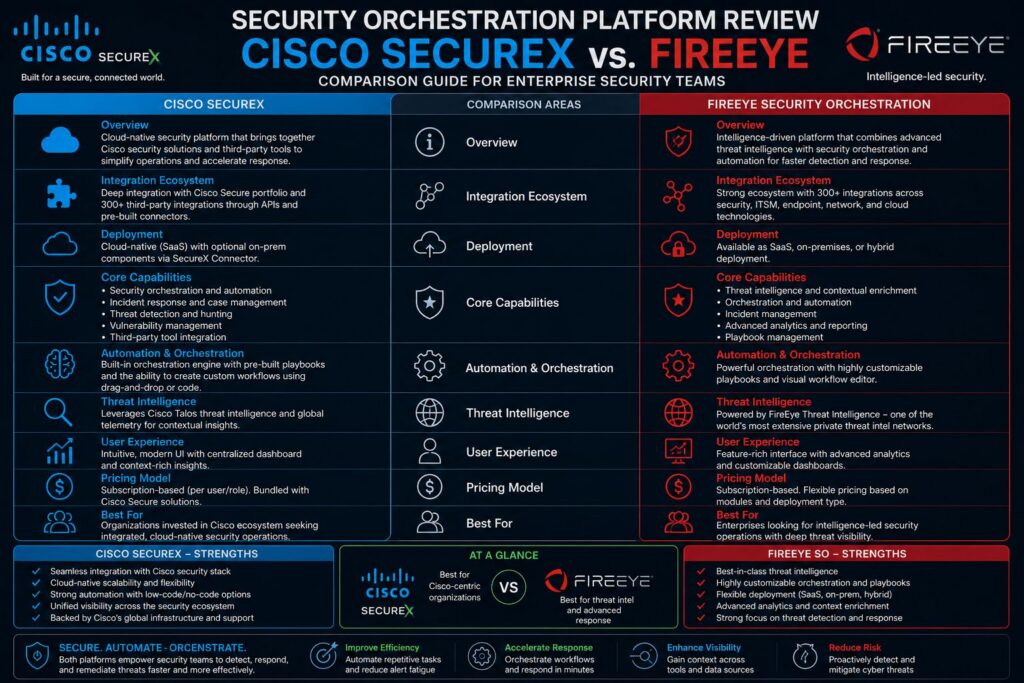
Overview: Comparing Security Orchestration Platforms
- Cisco SecureX provides a truly unified view that brings together visibility across your entire security stack — including third-party tools — eliminating the need to switch between multiple consoles.
- FireEye (now Trellix) offers powerful forensic and incident response capabilities backed by Mandiant threat intelligence, making it a top choice for organizations dealing with advanced persistent threats.
- SecureX is available at no extra charge for existing Cisco security customers, giving it a significant ROI advantage from the start.
- The biggest difference between these platforms is in orchestration automation — and which one comes out on top depends largely on whether your stack is Cisco-native or multi-vendor.
- There are important differences in how Cisco Talos and Mandiant intelligence feeds translate into real-world detection speed — and the results may surprise you.
Choosing the wrong security orchestration platform doesn’t just waste money — it creates vulnerabilities that attackers can exploit.
Modern security teams are overwhelmed with alerts, wrestling with disjointed tools, and losing valuable response time due to lack of communication between their platforms. This is the exact issue that security orchestration, automation, and response (SOAR) platforms were designed to address. NetCom Learning offers training and advice on enterprise security platforms like Cisco SecureX, assisting businesses in maximizing their security investments.
Two Different Approaches to the Same Objective: More Intelligent Security Operations
- Combined visibility across hybrid and multi-cloud environments
- Automated playbooks that lessen the manual analyst workload
- Quicker mean time to detect (MTTD) and mean time to respond (MTTR)
- Centralized threat intelligence that feeds into active defense
- Simplified workflows that connect prevention, detection, and response
Both Cisco SecureX and FireEye (which has been rebranded as Trellix following the merger with McAfee Enterprise) were designed to tackle these specific issues. However, they tackle the problem from very different perspectives, and that difference is crucial when deciding which platform to implement throughout your company.
SecureX is a cloud-native platform that was created to integrate with the Cisco security ecosystem. It acts as a connective tissue, combining Cisco Secure Endpoint, Cisco Umbrella, Cisco Secure Firewall, Duo, and numerous third-party integrations into a single, orchestrated environment. FireEye, however, has made a name for itself through its deep threat detection and superior incident response, all supported by Mandiant’s top-tier threat intelligence.
The Problems That Security Orchestration Solves
Security orchestration is a way to sift through the chaos. The average enterprise security team manages anywhere from 10 to 70+ individual security tools, and the lack of integration between them creates what’s often called “alert fatigue” — where analysts miss critical signals because they’re buried under thousands of low-priority notifications. A security orchestration platform centralizes those signals, automates the routine triage tasks, and surfaces what actually needs a human decision. The result is fewer breaches slipping through, and faster containment when threats do land.
How Cisco SecureX and FireEye Position Themselves in the Market
Cisco SecureX is an XDR (Extended Detection and Response) and SOAR solution that acts as a platform accelerator for organizations that are already using Cisco’s security solutions. FireEye, on the other hand, is more specialized — it focuses on enterprise-level threat detection, with a particular emphasis on advanced persistent threat (APT) defense and post-breach forensics. Knowing how each platform is positioned in the market is crucial when deciding which one is right for your organization.
What Cisco SecureX Does Best
Cisco SecureX is a truly well-implemented platform for businesses that utilize a Cisco-centric security stack. Rather than attempting to replace your current tools, it serves as the link between them, providing your SOC team with a clear operational view without requiring a full infrastructure revamp. For those concerned about potential vulnerabilities, it’s important to stay informed about threats like FortiClient EMS flaws that have been exploited in attacks.
Since its launch in 2020, the platform has been rapidly expanding, with Cisco consistently pushing out new features such as improved automation, enhanced Threat Response capabilities, and the Orbital Advanced Search module for endpoint telemetry. Users in managed security service provider (MSSP) environments have reported significant reductions in response times after deploying SecureX, especially when using Threat Response and Orbital together for active threat hunting.
View Your Entire Stack in One Place
SecureX’s dashboard provides a consolidated view of every connected security product — whether it’s a Cisco product or from a third party — all in one interface. SOC analysts no longer need to switch between Cisco Firepower, Umbrella, Secure Endpoint, and cloud security dashboards individually. Everything is available in one place, with correlated context that makes triage much faster. For large organizations managing hybrid environments with both on-premises and cloud workloads, this centralized view is a game-changer.
The platform’s ribbon interface offers easy-access widgets for incidents, threat intelligence, and automation workflows. It’s designed to allow an analyst to transition from detection to investigation to response without having to leave the SecureX environment — a workflow efficiency that adds up considerably over a full shift in a busy SOC.
Automated Playbooks and Orchestration That Shorten Response Times
SecureX Orchestration employs a visual, low-code workflow builder that empowers security teams to automate repetitive response tasks without requiring deep programming skills. You can create playbooks that automatically isolate a compromised endpoint via Cisco Secure Endpoint, block a malicious domain in Umbrella, and open a ServiceNow ticket — all triggered by a single alert. This level of end-to-end automation is where SecureX truly shines in a modern SOC.
Seamless Integration With Cisco Secure Endpoint, Umbrella, and Duo
One of the major advantages that SecureX has over its competitors is the depth of its native integration with the broader Cisco security portfolio. Real-time endpoint telemetry is fed directly into SecureX Threat Response by Cisco Secure Endpoint. Umbrella provides visibility at the DNS layer and blocks threats. Duo provides identity and authentication context. These integrations come together to create a security fabric that allows data to flow freely between tools, which directly improves the accuracy of detection and the speed of response.
Threat Intelligence Powered by Cisco Talos
Cisco Talos is one of the world’s most expansive commercial threat intelligence operations, processing billions of web requests, emails, and network connections every day. This intelligence is directly integrated into SecureX, providing the platform with near-instant access to indicators of compromise (IOCs), threat actor TTPs (tactics, techniques, and procedures), and vulnerability data.
- Cisco’s global infrastructure processes over 600 billion DNS queries daily with the help of Talos
- Regular threat advisories, vulnerability disclosures, and malware analysis reports are published by the team
- IOCs from Talos are automatically pushed into SecureX for active blocking and detection
- Talos-curated intelligence is used for threat hunting within SecureX for faster adversary identification
This intelligence pipeline means SecureX isn’t just reacting to threats already in your environment — it’s using global telemetry to get ahead of them. For organizations without the resources to build their own threat intelligence practice, Talos integration alone is a compelling reason to evaluate SecureX seriously.
Where Cisco SecureX Could Improve
There’s no such thing as a perfect platform, and SecureX has its own set of challenges that may be significant depending on your team’s workflow and the state of your current infrastructure.
SSO Process Frustration and Navigation Problems
One of the most frequently reported issues from SecureX users is the SSO (Single Sign-On) process. The authentication workflow between SecureX and its integrated modules — especially Orbital and Threat Response — can be cumbersome, requiring additional login steps that disrupt analyst flow during active investigations. When you’re in the midst of a threat hunt and need to pivot quickly between modules, forced re-authentication is more than just a nuisance — it’s an operational friction point that hampers response. In light of recent exploited vulnerabilities, ensuring seamless access is crucial for timely threat response.
The transition between modules is not as smooth as one would expect from a platform designed for unified operations. Sometimes, when you move from the main SecureX dashboard to a deeper investigation within Threat Response or Orbital, it feels like you’re launching a separate app rather than navigating a unified platform. Cisco has recognized this and is making ongoing improvements to the user interface, but as of the current version, the platform’s ambition is slightly ahead of its execution.
Communication Missteps in the XDR Transition
Cisco’s decision to rebrand and expand SecureX into a more comprehensive XDR (Extended Detection and Response) solution has led to some market confusion. The platform’s identity has changed — from a tool similar to SOAR orchestration to a complete XDR platform — but the communication hasn’t always been consistent with the product’s real capabilities. Security purchasers who are assessing SecureX for the first time often have difficulty determining exactly where it fits in relation to Cisco’s other security products, especially Cisco Secure Firewall and Cisco XDR.
It’s not just about marketing, it’s about real operational implications. Security teams that don’t fully understand what SecureX can do tend to underuse it, especially the Orbital Advanced Search and Threat Response modules, which are some of the most powerful features of the platform. Organizations that invest in proper training, especially through structured Cisco security certification paths, tend to get a lot more out of the platform than those who just install it without that foundation.
SecureX User Feedback on Existing Issues:
“The platform is constantly evolving, and hopefully the new ‘Cisco Secure’ branding will help with messaging about their XDR offering.”
“Better messaging from Cisco, easier movement into the Orbital and Threat Response modules, and sorting out the Cisco SecureX SSO process are the three things that would make this platform significantly stronger.”
— Verified SecureX users, TrustRadius
There is a clear gap between what SecureX is capable of and what most teams actually use it for — and it’s largely a training and documentation problem, not a technology problem. Organizations that close that gap consistently report faster incident response and better ROI from their existing Cisco security investments.
FireEye’s Offerings
FireEye earned its stripes by stepping in after some of the most severe corporate breaches in history. This forensic expertise is ingrained in the platform’s DNA, and it’s evident in the technology’s approach to detection and response. While SecureX is designed around orchestration and connectivity, FireEye is designed around detection depth and adversary intelligence.
FireEye’s key detection technology and Mandiant threat intelligence abilities have been maintained and incorporated into the larger Trellix XDR platform following the merger with McAfee Enterprise and the subsequent rebranding to Trellix. For businesses considering FireEye today, it’s crucial to understand that you’re essentially gaining access to two unique strengths: FireEye’s detection engine and Mandiant’s top-tier threat intelligence operation.
Mandiant Threat Intelligence Integration
Mandiant has a reputation for providing some of the most operationally relevant threat intelligence in the industry. Unlike broad telemetry-based intelligence feeds, Mandiant’s data comes directly from active incident response engagements. This means that the IOCs, TTPs, and threat actor profiles that flow into FireEye have been tested against real adversaries in real environments. This intelligence is especially valuable for organizations in high-target sectors like financial services, healthcare, critical infrastructure, and government. These are sectors where nation-state level threats are a real concern, not just a theoretical one.
Depth of Incident Response and Forensic Abilities
FireEye’s incident response abilities are far more comprehensive than those of many other platforms. The platform’s forensic toolkit allows for comprehensive memory analysis, disk forensics, and detailed timeline reconstruction. These abilities are essential when you need to know not only that a breach has occurred, but also how it happened, what data was accessed, and what persistence mechanisms the attacker left behind. For organizations that must comply with regulatory requirements for breach reporting and forensic preservation, this depth often makes the difference. In recent news, the European Commission confirmed a cyberattack that highlights the importance of robust incident response and forensic capabilities.
Identifying Advanced Persistent Threats
FireEye uses a multi-vector virtual execution (MVX) engine to examine suspicious files, URLs, and network traffic in a specially designed sandbox environment. This environment is designed to overcome evasion techniques that can trick traditional signature-based detection. This is where FireEye consistently performs better than platforms that primarily use known-bad signature matching.
- The MVX engine can analyze a variety of files and network traffic all at once
- It’s designed to detect new and never-before-seen malware and zero-day exploits
- It uses behavioral analysis to catch threats that change their signatures to avoid detection
- It uses cross-vector correlation to connect data from endpoint, network, and email threats into a single narrative of an attack
- It uses Mandiant’s active intelligence on known APT groups to attribute threats to specific actors
However, this level of sophistication in detection comes with a trade-off. FireEye’s platform is much more complex to deploy and tune than SecureX. Organizations that don’t have dedicated security engineering resources often find that they’re not able to fully utilize the platform’s capabilities. This is for the same reason that SecureX struggles: the technology is more advanced than the team’s ability to use it.
However, for companies with well-established security operations and a real APT threat profile, it’s hard to beat FireEye’s detection accuracy in hostile environments. It’s a platform designed for the worst-case scenarios — and it delivers when those scenarios occur.
Comparing Cisco SecureX and FireEye
When you look at these two platforms next to each other, it becomes clear that they each have a unique perspective on what a security operations platform should focus on. SecureX is designed to enhance orchestration, improve workflow efficiency, and make your existing tools work more effectively together. FireEye, on the other hand, is designed to provide in-depth detection, high-quality threat intelligence, and forensic capability in case of serious incidents.
Both philosophies are not incorrect – however, one will suit your company’s risk profile, team maturity, and current infrastructure much more effectively than the other. The comparison that follows concentrates on the aspects that truly count for daily security operations, as opposed to feature checklist marketing. For instance, understanding vulnerabilities like the exploited flaws in Fortinet, Microsoft, and Adobe software can be crucial for making informed decisions.
It is important to remember that these platforms are not always directly competing with each other. Some organizations use both – they use SecureX for orchestration and workflow automation across their Cisco stack, and they use FireEye’s detection capabilities for high-priority threat hunting and incident response. However, most organizations need to choose a primary platform based on their budget, team capacity, and strategic direction.
Orchestration and Automation Capabilities
For most organizations, SecureX is the clear winner in this category. Its visual workflow builder, pre-built automation playbooks, and deep native integration with the Cisco security portfolio make it significantly easier to build and maintain automated response workflows without specialized development resources. The low-code approach means security analysts — not just engineers — can build and modify playbooks as threat landscapes evolve.
Although FireEye has orchestration capabilities in its Trellix XDR platform, they are not as advanced as SecureX’s and require more technical resources to function effectively. For organizations that are mainly looking to automate SOC workflows and reduce the workload of analysts, SecureX is the more sensible option.
Support for Open API and Third-Party Integrations
SecureX and FireEye both offer support for open APIs and third-party integrations, but there are differences in the range and depth of this support. SecureX provides pre-built integrations with more than 50 security technologies, such as Splunk, ServiceNow, Palo Alto Networks, and Microsoft Defender. This means that most organizations will be able to connect their existing stack without needing to develop custom solutions. FireEye’s integration ecosystem is more focused, with deep integrations with high-value partners prioritized over broad compatibility. For environments that are truly heterogeneous, SecureX’s integration library provides a practical advantage in terms of deployment speed and ongoing maintenance overhead.
Quick Threat Response and Efficient Workflows
SecureX users in MSSP environments have seen a significant decrease in the average time it takes to respond to threats after implementing the platform’s automated playbooks. This is especially true for routine response scenarios such as isolating endpoints, blocking domains, and resetting credentials. The automation takes care of the repetitive tasks, leaving analysts free to concentrate on investigation and decision-making.
FireEye’s advantage in response speed is seen in another dimension – the accuracy and context of its initial detection means that analysts spend less time chasing false positives. When FireEye identifies a threat, there is a higher likelihood that it is a real incident supported by corroborating intelligence from Mandiant’s knowledge base. That detection accuracy results in faster time-to-containment, even if the automation layer is not as mature.
In the end, SecureX speeds up response time by making automation more efficient, whereas FireEye speeds up response time by making detection more accurate. The one that is more important will depend on whether your biggest issue is the volume of alerts and the speed of triage, or the fidelity of detection and the rates of false positives.
ROI: Impact on Dwell Time Reduction and Operational Costs
For existing Cisco security customers, SecureX offers a significant ROI advantage. This is because the platform comes at no additional cost with qualifying Cisco security product licenses. This pricing model alone simplifies the ROI calculation: any reduction in response time, analyst overhead, or dwell time is a net gain against zero incremental spend. FireEye’s licensing structure, on the other hand, comes with a higher upfront cost that necessitates a more careful ROI calculation. This is typically justified by the reduced risk exposure brought about by its superior APT detection capabilities. This calculation is more suitable for organizations with a demonstrably high-value threat profile.
Other Options Considered and Why They Didn’t Make the Cut
SecureX and FireEye aren’t the only players in the game. The wider security orchestration and XDR market is packed with several strong contenders that often make it to the final round of enterprise evaluations — and knowing why companies ultimately picked one of these two platforms over the others can be just as enlightening as the direct comparison.
When comparing SecureX and FireEye, the most common competitors that come up are Splunk SOAR, Palo Alto Cortex XDR, CrowdStrike Falcon, and Microsoft Sentinel. Each of these options has its own strengths and weaknesses, which is why they might not be the right fit for certain buyers.
Comparing the Automation Depth of Splunk SOAR and SecureX
Splunk SOAR, previously known as Phantom, is a robust automation platform that boasts one of the most extensive playbook libraries available — with over 300 pre-built apps and thousands of automation actions that cover a broad spectrum of security tools. For businesses that are already utilizing Splunk Enterprise Security as their SIEM, Splunk SOAR is a logical next step that establishes a tightly integrated detection-to-response pipeline. Its Python-based playbook editor provides security engineers with substantial flexibility to develop intricate, conditional automation logic that far surpasses what the visual builder in SecureX currently offers.
On the other hand, Splunk SOAR has a significant level of complexity and cost. To deploy, maintain, and scale the platform effectively, it requires dedicated engineering resources. It’s not a platform that you can just give to a mid-level analyst and expect to have operational results without a significant onboarding investment. SecureX’s low-code approach, combined with its zero incremental cost for Cisco customers, makes it a more accessible choice for organizations that need to get automation up and running quickly without a six-month implementation project. Splunk SOAR is the winner when it comes to raw automation depth, but SecureX is the winner when it comes to operational accessibility and total cost of ownership.
Contrasting Detection Approaches: Palo Alto Cortex XDR and FireEye
The detection approach taken by Palo Alto Cortex XDR is based on a data lake — it combines endpoint, network, and cloud telemetry in a unified analytics engine that uses behavioral AI to identify threats. It’s a powerful platform for organizations that already use Palo Alto Networks Next-Generation Firewalls and Prisma Cloud, offering a level of native integration that matches what SecureX offers to Cisco customers. The detection philosophy of Cortex XDR differs from that of FireEye: Cortex XDR depends heavily on machine learning models trained on Palo Alto’s telemetry base, while FireEye’s MVX engine conducts in-depth behavioral analysis on individual suspicious objects in a separate sandbox environment. Cortex XDR performs exceptionally well against known threat patterns and commodity malware. Against custom, nation-state-grade malware that is specifically designed to evade behavioral AI models, FireEye’s sandbox approach consistently identifies what ML-based systems overlook — this is why organizations that have real APT exposure continue to select FireEye despite its greater operational complexity.
Positioning of CrowdStrike Falcon and Microsoft Sentinel
As a pure-play endpoint detection and response (EDR) platform, CrowdStrike Falcon is among the strongest in the market. Its threat intelligence, which comes from the Adversary Intelligence team, rivals that of Mandiant in terms of adversary attribution depth. As such, it is a legitimate alternative to SecureX and FireEye for organizations where the endpoint is the main threat surface and where cloud-native deployment is a strict requirement. On the other hand, Microsoft Sentinel is a cloud-native SIEM and SOAR platform that is a winner in terms of price and native integration within Microsoft 365 and Azure environments. For organizations that are deeply ingrained in the Microsoft ecosystem, the economics of Sentinel are compelling. However, neither CrowdStrike Falcon nor Microsoft Sentinel can match the breadth of orchestration across heterogeneous security stacks offered by SecureX, nor the forensic depth for post-breach investigation provided by FireEye. Rather than being genuine competitors, they cater to different buyer profiles.
Deciding Which Platform Best Suits Your Security Stack
For organizations that operate a Cisco-centric security stack and are primarily seeking to improve operational efficiency — by reducing alert fatigue, automating repetitive response tasks, and achieving unified visibility across all tools — Cisco SecureX is the obvious choice. It’s cost-effective, continuously improving, and when teams take the time to properly learn the platform, it delivers tangible reductions in response time and analyst overhead. The Orbital Advanced Search and Threat Response modules alone justify the investment in getting your team properly trained on the platform.
For organizations dealing with complex and targeted threats such as advanced persistent threat groups, nation-state actors, or highly customized malware campaigns, FireEye’s capabilities are worth the additional investment and complexity. This is because they offer detection accuracy and forensic depth. The Mandiant intelligence integration and MVX sandbox detection engine of FireEye provide adversarial coverage that few platforms can match. For many large enterprises, the truth is that these platforms are not mutually exclusive. SecureX handles orchestration and workflow automation across the broader stack, while FireEye handles detection and response scenarios where accuracy is critical.
Commonly Asked Questions
When considering different orchestration platforms, security buyers often have the same questions. The answers provided here aim to cut through the jargon and focus on what really matters when these platforms are actually deployed.
These aren’t just “what if” scenarios — they’re the questions that will help you decide if a platform is right for your environment, your budget, and your team’s current skill level. Knowing the answers before you start a formal evaluation will save your team a lot of time and help you avoid expensive deployment mistakes.
Is Cisco SecureX free for existing Cisco security customers?
SecureX Licensing At A Glance
Customer Type SecureX Access Additional Cost Existing Cisco Security Product Customer Included with qualifying license None Cisco Secure Endpoint Customer Full platform access None Cisco Umbrella Customer Full platform access None Non-Cisco Security Customer Not available as standalone Requires Cisco product purchase
Yes, Cisco SecureX is free for existing Cisco security customers. If you have an active license for a qualifying Cisco security product, you can access SecureX at no additional cost. Qualifying products include Cisco Secure Endpoint, Cisco Umbrella, Cisco Secure Firewall, Duo, and several others. This is a major selling point for SecureX. If your organization already uses multiple Cisco security products, you can start using SecureX without spending any more on licensing. Additionally, staying informed about exploited flaws in popular software can help enhance your security strategy.
The reality of the situation is that many Cisco security clients are already funding SecureX without actively utilizing it. If your company is in this situation, the ROI discussion isn’t about whether the platform justifies the expense — it’s about the internal investment needed to educate your team and correctly operationalize the platform. This training investment is what distinguishes companies that obtain significant value from SecureX from those that leave its capabilities unused.
It is important to mention that although SecureX is included with qualifying licenses, some of the most potent modules – specifically Orbital Advanced Search – may need specific product tiers or add-on licensing depending on your current Cisco agreement. A review of your existing license portfolio before activating SecureX will make it clear exactly what capabilities are available to you from day one.
Is FireEye or Cisco SecureX better for small and mid-sized businesses?
FireEye is really built for big businesses with mature security operations teams, dedicated security engineering resources, and threat profiles that justify the platform’s cost and complexity. For most small and mid-sized businesses (SMBs), FireEye’s licensing costs, implementation complexity, and operational overhead make it a poor fit — the platform’s capabilities are more than what SMB security teams can realistically put into operation, and the price point is hard to justify against more accessible alternatives.
Cisco SecureX is a more effective scaling option for the mid-market, especially for organizations that have already adopted Cisco networking and security infrastructure. Its no-additional-cost model for existing customers and its low-code automation approach mean that smaller security teams can deploy and operate the platform without specialist resources. For SMBs evaluating their first security orchestration platform, SecureX represents a significantly more practical entry point — with the advantage of growing with the organization as security maturity increases over time.
Is it possible for Cisco SecureX to work with non-Cisco security tools?
Noteworthy Non-Cisco Integrations Available in SecureX
Vendor Type of Integration Use Case Splunk Bidirectional API Correlation of SIEM data and alert forwarding ServiceNow Automation of ticketing Creation and updates of incident tickets automatically Palo Alto Networks Sharing of threat intelligence Blocking of cross-platform IOC Microsoft Defender Endpoint telemetry Ingestion of endpoint detection data AWS Security Hub Findings of cloud security Visibility of cloud workload threats
Yes, it is possible — Cisco SecureX supports integration with a wide variety of non-Cisco security products through open APIs, pre-built modules, and the SecureX orchestration workflow engine. The platform’s integration library covers more than 50 security technologies across endpoint, network, cloud, identity, and ITSM categories, which means most organizations can connect their existing heterogeneous security stack without the need for custom development work.
There is a difference in the quality and depth of third-party integrations. The native Cisco integrations — Secure Endpoint, Umbrella, Firepower, Duo — provide the most reliable automation triggers and the most extensive bidirectional data flows. For common use cases like alert forwarding, ticket creation, and IOC sharing, third-party integrations are generally good, but they may require additional configuration for more complex cross-platform automation scenarios. Before deployment, organizations that heavily use non-Cisco environments should conduct a detailed integration mapping exercise to ensure that their specific tool combinations are supported at the depth required by their workflows.
If your organization is ready to invest in custom development, SecureX’s open REST API enables your team to create integrations for tools that aren’t yet included in the pre-built library. The SecureX developer ecosystem offers documentation and community resources for this task, but it does necessitate programming skills that not all security teams possess in-house. For those interested in exploring enterprise AI solutions, a comparison of OpenAI and Anthropic might offer valuable insights.
What has happened with FireEye, and is the platform still being actively developed?
In 2021, FireEye underwent a significant corporate restructuring. It sold its FireEye Products business (the technology platform) to Symphony Technology Group. This group then merged it with McAfee Enterprise to form Trellix. The Mandiant brand and professional services business was kept separate and later bought by Google. It now operates as Google Cloud’s Mandiant division. This means that the FireEye detection technology and platform you are evaluating today is operating under the Trellix brand. Mandiant threat intelligence is now officially a part of Google’s security portfolio. However, it is still available through Trellix’s commercial agreements.
FireEye’s underlying detection technology continues to be actively developed by Trellix, which has integrated it into a wider XDR platform that combines features from both the FireEye and McAfee Enterprise product lines. The Trellix XDR platform, which retains FireEye’s core detection strengths while adding broader platform capabilities from the McAfee Enterprise portfolio, is the accurate evaluation target for organizations evaluating “FireEye” today. The brand transition has created some market confusion, but the technology itself remains actively developed and supported.
Which platform provides superior threat intelligence: Cisco Talos or Mandiant?
Both Cisco Talos and Mandiant are top-tier commercial threat intelligence providers, but they shine in different areas. Cisco Talos is a leader in volume and speed — processing vast amounts of global telemetry every day across Cisco’s extensive installed base of network infrastructure, endpoints, and cloud security products. This wide scope means Talos is exceptionally quick at detecting new malware campaigns, phishing infrastructure, and common threat actor activity as it appears across the internet. For organizations whose primary threat exposure is opportunistic attackers, ransomware groups, and broad-based phishing campaigns, Talos intelligence delivered through SecureX offers excellent coverage with minimal operational overhead.
Mandiant has the advantage of depth over breadth when it comes to intelligence. Mandiant’s analysts are directly involved in active incident response engagements against the world’s most sophisticated threat actors. These include nation-state groups, advanced cybercriminal organizations, and custom malware campaigns that target specific industries. The intelligence obtained from these engagements goes beyond IOCs and includes detailed adversary profiles, kill chain analysis, and attribution data. Organizations can use this data to proactively strengthen their defenses against known threat actors that are specifically targeting their sector.
Truth be told, for most business corporations, Talos intelligence is more than enough and quite effective. For organizations in sectors that have a history of exposure to threats from nation-states — such as defense contractors, operators of critical infrastructure, financial institutions, and government agencies — the depth of operational intelligence provided by Mandiant offers coverage that is not fully replicated by the broad telemetry approach of Talos. The correct choice is less about which intelligence operation is objectively the “best” and more about which threat profile most accurately reflects the adversaries your organization is most likely to encounter.
The European Commission recently confirmed a cyberattack on its cloud systems, which has raised concerns about the security measures in place to protect sensitive data. This incident highlights the importance of robust cybersecurity strategies and the need for constant vigilance against potential threats. For more details on the impact of this cyberattack, interested readers can explore the full report.