Article At A Glance
- SIEM and SOAR solve different problems: SIEM tells you what is happening across your environment, while SOAR automates what to do about it — understanding this split is the foundation of a strong security operations strategy.
- Most IT teams need both tools working together — SIEM feeds alerts into SOAR, which then executes automated playbooks to contain threats faster than any manual process can.
- Cost models differ significantly: SIEM is typically priced by data volume ingested, while SOAR licensing is usually tied to automation capabilities or user seats — a detail that catches many IT budget cycles off guard.
- Small teams with limited resources face a real trade-off between the two — and the answer isn’t always obvious. We break down exactly how to evaluate that decision.
- Hyperautomation platforms are changing the equation by combining detection, response, and orchestration into a single layer — potentially replacing the need to manage both tools separately.
SIEM vs. SOAR: Two Tools, One Goal
Every IT security team is fighting the same battle: too many alerts, not enough time, and threats that don’t wait around while analysts catch up. SIEM and SOAR both exist to solve that problem — but they approach it from completely different angles.
SIEM, which stands for Security Information and Event Management, has been the backbone of security operations centers for years. SOAR — Security Orchestration, Automation, and Response — came later to address a gap SIEM couldn’t close on its own: actually doing something about the threats it found. Together, they represent the two core pillars of a modern security operations platform. Understanding how they differ, where they overlap, and when you need one versus both is one of the most important decisions an IT security team can make.
What SIEM Actually Does in Your SOC
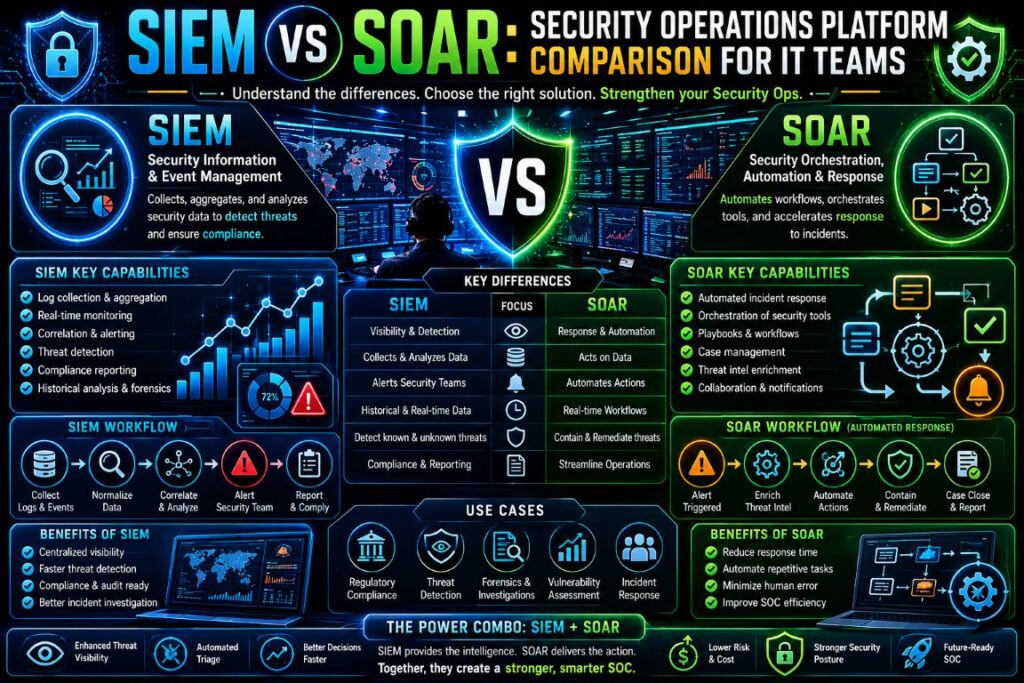
SIEM is your visibility engine. It works by continuously collecting log data from across your entire environment — firewalls, endpoints, cloud services, applications, identity providers — and aggregating it into a centralized platform where it can be analyzed, correlated, and surfaced as alerts. When something suspicious happens, SIEM is what connects the dots across dozens of data sources to flag it.
The core strength of SIEM is detection and context. It answers the questions your security team needs answered first: What happened? When did it happen? Which systems were involved? Real-time threat detection, security event correlation, and compliance reporting are its primary outputs. For any organization that needs centralized audit trails or has regulatory obligations, SIEM is essentially non-negotiable.
What SOAR Adds That SIEM Cannot
Where SIEM stops at detection, SOAR picks up the response. Once an alert is generated, SOAR takes over by triggering predefined incident response playbooks — automated workflows that can isolate an endpoint, block a malicious IP, notify the right team members, and open a ticket, all without a human touching a keyboard.
SOAR’s value is in speed and consistency. Automated threat intelligence feed management, phishing response workflows, malware investigation processes, and incident enrichment are among its most common use cases. Rather than waiting for an analyst to triage an alert, SOAR can execute a full initial response in seconds. That gap in response time is often the difference between containment and a full breach.
Why Most IT Teams Need Both
SIEM and SOAR are not competing tools — they are complementary ones. SIEM generates the alerts; SOAR acts on them. In practice, SIEM feeds enriched, correlated alerts directly into SOAR, which then triggers the appropriate playbook for that specific incident type. The response actions SOAR takes then create their own audit trails, which feed back into SIEM for compliance and ongoing analysis.
Running both tools together allows security teams to stay informed through SIEM’s visibility while eliminating the manual bottlenecks that slow incident response. Without SOAR, even the best SIEM implementation leaves analysts buried in alerts they have to handle manually. Without SIEM, SOAR has nothing meaningful to respond to. The two tools are genuinely stronger together than either is alone. For a deeper understanding of how these tools compare, check out this enterprise security platform comparison.
Core Differences Between SIEM and SOAR
While both platforms support security operations, the way they function day-to-day is fundamentally different. Mapping out those differences clearly is what allows IT teams to make confident, informed decisions about their security stack.
Detection vs. Response: The Fundamental Split
The clearest way to separate SIEM and SOAR is this: SIEM focuses on detection and visibility, while SOAR focuses on response and automation. SIEM collects and analyzes vast amounts of log data to surface potential threats. SOAR acts on processed alerts and findings to execute a response. One watches; the other acts.
This split has real operational consequences. A SIEM without SOAR means your analysts must manually investigate and respond to every alert it generates — which at enterprise scale can mean hundreds of alerts per day. A SOAR without SIEM lacks the enriched, correlated data needed to trigger meaningful automated responses. The detection-response divide is not a limitation of either tool; it’s by design, and understanding it prevents misaligned expectations.
Automation Depth: Rule-Based Alerts vs. Orchestrated Playbooks
SIEM automation is largely rule-based. You configure correlation rules and thresholds, and when log data matches those rules, an alert is generated. It’s powerful for detection, but the automation stops there. SOAR goes several layers deeper — it uses structured playbooks that define exactly what should happen after an alert fires, across multiple tools and teams simultaneously.
A SOAR playbook for a phishing incident, for example, might automatically extract the suspicious URL, query a threat intelligence feed, sandbox the attachment, revoke the user’s session token, notify the security team via Slack, and log the incident in your ticketing system — all within minutes of detection. No SIEM ruleset can execute that chain of actions. That is the automation depth advantage SOAR holds.
How Each Tool Handles Integration With Your Security Stack
Both SIEM and SOAR are deeply integrations-dependent, but they connect to your security stack in different ways. SIEM integrates by aggregating data inward — pulling logs, events, and telemetry from firewalls, endpoints, cloud platforms, and identity tools into its centralized analysis engine. The more sources feeding into it, the better its detection coverage.
SOAR integrates by orchestrating actions outward — connecting to those same security tools to trigger responses, not just read from them. A SOAR platform might integrate with your EDR to isolate an endpoint, your firewall to block an IP, your ticketing system to create a case, and your communication platform to alert the right analyst, all as part of a single automated workflow. Many organizations also use XDR for deep threat detection in specific domains like endpoints, email, and identity, while SIEM provides the centralized audit trail and SOAR handles cross-tool orchestration.
Cost Models: Data Volume Pricing vs. Automation Licensing
Budgeting for these tools requires understanding how each one is priced. SIEM platforms are typically priced by the volume of data ingested — meaning the more log sources and event data you feed into the platform, the higher your costs. This can lead to difficult trade-offs where teams filter out log sources to control spending, potentially reducing detection coverage in the process.
SOAR pricing works differently. It is generally tied to automation capabilities, the number of playbooks executed, or user seat counts — not raw data volume. This means SOAR costs scale with your operational activity rather than your data footprint. For IT teams doing budget planning, these two distinct cost structures need to be evaluated separately, and both should be factored into the total cost of running a security operations platform.
Key Benefits of SIEM for IT Security Teams
SIEM has earned its place as the cornerstone of security operations for good reason. It gives IT teams something they cannot operate effectively without: a single, unified view of everything happening across their environment in real time. When a threat emerges, SIEM is what makes it visible before it becomes a crisis. For a comprehensive understanding of security platforms, check out this enterprise security platform comparison.
SIEM Core Capabilities at a Glance:
- Log aggregation: Collects security event data from firewalls, endpoints, cloud platforms, identity providers, and applications into one centralized platform
- Event correlation: Connects related events across multiple data sources to identify patterns that indicate a threat
- Real-time alerting: Surfaces threats as they happen rather than after the fact
- Compliance reporting: Generates audit-ready reports for regulatory frameworks including PCI-DSS, HIPAA, and SOC 2
- Threat intelligence integration: Correlates live event data against known threat indicators to improve detection accuracy
The operational impact of a well-configured SIEM is significant. Security teams stop reacting to isolated alerts and start seeing the full picture — a failed login attempt that connects to a lateral movement event that connects to an unusual data transfer suddenly becomes a coherent attack story instead of three unrelated tickets.
Real-Time Visibility Across All Security Events
Real-time visibility is where SIEM earns its keep every single day. As log data flows in from every connected source, SIEM’s correlation engine is constantly running rules against that data to identify anomalies, known attack patterns, and policy violations the moment they appear. There is no waiting for end-of-day reports or manual log reviews.
This continuous monitoring capability is especially critical for IT teams managing hybrid environments — a combination of on-premises infrastructure, cloud workloads, and remote endpoints. Each of those layers generates its own event data, and without a centralized platform pulling it together, threats that move across boundaries go undetected. SIEM closes that visibility gap by normalizing and correlating data regardless of where it originates.
Example: An attacker compromises a cloud identity account and uses it to access an on-premises file server after hours. Without SIEM correlation, those two events live in separate logs and likely go uninvestigated. With SIEM, the cross-environment connection triggers an alert within minutes of the access attempt.
Centralized Log Management and Compliance Reporting
Beyond threat detection, SIEM solves a persistent operational headache for IT teams: log management at scale. Every device, application, and service in your environment generates logs. Storing, indexing, and making those logs searchable across months or years of history is a significant technical challenge — and one that SIEM handles as a core function.
For organizations operating under compliance frameworks, this capability is not optional. Regulatory requirements like PCI-DSS, HIPAA, and SOC 2 mandate specific log retention periods, audit trail integrity, and the ability to produce detailed event histories on demand. SIEM satisfies all of those requirements in one platform, reducing the compliance burden on IT teams considerably.
Key Benefits of SOAR for IT Security Teams
If SIEM is the system that sees everything, SOAR is the system that acts on what it sees — and acts fast. For IT security teams drowning in alerts, SOAR is the force multiplier that lets a small team respond with the speed and consistency of a much larger one. For a comprehensive review of SOAR capabilities, you can check out this security orchestration platform review.
Reduced Mean Time to Resolution Through Automation
Mean Time to Resolution (MTTR) is one of the most important metrics in security operations, and SOAR directly compresses it. When a SOAR playbook handles the initial triage, enrichment, and containment steps automatically, the time between alert and resolution drops from hours to minutes. For incidents like phishing attacks or malware detections — where speed of containment directly limits blast radius — that difference is measurable in how much damage actually occurs.
Automated response also eliminates the human latency that manual processes introduce. An analyst who receives an alert at 2:00 AM may not action it until morning. A SOAR playbook executes the same response immediately, regardless of time zone, shift schedules, or analyst availability. That around-the-clock consistency is something no manual process can replicate.
Analyst Workload Relief on Repetitive Incident Tasks
A significant portion of what security analysts do every day is repetitive: pulling IP reputation data, checking file hashes against threat intelligence databases, resetting compromised credentials, updating ticket statuses. These tasks are necessary, but they consume hours that could be spent on higher-value investigation work. SOAR automates exactly this category of activity, handling routine incident enrichment and triage automatically so analysts can focus on the threats that actually require human judgment.
The practical result is that your existing team handles a higher volume of incidents without burning out or missing critical alerts buried in the queue. For IT teams that cannot justify headcount increases, SOAR is often the most cost-effective way to scale security operations capacity.
Faster Incident Collaboration With Built-In War Room Features
When a serious incident hits, coordination between team members is often just as important as the technical response. Many SOAR platforms include built-in collaboration features — sometimes called war rooms or incident workspaces — where all communication, evidence, timelines, and response actions are captured in a single shared environment. This eliminates the chaos of managing an incident across disconnected email threads, chat channels, and spreadsheets, and ensures that every action taken is documented and auditable.
Where XDR Fits Into the SIEM and SOAR Picture
XDR, or Extended Detection and Response, has emerged as a third major platform category that IT teams now need to position relative to SIEM and SOAR. Understanding where XDR fits — and where it doesn’t — prevents costly overlap and gaps in coverage.
| Platform | Primary Function | Data Source Focus | Automation Level |
|---|---|---|---|
| SIEM | Detection & visibility | Broad — all log sources | Rule-based alerting |
| SOAR | Response & orchestration | Alert-driven from SIEM/XDR | Deep playbook automation |
| XDR | Threat detection in specific domains | Endpoints, email, identity, network | Automated within its domain |
XDR excels at deep threat detection within specific security domains — particularly endpoints, email, and identity — where its native integrations provide richer telemetry than a SIEM’s broad-but-shallow log collection can achieve. Many organizations deploy XDR for this domain-specific depth while relying on SIEM for the centralized audit trail that spans the entire environment.
In a well-architected security stack, XDR detections can trigger SOAR playbooks for automated response, while SIEM captures the full incident timeline for compliance and forensic purposes. The three platforms are not redundant — they occupy distinct lanes. Where budget constraints force a choice, the decision should be driven by your team’s primary pain point: visibility gaps point toward SIEM, response speed gaps point toward SOAR, and endpoint or email-specific detection gaps point toward XDR.
How to Choose Between SIEM, SOAR, or Both
The honest answer is that most mature IT security teams end up running both SIEM and SOAR — but the path to get there should be deliberate, not accidental. Deploying the wrong tool first, or deploying both before your team is ready to operate them, leads to shelfware and wasted budget. The right approach starts with an honest assessment of where your operations stand today. For more insights, you can check out this security orchestration platform review.
Evaluate Your Team’s Technical Maturity First
SIEM is generally the right starting point for teams that are still building foundational visibility. If you don’t have centralized log management, consistent event correlation, or reliable alerting across your environment, SIEM addresses those gaps before anything else. Deploying SOAR on top of a SIEM that isn’t yet generating clean, reliable alerts means automating a noisy, unreliable process — which creates more problems than it solves.
SOAR makes the most sense for teams that already have a functioning SIEM and are being overwhelmed by the manual work that follows every alert it generates. If your analysts are spending the majority of their time on repetitive triage and enrichment tasks rather than actual investigation, that’s the signal that SOAR is the right next investment. The technical maturity threshold for SOAR is higher — it requires well-defined incident response processes to build playbooks from, and those processes need to exist before automation can replicate them reliably. For a detailed review of security orchestration platforms, consider exploring comparisons between leading solutions.
Match the Platform to Your Threat Volume and Incident Frequency
The volume and frequency of security incidents your team handles is one of the most reliable indicators of which platform to prioritize. Organizations processing a high volume of daily alerts — particularly those dealing with phishing attempts, brute force attacks, or cloud misconfiguration events at scale — will see the fastest return from SOAR. When the same incident types repeat dozens of times per day, automating the response workflow pays for itself quickly. If your environment generates relatively low alert volumes but lacks centralized visibility across systems, SIEM should come first.
Incident frequency also affects how you think about playbook development. SOAR playbooks deliver the most value when they address your most common incident types — the ones your analysts handle repeatedly and consistently. Before investing in SOAR, audit your last 90 days of incidents and identify the top five most frequent categories. If clear, repeatable response patterns exist for those categories, SOAR automation will immediately reduce analyst workload. If your incidents are highly variable and require heavy human judgment each time, SIEM’s detection and context capabilities may deliver more value in the near term.
When Hyperautomation Platforms Outperform Either Tool Alone
Hyperautomation represents the next evolution beyond deploying SIEM and SOAR as separate tools. Rather than managing two distinct platforms with separate integrations, licensing, and operational overhead, hyperautomation platforms combine detection, response, and orchestration into a unified layer — delivering what neither SIEM nor SOAR fully achieves independently. Platforms in this category, such as Palo Alto Networks Cortex XSIAM, are designed to handle the full security operations lifecycle from a single interface, significantly reducing tool sprawl and the complexity of maintaining integrations between systems.
The trade-off is real, though. Hyperautomation platforms typically require a higher level of organizational readiness to implement effectively. They demand well-defined security processes, mature data infrastructure, and teams capable of operating sophisticated automation at scale. For organizations already running SIEM and SOAR in tandem and finding the operational overhead unsustainable, hyperautomation is a compelling consolidation path. For teams just beginning to build security operations maturity, the complexity may outweigh the benefits until foundational capabilities are in place.
The Right Platform Depends on What Your Team Can Actually Operate
Technology decisions in security operations have a tendency to be driven by vendor capability comparisons rather than operational reality. The most sophisticated SIEM or SOAR platform available is only valuable if your team has the skills, bandwidth, and processes to operate it effectively. A well-configured, actively managed SIEM from a mid-tier vendor will consistently outperform an enterprise-grade platform that nobody has time to tune properly.
Before committing to either platform, evaluate what your team can realistically maintain. SIEM requires ongoing rule tuning, log source management, and alert threshold adjustments to remain effective. SOAR requires continuous playbook development and refinement as your threat landscape and environment evolve. Neither is a set-and-forget investment. The teams that extract the most value from both tools are the ones that treat them as living systems requiring consistent attention — not infrastructure that gets deployed and handed off to run on autopilot. For a deeper understanding, you might consider an enterprise security platform comparison.
Frequently Asked Questions
The SIEM vs. SOAR comparison generates consistent questions from IT security professionals at every stage of their security operations journey. The answers below address the most common decision points directly.
What is the primary difference between SIEM and SOAR?
The primary difference is function: SIEM detects and surfaces threats by collecting and correlating security event data, while SOAR responds to those threats through automated playbooks and cross-tool orchestration. SIEM answers what happened and when, while SOAR answers what to do about it. SIEM provides visibility; SOAR provides action. For a detailed security orchestration platform review, you can explore how these tools are designed to work in sequence, not in competition with each other.
Can SIEM and SOAR work together in the same security environment?
Yes — and in most mature security operations environments, they do. SIEM and SOAR are architecturally complementary. SIEM generates enriched, correlated alerts that feed directly into SOAR, which then executes the appropriate automated response playbook for each incident type. The response actions that SOAR takes create their own audit trails, which flow back into SIEM for compliance reporting and forensic analysis. For a detailed comparison of security orchestration platforms, you can explore various options available in the market.
Running both tools together enables security teams to benefit from SIEM’s broad detection coverage and SOAR’s response speed simultaneously. Integration between the two platforms is now standard — most enterprise SIEM and SOAR solutions ship with pre-built connectors for common pairings, and the operational overhead of maintaining the integration is significantly lower than it was even three to four years ago. For a deeper understanding, check out this security orchestration platform review.
Which is better for a small IT team with limited security resources?
For small IT teams, the answer depends on the most pressing gap in current security operations. If the team lacks centralized visibility and struggles to detect threats across a fragmented environment, SIEM is the higher-priority investment. If the team has reasonable detection coverage but is overwhelmed by manual response work, SOAR will deliver faster relief.
Budget is also a practical constraint here. SIEM’s data-volume pricing model can scale in ways that strain smaller budgets as environments grow. Some smaller teams find that a unified platform that combines both functions offers better value than running two separate enterprise tools with separate licensing structures.
A straightforward evaluation framework for small teams can be found in our security orchestration platform review.
- Start with SIEM if you have no centralized log management or consistent alerting across your environment
- Start with SOAR if you have a functioning detection layer but analysts are spending more than 50% of their time on repetitive triage tasks
- Consider a unified platform if budget constraints make running two separate enterprise tools unsustainable
- Avoid SOAR before SIEM if your alert quality is inconsistent — automating a noisy detection process amplifies the problem rather than solving it
- Prioritize platforms with strong out-of-the-box integrations to reduce the configuration burden on a team with limited bandwidth
Does SOAR replace the need for human security analysts?
No. SOAR automates the repetitive, rule-based components of incident response — initial triage, enrichment, containment actions for known threat patterns — but it does not replace the judgment, creativity, and contextual reasoning that human analysts bring to complex investigations. SOAR is most accurately described as an analyst force multiplier: it handles the high-volume, low-complexity work so analysts can focus their attention on the incidents that genuinely require human decision-making. The security teams that get the most from SOAR are those that treat it as a tool that elevates analyst capability, not one that eliminates the need for analysts entirely.
What is hyperautomation and how does it relate to SIEM and SOAR?
Hyperautomation vs. Traditional SIEM + SOAR Deployment
Capability SIEM Alone SOAR Alone SIEM + SOAR Combined Hyperautomation Platform Threat Detection ✓ Strong ✗ Limited ✓ Strong ✓ Strong Automated Response ✗ Rule-based only ✓ Strong ✓ Strong ✓ Strongest Cross-Tool Orchestration ✗ Limited ✓ Strong ✓ Strong ✓ Strong Compliance & Audit Trails ✓ Strong ✗ Limited ✓ Strong ✓ Strong Operational Complexity Medium Medium High Medium-High (consolidated) Typical Cost Model Data volume Automation/seats Both models Unified licensing
Hyperautomation is the convergence of detection, response, orchestration, and AI-driven analysis into a single integrated platform — rather than a collection of separately managed tools. In the context of security operations, it represents a shift away from the traditional model of deploying SIEM and SOAR as distinct products that need to be integrated and maintained independently.
Where traditional SIEM + SOAR deployments require teams to manage two licensing structures, two integration layers, and two sets of operational processes, hyperautomation platforms consolidate those functions into a unified environment. The practical benefit is reduced tool sprawl, lower integration maintenance overhead, and a single operational workflow that spans detection through response without handoff friction between systems.
The relevance to SIEM and SOAR is that hyperautomation platforms do not eliminate the functions those tools perform — they absorb them. Detection and log correlation still happen; automated response playbooks still execute; compliance audit trails are still generated. The difference is that all of it operates within one platform rather than two, with a unified data layer that makes the detection-to-response loop faster and more consistent.
For IT teams currently evaluating whether to invest in SIEM, SOAR, or both, hyperautomation platforms are worth including in the evaluation — particularly if the prospect of managing two separate enterprise security tools with limited staff feels operationally unsustainable. The maturity bar is higher, but for the right team, the consolidation benefits are substantial.
If your team is ready to strengthen its security operations posture — whether through SIEM, SOAR, or a unified platform — consulting with a cybersecurity specialist who understands the full landscape of available solutions is the fastest path to building a stack that actually fits how your team operates.