Article-At-A-Glance: DLP vs. IRM
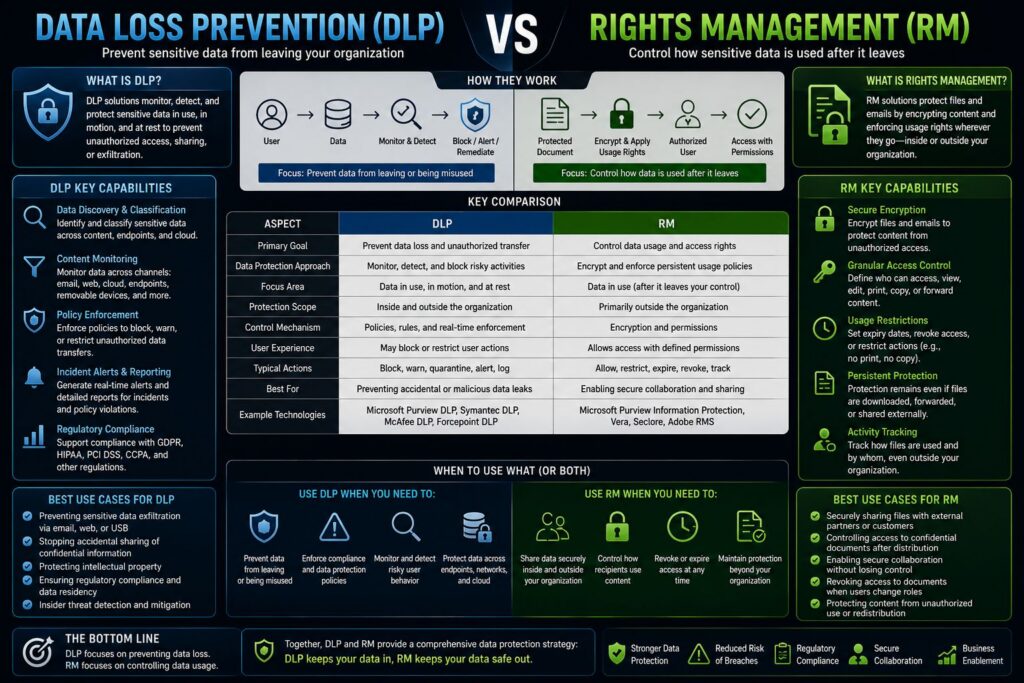
- DLP and IRM are both data protection tools, but they work very differently — DLP monitors and blocks data in motion, at rest, and in use, while IRM encrypts files and controls access even after they leave your network.
- Using only one of these technologies leaves dangerous gaps — the most secure organizations deploy both together, with DLP feeding into IRM remediation policies for complete coverage.
- Real-world breaches like the British Airways £183M GDPR fine show exactly what happens when data protection strategies fall short.
- Regulations like GDPR, PCI-DSS, and HIPAA are not optional — DLP and IRM both play specific roles in helping organizations stay compliant and avoid crippling penalties.
- Choosing between DLP and IRM depends on your biggest risk vector — keep reading to find out which one your organization needs first, and why the answer might surprise you.
Picking the wrong data protection strategy doesn’t just cost you money — it can end your business entirely.
Every organization handling sensitive data faces the same core problem: how do you stop information from leaving your control, whether by accident, negligence, or outright theft? Two technologies sit at the center of this conversation — Data Loss Prevention (DLP) and Information Rights Management (IRM). Most security teams debate one against the other, when the real answer is almost always a combination of both. Understanding exactly what each tool does, where it draws the line, and how they interact is what separates a resilient data security posture from a costly vulnerability.
Organizations serious about protecting sensitive data often turn to specialists in this space. Providers like SealPath focus specifically on the intersection of DLP and IRM, offering platforms that bridge the gap between detection and persistent file protection — a combination that reflects where enterprise data security is heading.
Two Technologies, One Goal: Stopping Data Leaks
Both DLP and IRM exist to solve the same fundamental problem — keeping sensitive data out of the wrong hands. But they approach that problem from completely different angles. DLP is a surveillance and enforcement layer: it watches where data goes and intervenes when something looks wrong. IRM is a persistent protection layer: it wraps the data itself in encryption and access controls that travel with the file wherever it goes. Think of DLP as a security guard at the door, and IRM as a lock on the briefcase being carried out.
What is Data Loss Prevention (DLP)?
Data Loss Prevention is a set of technical controls designed to detect, monitor, and block the unauthorized transmission or exposure of sensitive data. According to Gartner’s definition, DLP is specifically built to help organizations comply with personal data regulations, prevent unintended disclosure, minimize insider risk, and ensure sensitive data is not overly accessible. It operates primarily on two states of unstructured data: data at rest (stored on endpoints, servers, or cloud repositories) and data in motion (moving across networks, email, or web channels).
Modern DLP platforms go beyond simple keyword matching. They use content-aware detection — analyzing the actual substance of files and communications — to identify sensitive information patterns like credit card numbers, Social Security numbers, medical records, and proprietary source code. When a policy violation is detected, DLP can respond automatically with alerts, quarantine actions, blocks, redactions, or access restrictions depending on the severity and context of the event.
How DLP Monitors Data at Rest, in Motion, and in Use
DLP coverage spans three distinct data states, each requiring different monitoring approaches. Data at rest refers to files sitting in storage — on employee laptops, shared drives, cloud buckets, or database servers. DLP scans these repositories looking for sensitive content that shouldn’t be there or that isn’t properly secured. Data in motion is intercepted as it travels — across email, web uploads, file transfers, and cloud sync tools. Data in use is monitored at the endpoint level, tracking actions like copy-paste, screenshot, print, or USB transfer that could exfiltrate data without any network transmission. A comprehensive DLP deployment needs to cover all three states simultaneously, because attackers and careless employees exploit whichever channel is left unmonitored.
What DLP Actually Detects: PII, Financial Data, and Intellectual Property
The detection capability of a DLP platform is only as strong as its policy library and content inspection engine. Leading solutions ship with hundreds of predefined data identifiers out of the box. Check Point DLP, for example, includes over 700 predefined data types, covering an enormous range of sensitive content categories. Typical detection targets include:
- Personally Identifiable Information (PII) — names, addresses, Social Security numbers, passport numbers, dates of birth
- Financial data — credit card numbers (PAN data), bank account details, financial statements
- Protected Health Information (PHI) — medical records, insurance identifiers, prescription data covered under HIPAA
- Intellectual property — source code, product designs, trade secrets, confidential contracts
- Authentication credentials — passwords, API keys, encryption certificates found in files or communications
Custom policies extend these defaults to match industry-specific requirements. A financial institution might build policies around specific account number formats or trading algorithms, while a law firm might flag documents containing specific client matter references. The flexibility of the policy engine is what makes DLP applicable across virtually every regulated industry.
One critical nuance: DLP detects and responds based on context and content at the moment of detection. It doesn’t follow the file after it has already left. That boundary is exactly where IRM picks up the work.
Automated Responses: How DLP Blocks, Alerts, and Reports Threats
When a DLP policy is triggered, the platform doesn’t just log the event — it acts. Automated response options typically include real-time blocking of the transfer, quarantining the file, sending alerts to security teams, notifying the end user with a policy reminder, redacting sensitive portions of a document, or escalating the incident for investigation. The response can be calibrated to the risk level — a low-confidence match might generate a warning, while a confirmed credit card number leaving the network via unencrypted email triggers an immediate block and incident ticket. This graduated response model reduces alert fatigue while ensuring the highest-risk events get immediate human attention.
What is Information Rights Management (IRM)?
Information Rights Management takes a fundamentally different approach to data protection. Rather than monitoring the environment around the data, IRM protects the data itself. IRM applies encryption and granular access permissions directly to files and documents, creating a protective wrapper that travels with the content regardless of where it goes — inside the organization, sent to a partner, uploaded to a cloud service, or forwarded by a recipient to someone else entirely. The file carries its own security policy with it at all times.
This persistent protection model is what makes IRM uniquely powerful for scenarios where data must leave the controlled network perimeter. A DLP tool can block an unauthorized email, but it cannot protect a file that was legitimately sent to a business partner and then forwarded to a third party without authorization. IRM can, because the encryption and access controls remain enforced even after the file is outside your infrastructure.
How IRM Controls Access to Files After They Leave Your Network
IRM protection is enforced through a server-based or cloud-based rights management service that validates access requests in real time. When a protected file is opened, the IRM client on the device contacts the rights management server to confirm whether the requesting user has permission to open, edit, print, or copy the document — at that moment, in that context. If the user’s access rights have been revoked since the file was sent, the server denies access even though the file already exists on their device. This real-time validation is one of IRM’s most powerful features: access can be revoked after the fact, without needing to retrieve the file.
Encryption and Permission Controls in IRM
IRM permissions are highly granular. A document owner can grant specific rights — view only, edit, print, copy, forward, set an expiration date — to specific users or groups. For example, a legal team member might send a contract with view-only rights that expire in 72 hours, no printing allowed, and no forwarding permission. The encryption ensures that even if the file is intercepted or the device is compromised, the content cannot be read without valid credentials and active access rights. This level of control is simply not available from DLP alone.
DLP vs. IRM: Where Each Technology Draws the Line
The most important thing to understand when comparing DLP and IRM is that they are not competing solutions — they have different operational boundaries. DLP protects the environment; IRM protects the asset. Knowing where each technology stops is just as important as knowing what it does.
What DLP Cannot Do That IRM Can
DLP is powerful within its monitored perimeter, but it has hard limits that create real exposure. Once data has legitimately left the organization — sent to an authorized third party, downloaded by an approved user, or synced to a personal cloud account before the DLP policy was in place — DLP has no further visibility or control. It cannot revoke access to a file already in someone else’s possession. It cannot prevent a legitimate recipient from forwarding a sensitive document to an unauthorized party. It cannot enforce access restrictions on files stored on unmanaged devices outside corporate jurisdiction. For a comprehensive approach, you might consider exploring zero trust network security to mitigate these risks.
IRM fills every one of these gaps. The specific capabilities IRM provides that DLP cannot include:
- Persistent file-level encryption that remains active regardless of where the file is stored or transmitted
- Post-delivery access revocation — the ability to cut off access to a file already sent to a recipient
- Granular permission controls beyond binary allow/block — view, edit, print, copy, forward, all individually configurable
- Expiration dates on document access that automatically close access windows without manual intervention
- Protection outside the network perimeter — files on partner systems, personal devices, or foreign cloud environments remain controlled
These capabilities matter enormously in practical enterprise scenarios. Consider a financial services firm sharing a sensitive M&A document with external legal counsel. DLP can ensure it’s sent securely, but once it lands in the law firm’s email system, DLP’s jurisdiction ends. IRM maintains control of that document from creation to deletion, regardless of which systems it touches along the way.
What IRM Cannot Do That DLP Can
IRM’s strength is persistent file protection, but it operates entirely at the file level — and that creates its own blind spots. IRM has no visibility into network traffic patterns, bulk data movements, or the behavioral signals that indicate an insider threat or external attack in progress. It cannot scan repositories to find misplaced sensitive data. It cannot intercept an employee attempting to email 10,000 customer records as an unprotected spreadsheet, because IRM only controls files that have already been protected under an IRM policy. If the file was never wrapped with IRM protection in the first place, IRM offers nothing.
The specific capabilities DLP provides that IRM cannot include:
- Network-wide traffic monitoring — scanning all outbound communications for policy violations regardless of file type or channel
- Discovery scanning of data at rest — identifying sensitive content stored in the wrong locations across endpoints, servers, and cloud storage
- Behavioral analytics — detecting unusual patterns like a user suddenly downloading 500 files at 2 AM
- Broad data classification coverage — finding and tagging sensitive data that has never been manually labeled or protected
- Regulatory reporting and audit trails — generating compliance evidence across the entire data environment, not just protected files
The Insider Threat Problem: Which Technology Handles It Better
Insider threats are where the DLP vs. IRM comparison gets genuinely complicated. DLP is better at detecting insider threats — it can flag unusual behavior, catch accidental oversharing, and block policy violations in real time. IRM is better at limiting the damage when an insider threat succeeds. A malicious employee who manages to copy a sensitive file to a personal device before DLP triggers the alert will still be blocked from reading that file if it carries IRM protection. The practical answer is that neither technology alone adequately addresses insider risk — DLP catches the attempt, IRM neutralizes the outcome. Organizations that face significant insider risk exposure need both layers working in concert, as highlighted in this security operations platform comparison.
The Real Cost of Getting This Wrong
Data protection isn’t an abstract IT concern — the financial and reputational consequences of getting it wrong are concrete, documented, and severe. Regulatory bodies across the world have demonstrated a clear willingness to issue penalties that reach hundreds of millions of dollars, and those figures don’t include the downstream costs of litigation, remediation, customer churn, and brand damage that follow a major breach.
The pattern across high-profile breach cases is consistent: organizations had some security measures in place, but gaps in their data protection architecture — exactly the kind that DLP and IRM are designed to close — allowed sensitive data to be exposed at massive scale. The financial sector, hospitality industry, and healthcare space have all produced landmark cases that now define how regulators interpret GDPR obligations.
Key Regulatory Penalties at a Glance:
Organization Penalty Regulation Root Cause British Airways £183 million GDPR Skimming script on payment pages; inadequate data monitoring Marriott International £99 million GDPR Undetected breach of Starwood guest database over four years Equifax $575 million (FTC) FTC Act / State Laws Failure to patch known vulnerability; 147 million records exposed Morgan Stanley $35 million (SEC) SEC Safeguards Rule Improper disposal of hardware containing customer PII
These aren’t edge cases involving obscure regulations. Each of these organizations had legal and compliance teams, dedicated security budgets, and technology infrastructure — and still paid historic penalties because their data protection controls had critical gaps. What makes these cases instructive is that many of the failure points they exposed are precisely what DLP and IRM are built to address.
The Morgan Stanley case is particularly telling from a DLP perspective. The firm was fined $35 million by the SEC for failing to properly secure customer data on decommissioned hardware — a data-at-rest problem that a properly configured DLP discovery scan would have flagged. The Marriott case illustrates the IRM gap: a compromised database was accessed for nearly four years undetected, meaning persistent file-level protections and access controls were not in place on the most sensitive guest records.
British Airways: £183M Fine and What Went Wrong
The British Airways breach, which led to the then-record GDPR fine of £183 million issued by the UK Information Commissioner’s Office, stemmed from a malicious script injected into the airline’s booking website. The script skimmed payment card data and personal details from approximately 500,000 customers over a period of several weeks before detection. The core failure was a lack of adequate monitoring of data flowing through the web environment — precisely the kind of data-in-motion surveillance that network DLP is designed to provide.
What makes this case significant beyond the penalty itself is the regulatory reasoning. The ICO concluded that British Airways had failed to implement appropriate technical and organizational measures to protect personal data — the standard set by GDPR Article 32. A DLP solution monitoring outbound web traffic for payment card data (PAN data, which is a standard detection category in every major DLP platform) would have been positioned to detect the anomalous data flow. The breach continued undetected for weeks because no such monitoring was in place at the required depth.
GDPR Article 32 requires organizations to implement “appropriate technical and organizational measures” to ensure a level of security appropriate to the risk — including the ability to detect, respond to, and report data breaches in a timely manner. DLP and IRM are both directly relevant technical measures under this standard.
The British Airways case established a precedent that regulators will not accept the absence of monitoring infrastructure as a reasonable security posture for organizations handling high volumes of personal and financial data. If your organization processes payment data at scale without DLP coverage on web and network channels, you are operating in exactly the risk profile that produced this fine.
Marriott’s £99M Penalty and the Lessons for Every Business
The Marriott International breach — rooted in the 2016 acquisition of Starwood Hotels — exposed the records of up to 500 million guests, including passport numbers, payment card details, and reservation information. The breach had been active within the Starwood network for approximately four years before it was discovered in 2018, two years after Marriott completed the acquisition. The ICO issued a £99 million GDPR fine, reduced from an initial £123 million figure. The core lesson here is about persistent, undetected access to sensitive data repositories — a problem that both DLP behavioral analytics and IRM access controls are specifically designed to prevent. Organizations inheriting third-party infrastructure through mergers and acquisitions inherit all of their data security gaps too, and the regulatory liability that comes with them.
GDPR, PCI, and the Regulations That Make DLP and IRM Non-Negotiable
The regulatory landscape has made data protection controls a legal requirement, not a best-practice suggestion. GDPR requires appropriate technical measures to protect personal data of EU residents, with fines reaching 4% of global annual turnover or €20 million — whichever is higher. PCI-DSS (Payment Card Industry Data Security Standard) mandates specific controls around the storage, processing, and transmission of cardholder data, with DLP directly supporting requirements around monitoring data flows and detecting unauthorized access. HIPAA requires covered entities in healthcare to implement technical safeguards protecting electronic protected health information (ePHI), including access controls and audit controls that both DLP and IRM directly support.
Beyond these three major frameworks, sector-specific regulations including SOX (financial reporting data), CCPA (California consumer privacy), and ISO 27001 (information security management) all contain requirements that DLP and IRM address directly. The practical reality is that any organization operating in a regulated industry — finance, healthcare, legal, government, education — faces mandatory data protection obligations where both technologies are relevant compliance tools, not optional additions.
Top DLP Solutions on the Market Right Now
The enterprise DLP market contains a concentrated group of mature platforms with meaningfully different architectural approaches, coverage models, and integration ecosystems. Choosing between them depends heavily on your existing infrastructure, the primary channels you need to monitor, and whether your priority is endpoint coverage, network monitoring, or cloud data protection. Here’s how the leading platforms actually stack up in practice.
Symantec Data Loss Prevention: Content-Aware Protection Across Endpoints and Cloud
Symantec Data Loss Prevention, now part of Broadcom’s enterprise security portfolio, is one of the most established and comprehensive DLP platforms available. Its core strength is content-aware detection — using a combination of exact data matching, indexed document matching, and statistical analysis to identify sensitive data with high accuracy across endpoints, networks, and cloud environments. Symantec DLP covers data at rest, in motion, and in use within a unified policy framework, which reduces the administrative overhead of managing separate tools for each coverage layer. It’s particularly well-suited for large enterprises with complex, multi-channel data environments where consistent policy enforcement across every vector is non-negotiable.
Microsoft Purview DLP: Built-In Compliance for Microsoft Environments
Microsoft Purview Data Loss Prevention is the natural DLP choice for organizations already invested in the Microsoft 365 ecosystem. It integrates natively with Exchange Online, SharePoint, OneDrive, Teams, and Edge, applying DLP policies across communication and collaboration channels without requiring additional agent deployments on managed devices. Purview DLP uses Microsoft’s extensive library of sensitive information types — pre-built classifiers for hundreds of data categories across dozens of countries and regulatory frameworks — combined with machine learning-based trainable classifiers for custom content recognition.
The platform also connects directly with Microsoft Purview Information Protection, which is Microsoft’s IRM and data classification layer — making Purview one of the clearest real-world examples of DLP and IRM working in an integrated architecture. For organizations running Microsoft-centric environments, the combination of Purview DLP and Purview Information Protection delivers coverage that spans detection, classification, labeling, encryption, and access control within a single vendor framework. The primary limitation is coverage outside the Microsoft ecosystem — organizations with significant non-Microsoft endpoints or third-party SaaS tools may find gaps that require supplementary solutions.
Proofpoint DLP: People-Centric Protection With AI-Enhanced Detection
Proofpoint Enterprise DLP takes a distinctly people-centric approach to data loss prevention, built on the insight that most data breaches involve human behavior — whether negligent, accidental, or malicious. Rather than treating all policy violations as equal events, Proofpoint’s platform integrates behavioral context into its detection model. It identifies which users are highest risk — based on behavioral signals like unusual file access patterns, recent HR flags, or detected credential exposure — and applies more aggressive monitoring and response to those individuals. This approach significantly reduces false positive rates while ensuring that genuine risk events receive proportionate attention. Proofpoint DLP is particularly strong on email channel coverage, which aligns with its heritage as an email security platform, making it a natural fit for organizations where email represents the primary data exfiltration vector.
Check Point DLP: 700+ Predefined Data Types With Firewall Integration
- 700+ predefined data types covering PII, financial data, healthcare information, legal documents, and source code out of the box
- Native integration with Check Point’s Next Generation Firewalls — DLP inspection happens at the network gateway without requiring separate appliances
- UserCheck technology — real-time user education at the point of policy violation, prompting users to confirm intentional actions before data is transmitted
- Multi-protocol inspection covering email (SMTP), web (HTTP/HTTPS), FTP, and instant messaging channels simultaneously
- Centralized management through Check Point’s SmartConsole — unified policy administration across DLP, firewall, and threat prevention from a single interface
Check Point DLP’s tightest competitive advantage is its firewall-native architecture. For organizations already running Check Point Next Generation Firewalls, enabling DLP is an incremental addition to existing infrastructure rather than a separate platform deployment. This dramatically lowers total cost of ownership compared to deploying a standalone DLP solution alongside an existing Check Point perimeter security stack.
The UserCheck feature deserves specific attention because it addresses one of the most persistent frustrations in DLP deployments: alert fatigue and user friction. Instead of silently blocking actions or generating tickets that reach the security team days later, UserCheck intercepts the action in real time and presents the user with a policy reminder and a choice — confirm the action was intentional, or cancel it. This approach simultaneously enforces policy, educates users, and creates an auditable record of intentional versus accidental violations, which is valuable evidence in both internal investigations and regulatory inquiries.
For organizations in industries with highly specific data sensitivity requirements — legal, financial services, or government — Check Point’s breadth of predefined data types means that initial policy deployment can achieve broad coverage quickly, without an extended custom policy development phase. The 700+ type library covers regulatory requirements across GDPR, HIPAA, PCI-DSS, and multiple country-specific privacy laws simultaneously, making it one of the fastest platforms to bring to an operational compliance posture after deployment.
Across all four platforms, the recurring theme is that the right DLP solution is heavily dependent on where your data lives and moves. Microsoft Purview wins in Microsoft-heavy environments. Proofpoint wins where email is the primary risk channel. Symantec wins in complex, multi-vector enterprise environments. Check Point wins where firewall-integrated network DLP is the priority. None of them is universally superior — the architecture of your environment determines which platform closes your specific gaps most effectively.
When to Use DLP, IRM, or Both
The decision between DLP, IRM, or a combined deployment comes down to one question: where does your greatest data risk actually live? Organizations that primarily face risks from internal mishandling, accidental oversharing, or regulatory compliance gaps around monitored channels will find DLP delivers the most immediate protection. Organizations whose sensitive data routinely travels outside their network perimeter — to partners, clients, contractors, or cloud environments — face a different threat profile where IRM’s persistent protection model is more directly relevant.
The honest answer for most mid-to-large enterprises is that both technologies are necessary, and the sequence of deployment matters. Start with the layer that closes your most critical open exposure first, then build toward a combined architecture. The integration point between DLP and IRM — where DLP’s content detection automatically triggers IRM protection as a remediation action — is where the most mature data security programs operate.
Organizations That Need DLP First
If your organization doesn’t have clear visibility into what sensitive data you hold, where it’s stored, and how it’s moving through your environment, DLP needs to come first. You cannot protect what you haven’t found. DLP’s discovery and classification capabilities establish the foundational data inventory that every subsequent security control — including IRM — depends on. Healthcare organizations processing high volumes of ePHI across internal systems, financial institutions monitoring payment card data flows across network channels, and retailers handling large volumes of customer PII in e-commerce environments all sit in this category. For those exploring network security, consider learning about Zero Trust network architecture as part of a comprehensive security strategy.
Similarly, organizations that have experienced accidental data exposure through employee error — sending sensitive files to wrong recipients, uploading confidential documents to public cloud shares, printing regulated data without authorization — need DLP’s real-time interception capabilities before anything else. IRM can’t protect files that were never tagged and wrapped with a protection policy, so if unprotected sensitive data is already flowing freely through your environment, DLP is the right first investment to detect and stop those flows while you build toward a more complete architecture.
Organizations That Need IRM First
Organizations whose core risk is sensitive data leaving their control in the hands of legitimate users — and then being misused, over-shared, or accessed beyond its intended scope — should prioritize IRM. Professional services firms sharing confidential client deliverables with external parties, law firms distributing privileged legal documents to co-counsel, pharmaceutical companies sharing proprietary research with external clinical partners, and investment banks distributing non-public financial analyses to clients are all operating in environments where the critical failure point isn’t unauthorized transmission — it’s what happens to the file after it’s been legitimately sent.
IRM is also the right first investment for organizations that have already deployed basic DLP and are hitting the hard limit of what perimeter-based monitoring can protect. If your DLP deployment is mature and your remaining exposure is concentrated in the behavior of files after they leave your network, IRM closes that specific gap with precision. The persistent encryption and real-time access revocation capabilities of IRM address exactly the scenarios where DLP has no remaining jurisdiction.
Why the Most Secure Organizations Deploy Both Together
The most resilient data security architectures don’t treat DLP and IRM as alternatives — they treat them as complementary layers of a single defense-in-depth strategy. When DLP and IRM are integrated, DLP’s detection capabilities feed directly into IRM’s protection actions. A DLP scan discovers a sensitive financial document sitting unprotected on a shared drive, and rather than simply alerting, it triggers automatic IRM encryption as the remediation action. A DLP network policy detects a sensitive contract being emailed to an external address, and simultaneously wraps the attachment with IRM rights restrictions before delivery. The two technologies become a closed loop: detection without protection is incomplete, and protection without detection misses data that was never identified as sensitive in the first place.
- DLP discovers and classifies — finding sensitive data across endpoints, networks, and cloud environments regardless of whether it’s been manually labeled
- IRM protects and controls — applying persistent encryption and permission policies to files once they’ve been identified as sensitive
- DLP monitors in real time — intercepting policy violations across every channel as they happen, before data exposure becomes a breach
- IRM enforces after delivery — maintaining access control and revocation capability on files already in circulation outside the network perimeter
- DLP generates compliance evidence — creating audit trails and reporting across the full data environment for regulatory purposes
- IRM limits breach impact — ensuring that even successfully exfiltrated files remain encrypted and inaccessible without valid credentials and active access rights
Platforms like SealPath are specifically designed to bridge this gap, enabling organizations to use IRM protection as a direct remediation action within DLP workflows. When a DLP tool identifies sensitive content, SealPath can apply automatic IRM policies to that content — turning detection into persistent protection without requiring manual intervention from security teams. This kind of integration is what transforms two separate tools into a unified data protection architecture.
The integration between DLP and IRM also addresses the limitations of each technology in isolation. DLP alone leaves data vulnerable once it crosses the network perimeter legitimately. IRM alone misses sensitive data that was never identified and wrapped with a protection policy. Together, they create overlapping coverage that closes the gaps each technology leaves on its own. No single vector for data loss — accidental, negligent, or malicious — escapes both layers simultaneously.
From a regulatory perspective, the combined deployment also produces stronger compliance evidence. DLP generates audit trails of what was monitored, detected, and blocked. IRM generates access logs showing who opened protected files, when, from where, and what actions were taken. Together, these records give compliance teams a comprehensive evidentiary picture that satisfies regulators examining both preventive controls and monitoring capabilities — exactly the kind of documentation that separates organizations that avoid GDPR fines from those that receive them.
DLP and IRM Work Better Together Than Apart
The core insight that emerges from comparing DLP and IRM thoroughly is that framing them as competitors misunderstands both technologies. DLP is a detection and prevention layer. IRM is a persistent protection layer. They operate at different points in the data lifecycle, on different threat vectors, with different technical mechanisms — and those differences are precisely what makes their combination so effective. For more on how these technologies integrate, explore this security orchestration platform review.
The practical deployment path for most organizations is sequential rather than simultaneous. Start with DLP to establish visibility — understand what sensitive data you hold, where it lives, and how it’s moving. Use that intelligence to prioritize which data categories and document types need IRM protection most urgently. Then deploy IRM targeted at your highest-value, highest-risk content, and configure your DLP policies to trigger IRM protection automatically as a remediation action when sensitive unprotected content is discovered. Build toward the integrated architecture gradually, with each investment informed by the visibility the previous layer provided. For more insights, explore this Zero Trust network security architecture comparison guide.
Data security is not a product you buy once — it’s a posture you build and maintain continuously. The organizations that avoid catastrophic breaches and regulatory penalties are those that have layered complementary controls, not those that deployed a single solution and considered the problem solved. DLP and IRM together represent exactly that kind of layered defense: one watching the environment, one protecting the asset, both working toward the same goal.
- Never rely on a single layer — DLP without IRM leaves data unprotected after legitimate transmission; IRM without DLP misses unprotected sensitive data entirely
- Integrate detection with remediation — configure DLP to trigger automatic IRM protection as a response action, not just an alert
- Start with visibility — DLP discovery should precede IRM deployment so protection policies are applied to the right content
- Build for external data flows — any sensitive data that legitimately leaves your network perimeter needs IRM, full stop
- Use compliance requirements as deployment drivers — GDPR, PCI-DSS, and HIPAA all support the business case for both technologies simultaneously
Frequently Asked Questions
These are the questions that come up most consistently when organizations are evaluating DLP and IRM for the first time or comparing the two technologies to determine where to invest first.
What is the main difference between DLP and IRM?
DLP monitors and controls how data moves through your environment — detecting sensitive content and blocking or alerting on policy violations in real time across networks, endpoints, and cloud channels. IRM encrypts files and attaches access permissions directly to the content itself, maintaining control over who can open, edit, print, or forward a document even after it has left your network entirely. DLP protects the environment around the data; IRM protects the data itself. The two technologies are complementary rather than competing — each addresses gaps the other leaves open.
Can DLP prevent data leaks caused by employees?
Yes — DLP is specifically designed to address both accidental and intentional insider data leaks. It monitors employee actions across email, web uploads, USB transfers, cloud sync, print, and copy-paste operations, intercepting policy violations in real time regardless of whether the intent was malicious or careless. Platforms like Proofpoint DLP go further by incorporating behavioral analytics to identify which users represent elevated risk and applying more aggressive monitoring to those individuals. However, DLP can only intercept actions it detects in real time within its monitored scope — a file that is already in circulation outside the monitored environment needs IRM to remain protected after the fact.
Is IRM the same as Digital Rights Management (DRM)?
IRM and DRM share the same underlying technical concept — using encryption and access controls to manage who can use digital content and how — but they target different use cases and operate in different contexts. DRM is primarily associated with consumer media protection: preventing unauthorized copying or distribution of music, movies, ebooks, and software. IRM applies the same technical mechanisms to enterprise business documents — contracts, financial reports, intellectual property, regulated data — with controls designed for corporate environments, including integration with enterprise identity management systems and compliance workflows.
In practice, the distinction matters because enterprise IRM solutions are built around corporate identity systems like Active Directory and Azure AD, are designed to integrate with DLP and SIEM platforms, and produce audit logs formatted for regulatory compliance purposes. Consumer DRM is built around content distribution platforms and licensing models. While the cryptographic principles are similar, the implementation, integration requirements, and governance capabilities are entirely different. When evaluating solutions for enterprise data protection, always look specifically at IRM platforms with enterprise identity integration, not consumer DRM tools.
Which regulations require businesses to implement DLP or IRM solutions?
No major regulation explicitly mandates DLP or IRM by name — but multiple frameworks require the capabilities that DLP and IRM provide, making them effectively necessary technical controls for compliance. GDPR Article 32 requires appropriate technical measures to protect personal data and the ability to detect and respond to breaches promptly. PCI-DSS Requirements 7, 10, and 12 require access controls, audit logging, and monitoring of cardholder data environments. HIPAA’s Security Rule requires access controls, audit controls, and encryption for ePHI at rest and in transit. SOX requires controls over financial reporting data access and integrity.
The pattern across all of these frameworks is the same: organizations must demonstrate that they have technical controls capable of protecting sensitive data, detecting unauthorized access or transmission, and producing audit evidence of both. DLP addresses the detection, monitoring, and blocking requirements. IRM addresses the access control, encryption, and persistent protection requirements. Together, they provide the technical control evidence that satisfies the intent of these regulations across multiple requirement areas simultaneously.
- GDPR — Article 32 technical measures, breach detection capability, appropriate encryption
- PCI-DSS — Requirements 7 (access control), 10 (audit logging), 12 (information security policy)
- HIPAA Security Rule — Access controls (§164.312(a)), audit controls (§164.312(b)), encryption (§164.312(a)(2)(iv))
- SOX — Access controls and integrity controls over financial reporting systems and data
- CCPA — Reasonable security measures for California consumer personal information
- ISO 27001 — Annex A controls covering data classification, access control, and cryptography
Do small businesses need DLP and IRM, or are these tools only for large enterprises?
Small businesses are not exempt from data breach consequences or regulatory obligations — and in many ways, they face greater proportional risk because they typically have fewer resources to absorb the financial and reputational impact of a breach. A GDPR fine calculated as a percentage of global annual turnover hits a small business harder relative to its size than it hits a multinational corporation. A breach that exposes customer payment card data triggers PCI-DSS obligations regardless of whether the business processes 100 transactions a month or 10 million.
The good news is that the DLP and IRM market has evolved significantly to serve smaller organizations. Microsoft Purview DLP is included in Microsoft 365 Business Premium subscriptions — meaning small businesses already running Microsoft 365 have access to enterprise-grade DLP capabilities without a separate licensing investment. Cloud-native DLP solutions from vendors across the market have dramatically reduced the infrastructure requirements and administrative overhead that historically made DLP impractical for smaller IT teams.
For IRM specifically, cloud-based rights management services have made persistent file protection accessible at price points and deployment complexities that work for small business environments. Microsoft Azure Information Protection, for example, scales from individual users to enterprise deployments on a per-user subscription model. Small businesses sharing sensitive client deliverables, financial documents, or proprietary business information with external parties have a legitimate and affordable path to IRM protection that didn’t exist a decade ago.
The practical starting point for a small business is almost always DLP first — specifically, enabling DLP policies within whatever cloud productivity platform you’re already using (Microsoft 365 or Google Workspace both offer built-in DLP capabilities). This establishes baseline visibility and policy enforcement without a separate tool purchase. IRM can follow as a targeted addition for the specific file types and sharing scenarios that represent your highest external exposure risk.
The bottom line: sensitive data is sensitive regardless of the size of the organization that holds it. Regulators, attackers, and affected customers don’t apply a small business exemption. The tools available today make meaningful DLP and IRM protection achievable for organizations of virtually any size — the question is not whether to protect your data, but which layer to build first given your specific risk profile and the resources available to you.