
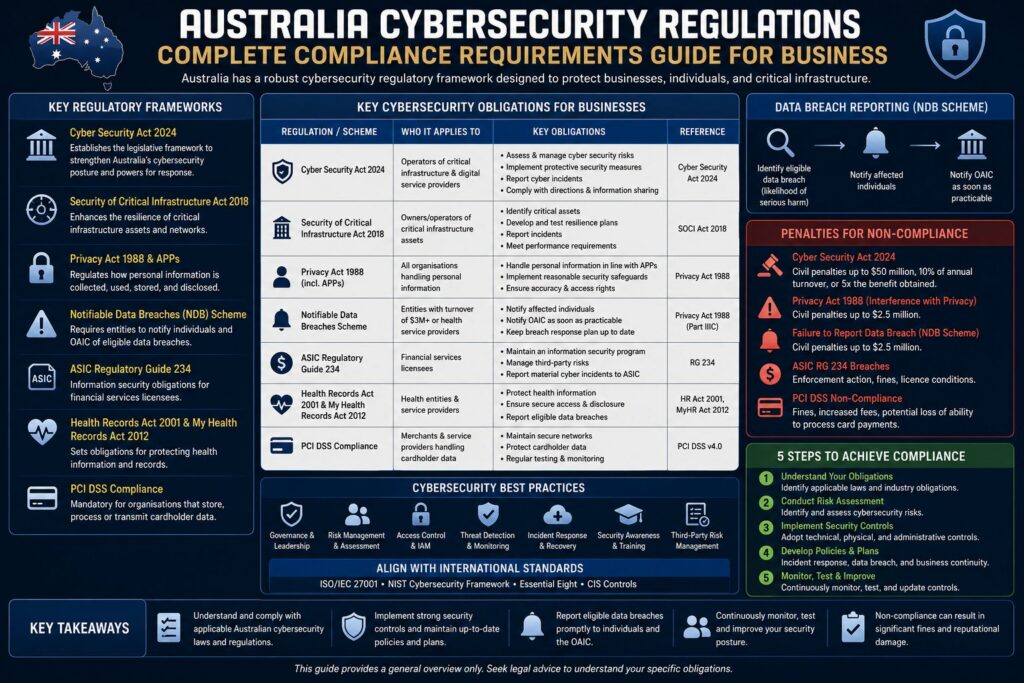
- Australia’s cybersecurity compliance landscape is multi-layered — most businesses must navigate the Privacy Act 1988, the NDB scheme, and at least one industry-specific framework like APRA CPS 234 or the SOCI Act.
- The ASD’s Essential Eight is the go-to baseline for hardening your systems, and while it’s mandatory for federal government agencies, private businesses that ignore it are increasingly exposed to regulatory and financial risk.
- Non-compliance carries serious consequences — under the Privacy Act amendments, fines for serious or repeated breaches can reach up to $50 million AUD, or three times the benefit obtained, whichever is greater.
- Australia’s Cyber Security Act 2024 changed the game — it introduced mandatory ransomware payment reporting and new obligations for critical infrastructure operators that many businesses aren’t yet prepared for.
- Keep reading to find out which specific regulations apply to your industry, what the Essential Eight maturity levels actually require, and the most common compliance mistakes that leave Australian businesses exposed.
Australian cybersecurity compliance isn’t optional anymore — regulators are watching, breach reports are rising, and the legal framework is tightening fast.
Whether you’re running a fintech startup in Sydney, a healthcare practice in Brisbane, or a mid-size retailer operating across states, the compliance obligations that apply to your business are almost certainly more complex than you think. The rules aren’t just federal — they stack: federal privacy law, industry prudential standards, state-level controls, and sector-specific frameworks all apply simultaneously depending on what you do and who you serve.
For businesses looking to get a handle on where they stand, resources like those provided by cybersecurity and compliance specialists can help cut through the noise and identify which frameworks actually apply — without having to read every piece of legislation from scratch.
Australia’s Cybersecurity Compliance Rules Are Getting Stricter — Here’s What’s at Stake
The threat environment in Australia has changed dramatically over the past several years. High-profile breaches at Medibank, Optus, and Latitude Financial exposed the personal data of millions of Australians and triggered a swift government response. What followed was a wave of regulatory reform that businesses across every sector are now feeling the effects of.
The Privacy Act amendments, the Cyber Security Act 2024, and APRA’s ongoing enforcement activity signal one clear message: the era of self-regulation is over. Regulators aren’t just writing guidance anymore — they’re issuing fines, launching investigations, and publishing the names of non-compliant organisations. The Australian Information Commissioner has already taken enforcement action against multiple businesses post-Medibank, and there’s no sign of that slowing down.
The Core Laws Every Australian Business Must Know
Australia’s cybersecurity and data protection legal framework is built across multiple pieces of legislation, each targeting different risks and different types of organisations. There’s no single unified “cybersecurity law” — instead, compliance is assembled from overlapping obligations depending on your sector, size, and data handling practices. Here’s what forms the foundation, including the debate between cloud security solutions vs. on-premise cybersecurity infrastructure.
Privacy Act 1988 and the Australian Privacy Principles (APPs)
The Privacy Act 1988 is the cornerstone of data protection in Australia. It applies to all private sector organisations with an annual turnover above $3 million AUD, as well as health service providers, credit reporting bodies, and certain other entities regardless of turnover. At its core are the 13 Australian Privacy Principles (APPs), which govern how personal information is collected, stored, used, and disclosed. APP 11 specifically requires organisations to take active steps to protect personal information from misuse, interference, loss, and unauthorised access — making it directly relevant to cybersecurity controls.
The 2022 amendments to the Privacy Act significantly increased penalties. Serious or repeated breaches now attract fines of up to $50 million AUD, or three times the value of any benefit obtained, or 30% of the entity’s adjusted turnover during the breach period — whichever is greatest. This is a dramatic shift from the previous maximum of $2.22 million, and it means privacy compliance is now firmly a board-level concern.
Notifiable Data Breaches (NDB) Scheme
Introduced in February 2018 under Part IIIC of the Privacy Act, the Notifiable Data Breaches (NDB) scheme requires organisations covered by the Privacy Act to notify both the Australian Information Commissioner (OAIC) and affected individuals when an eligible data breach occurs. An eligible breach is one that is likely to result in serious harm to any individual whose information is involved. Notifications must be made as soon as practicable — and the OAIC expects that to mean within 30 days of becoming aware of the breach. Failure to notify is itself a breach of the Privacy Act and can trigger enforcement action independently of the original incident. For more information on protecting sensitive data, consider exploring sensitive data loss prevention strategies.
Security of Critical Infrastructure Act 2018 (SOCI Act)
The Security of Critical Infrastructure Act 2018, significantly expanded in 2022, is one of the most consequential pieces of cybersecurity legislation in Australian history. It now covers 11 critical infrastructure sectors:
- Communications
- Data storage and processing
- Defence industry
- Education and research
- Energy
- Financial services and markets
- Food and grocery
- Healthcare and medical
- Space technology
- Transport
- Water and sewerage
Responsible entities in these sectors must register their assets on the Register of Critical Infrastructure Assets, adopt and maintain a Critical Infrastructure Risk Management Program (CIRMP), and report cybersecurity incidents to the Australian Signals Directorate (ASD) within specific timeframes — 12 hours for significant incidents, 72 hours for relevant incidents.
The 2022 amendments also gave the Australian Government new “last resort” intervention powers, allowing the ASD to direct a company’s response to a serious cyberattack if the entity is unable or unwilling to act effectively. For businesses in any of the 11 sectors, SOCI Act compliance is not a suggestion — it’s a legal obligation with serious consequences for non-compliance.
What makes the SOCI Act particularly complex is its interaction with other frameworks. A healthcare organisation, for example, may simultaneously be subject to the SOCI Act, the Privacy Act, the My Health Records Act, and state-level health privacy legislation — all at once. Mapping out which obligations overlap is a critical first step. For a comprehensive understanding of cybersecurity frameworks, you might find this enterprise security platform comparison helpful.
APRA Prudential Standard CPS 234
For entities regulated by the Australian Prudential Regulation Authority (APRA) — which includes banks, insurers, and superannuation funds — Prudential Standard CPS 234 sets out mandatory information security requirements. It came into force in July 2019 and applies to all APRA-regulated entities regardless of size. CPS 234 requires entities to maintain information security capability commensurate with the size and extent of threats to their information assets, implement controls to protect those assets, and notify APRA of material information security incidents within 72 hours.
CPS 234 Key Obligations at a Glance:
• Define information security roles and responsibilities at board and management level
• Maintain an information security capability proportionate to the threat environment
• Implement controls for information assets managed by third parties
• Conduct regular testing of control effectiveness
• Notify APRA within 72 hours of a material information security incident
• Notify APRA within 10 business days of identifying a material control weaknessAPRA has made clear it takes CPS 234 enforcement seriously. Following a series of post-breach reviews, APRA issued remedial directions to multiple regulated entities and publicly stated that information security governance failures at the board level will not be tolerated. The standard essentially forces regulated entities to treat cybersecurity as a core operational risk — not just an IT issue. For a deeper understanding of cybersecurity frameworks, explore this Zero Trust Network Security Architecture Guide.
Third-party risk is another major focus of CPS 234. If a regulated entity relies on a vendor or cloud provider to manage information assets, those arrangements must be governed under a formal third-party security framework. This means your compliance posture is only as strong as the weakest link in your supply chain.
Australia’s Cyber Security Act 2024
Passed in November 2024, the Cyber Security Act 2024 is Australia’s first standalone cybersecurity legislation and represents a significant step in consolidating the country’s regulatory approach. Its most immediate impact is on ransomware: businesses that operate critical infrastructure assets and make ransomware payments are now legally required to report those payments to the ASD within 72 hours. This reporting obligation exists regardless of whether the payment resolves the incident and is separate from any SOCI Act incident reporting. The Act also introduces minimum cybersecurity standards for smart devices (IoT security standards) and establishes a Cyber Incident Review Board to conduct no-fault post-incident reviews — modelled on aviation accident investigation processes. For affected businesses, understanding how the Cyber Security Act 2024 interacts with existing SOCI Act, Privacy Act, and CPS 234 obligations is now a core compliance task.
ASD’s Essential Eight: The Baseline Every Business Should Meet
Developed by the Australian Signals Directorate, the Essential Eight is a prioritised set of mitigation strategies designed to protect organisations against the most common cyberattack techniques. It’s the closest thing Australia has to a universal cybersecurity baseline, and while it’s only mandatory for non-corporate Commonwealth entities, it’s widely adopted across the private sector as a practical hardening framework.
What the Essential Eight Actually Requires
The Essential Eight consists of eight specific controls across three core objectives: preventing malware delivery and execution, limiting the extent of incidents, and recovering data and system availability. The eight strategies are application control, patching applications, configuring Microsoft Office macro settings, user application hardening, restricting administrative privileges, patching operating systems, multi-factor authentication (MFA), and regular backups. Each of these addresses a specific attack vector — MFA alone, for example, stops the vast majority of credential-based attacks, which remain the leading cause of breaches in Australian businesses.
The Four Maturity Levels Explained
The Essential Eight uses a four-tier maturity model — Maturity Level Zero through Maturity Level Three — to help organisations measure and progress their security posture. Maturity Level Zero means an organisation has not implemented the controls or has significant weaknesses. Maturity Level One provides protection against opportunistic attackers using common techniques. Maturity Level Two protects against adversaries that invest more effort to evade detection. Maturity Level Three addresses sophisticated, targeted attacks by adversaries who adapt their methods specifically to the target environment.
For most private sector businesses, reaching Maturity Level Two is a realistic and meaningful goal. Maturity Level Three is typically aimed at government agencies and high-value targets such as defence contractors and critical infrastructure operators. The ASD publishes detailed assessment guides for each maturity level, which form the basis of most third-party Essential Eight assessments conducted in Australia.
Which Businesses Are Legally Required to Implement It
Non-corporate Commonwealth entities — government departments and agencies — are required to implement the Essential Eight under the Protective Security Policy Framework (PSPF). For corporate Commonwealth entities and private sector businesses, there is currently no direct legal mandate to follow the Essential Eight specifically. However, APRA-regulated entities will find significant overlap between CPS 234 requirements and Essential Eight controls, and many government procurement contracts now require suppliers to demonstrate Essential Eight compliance at a minimum of Maturity Level Two. The practical reality is that for any business that handles government data, operates in a regulated sector, or wants to demonstrate a credible security posture to partners and customers, the Essential Eight is the starting point — not the ceiling.
Industry-Specific Compliance Requirements in Australia
On top of the federal baseline frameworks, most Australian industries carry their own compliance obligations — and for many businesses, it’s the sector-specific rules that demand the most attention. A hospital faces different cybersecurity requirements than a bank, which faces different requirements than a defence contractor. Knowing which layers apply to you is non-negotiable.
The industry-specific requirements described below operate alongside — not instead of — the federal obligations. That means a healthcare provider, for example, is simultaneously managing Privacy Act compliance, My Health Records Act obligations, the NDB scheme, and potentially SOCI Act requirements. Compliance isn’t linear; it’s a matrix.
Finance: ASIC, AUSTRAC, and APRA Obligations
Financial services businesses in Australia operate under some of the most demanding cybersecurity compliance obligations in any sector. APRA-regulated entities (banks, insurers, superannuation funds) must comply with CPS 234 as discussed above. But the obligations don’t stop there. The Australian Securities and Investments Commission (ASIC) holds Australian financial services licensees to a duty of adequate cyber risk management under their licence conditions — ASIC has already pursued enforcement action against Lomb Scientific and RI Advice Group for failures in this area, with the RI Advice case resulting in a landmark court determination that inadequate cybersecurity practices constituted a breach of financial services licence obligations. For those seeking to bolster their cybersecurity measures, exploring cloud security solutions could be a beneficial step.
AUSTRAC-regulated businesses (those providing designated services under the Anti-Money Laundering and Counter-Terrorism Financing Act 2006) must implement AML/CTF programs that include IT systems controls, customer identification and verification processes, and transaction monitoring. While not purely a cybersecurity obligation, the IT infrastructure requirements of AML/CTF compliance are substantial — and failures in data integrity or system security can trigger AUSTRAC enforcement action.
Healthcare: My Health Records Act and State-Level Privacy Codes
Healthcare is one of the most heavily regulated sectors from a data privacy perspective in Australia. The My Health Records Act 2012 governs access to and disclosure of information stored in the My Health Record system. Healthcare providers registered with the system must comply with strict access controls, audit logging requirements, and breach notification obligations that operate in addition to those under the Privacy Act NDB scheme. The penalties for unauthorised collection or disclosure of My Health Record information are severe — up to 5 years imprisonment for the most serious offences.
Beyond federal law, state and territory health privacy legislation adds another compliance layer. New South Wales has the Health Records and Information Privacy Act 2002, Victoria has the Health Records Act 2001, and the Australian Capital Territory has the Health Records (Privacy and Access) Act 1997. These impose their own Health Privacy Principles (HPPs) on health service providers operating within those jurisdictions — which may be more stringent than the federal APPs in certain respects.
For healthcare businesses operating across state lines or using cloud-based electronic health record platforms, the compliance matrix is particularly complex. Data residency, access controls, audit trails, and breach response procedures all need to account for the specific requirements of each jurisdiction in which patients are treated.
Government Contractors: ISM and PSPF Requirements
Any business that contracts with Australian federal government agencies will encounter two key frameworks: the Information Security Manual (ISM) and the Protective Security Policy Framework (PSPF). The ISM, published and maintained by the ASD, provides a set of cybersecurity controls that government agencies and their contractors must implement when handling government information. The controls are risk-based — the required level of implementation depends on the classification of the information being handled, ranging from PROTECTED to TOP SECRET.
The PSPF governs the overall security posture of Australian government entities and sets requirements around personnel security, physical security, and information governance. For contractors handling PROTECTED-level information, achieving and maintaining an ISM-aligned security posture is a procurement requirement — not a competitive differentiator. The Australian Cyber Security Centre (ACSC) also publishes guidance on achieving compliance for government suppliers, and increasingly, the Department of Defence requires prime contractors and their subcontractors to demonstrate compliance with the Defence Industry Security Program (DISP).
Retail and E-Commerce: PCI DSS and Consumer Data Right (CDR)
Retailers and e-commerce businesses that accept card payments must comply with the Payment Card Industry Data Security Standard (PCI DSS) — a global standard mandated by card networks including Visa, Mastercard, and American Express. PCI DSS v4.0, the current version, requires merchants to maintain a secure network architecture, protect cardholder data, implement strong access controls, and conduct regular security testing. Australian retailers are not exempt from this requirement — non-compliance can result in fines from acquiring banks, increased transaction fees, and in the event of a breach, liability for fraudulent transactions. The level of compliance required scales with transaction volume, from the simplified Self-Assessment Questionnaire (SAQ) process for small merchants to full on-site audits by a Qualified Security Assessor (QSA) for large-volume merchants.
The Consumer Data Right (CDR), introduced under the Competition and Consumer Act 2010 and currently live in the banking and energy sectors, adds another dimension. Businesses that are accredited data recipients under the CDR framework must meet strict data security obligations set by the ACCC and the Data Standards Body — including requirements around data encryption, access control, audit logging, and incident response. As the CDR expands into telecommunications and other sectors, the number of businesses affected will grow significantly.
How Compliance Requirements Vary by State
Federal law sets the floor in Australia — but it doesn’t set the ceiling. State and territory governments maintain their own legislation that can impose additional obligations on businesses operating within their borders, particularly around privacy, surveillance, and information security for government-related activities. For businesses operating nationally, this creates a patchwork of requirements that must be carefully mapped against your specific operations in each jurisdiction.
The good news is that most state-level obligations don’t contradict federal requirements — they typically extend or supplement them in specific areas. The challenge is that many businesses aren’t even aware these state-level obligations exist until they’re already in breach of them. A Victorian healthcare provider, a Queensland government supplier, and a New South Wales employer all face different compliance landscapes on top of their shared federal obligations.
Understanding the jurisdictional layer that applies to your business isn’t a legal exercise you do once. As your business expands into new states, takes on new contracts, or enters new service lines, the compliance map changes. Building a process for ongoing jurisdictional review into your compliance program is essential for any business with multi-state operations.
New South Wales: Workplace Surveillance Controls
The Workplace Surveillance Act 2005 (NSW) imposes specific obligations on employers who monitor employee activity — including computer and internet surveillance. If you’re monitoring employee devices, email, or network activity for security purposes, you must provide prior written notice to employees, and covert surveillance is only permitted with specific court authorisation. For cybersecurity teams implementing endpoint monitoring, data loss prevention tools, or email filtering systems, this Act creates a compliance consideration that sits entirely outside the federal framework. Failure to comply can expose employers to civil liability and reputational damage from employee disputes.
Victoria: Healthcare Privacy Codes Beyond Federal Law
Victoria’s Health Records Act 2001 applies to both public and private health service providers operating in Victoria and imposes 11 Health Privacy Principles (HPPs) governing the collection, use, and disclosure of health information. In several respects the HPPs are more prescriptive than the federal APPs — particularly around data access rights and the obligations to provide individuals with access to their own health records. For healthcare businesses operating in Victoria, compliance requires mapping both the federal and state frameworks simultaneously and implementing controls that satisfy the stricter of the two wherever they diverge.
Queensland: Information Security for State Contracts
Queensland government agencies operate under the Queensland Government Information Security Policy, which aligns with the ISO 27001 framework and requires agencies to implement formal information security management systems. Suppliers and contractors working with Queensland government entities are increasingly required to demonstrate alignment with this policy as a condition of contract. The Queensland Government Chief Information Office (QGCIO) publishes detailed standards that procurement teams evaluate during tender assessments — meaning that for businesses targeting government work in Queensland, information security maturity is now a commercial differentiator, not just a compliance obligation.
Beyond government contracts, Queensland’s Information Privacy Act 2009 applies to Queensland government agencies and their contracted service providers, imposing its own set of Information Privacy Principles (IPPs) and National Privacy Principles (NPPs) depending on the type of entity. Businesses that process personal information on behalf of Queensland government agencies under contract are directly bound by these obligations and must implement corresponding technical and organisational controls.
Western Australia and Northern Territory: Resource Industry Frameworks
In Western Australia and the Northern Territory, the resource and mining sectors bring their own compliance considerations. Large resource companies operating critical systems — including industrial control systems (ICS) and operational technology (OT) environments — fall within the SOCI Act’s expanded scope, and the ASD has published specific guidance on securing OT environments that applies directly to resource sector operations. The convergence of IT and OT in modern mining operations means that cybersecurity compliance now extends beyond corporate networks into physical operational infrastructure — including remote site connectivity, SCADA systems, and autonomous equipment management platforms.
Both Western Australia and the Northern Territory also engage heavily with federal defence and space sector supply chains, which brings DISP and ISM obligations into scope for contractors in those regions. Businesses supporting defence or strategic infrastructure projects in these jurisdictions are increasingly subject to formal security vetting and system accreditation requirements that demand sustained investment in cybersecurity capability.
ISO 27001 and How It Fits Into Australia’s Compliance Landscape
ISO/IEC 27001 is the internationally recognised standard for Information Security Management Systems (ISMS). While it’s not mandated by any single Australian law, it has become the de facto benchmark for demonstrating cybersecurity maturity in enterprise procurement, government contracting, and regulated industry supply chains. Achieving ISO 27001 certification from an accredited certification body means an independent auditor has verified that your organisation has implemented a systematic, risk-based approach to managing information security — covering everything from asset management and access control to supplier relationships and business continuity. In practical terms, ISO 27001 certification provides significant overlap with CPS 234 requirements, aligns with Queensland government information security policy expectations, and satisfies many of the control requirements in the ISM for government contractors. It’s not a substitute for regulatory compliance, but it’s the strongest single credential an Australian business can hold to demonstrate that cybersecurity is being managed systematically rather than reactively.
Steps to Build a Compliance Program From Scratch
Building a cybersecurity compliance program can feel overwhelming when you’re staring at a stack of legislation, standards, and frameworks that all seem to apply simultaneously. The key is to approach it systematically — starting with clarity about what applies to you, then building controls that address the most critical gaps first, and embedding ongoing monitoring so the program stays current as your business and the regulatory environment evolve.
The steps below aren’t theoretical. They reflect the practical sequence that works for Australian businesses of all sizes — from sole traders with a handful of staff to mid-market companies with complex multi-state operations. The goal is a program that’s defensible, documented, and genuinely effective — not just a folder of policies that nobody reads.
1. Identify Which Regulations Apply to Your Business
Start by mapping your regulatory exposure. Identify your industry sector, the types of personal and sensitive information you handle, your annual turnover, whether you hold government contracts, and which states you operate in. This mapping exercise will tell you which combination of the Privacy Act, NDB scheme, SOCI Act, CPS 234, PSPF, ISM, and state-level legislation applies to your specific situation. Many businesses discover obligations they weren’t previously aware of during this step — particularly around the SOCI Act’s expanded sector coverage and state-level privacy codes.
2. Run a Cybersecurity Risk Assessment
Once you know which frameworks apply, conduct a formal risk assessment against those requirements. Identify your critical information assets, map the threats and vulnerabilities that could affect them, assess the likelihood and potential impact of each risk, and prioritise remediation based on both risk severity and regulatory requirement. The ASD’s Essential Eight assessment methodology provides a solid starting point for technical risk assessment, while ISO 27001’s risk assessment process provides a more comprehensive framework for organisations seeking certification. Document everything — a risk register that demonstrates active, ongoing risk management is one of the most important artefacts you can have in the event of a regulatory investigation.
3. Build Your IT Security Policy and Controls
Translate your risk assessment into a set of documented policies and technical controls. At minimum, you need an overarching Information Security Policy, an Access Control Policy, a Data Classification and Handling Policy, an Incident Response Plan, and a Business Continuity and Disaster Recovery Plan. Technical controls should directly address the gaps identified in your risk assessment — and should be mapped to the specific regulatory requirements they satisfy. This mapping is critical: when a regulator or auditor asks how you comply with APP 11 or CPS 234, you need to be able to point to specific controls and demonstrate they’re operating effectively. For a comprehensive understanding of Privileged Identity Access Management solutions, consider reviewing various platforms to enhance your security measures.
4. Train Your Staff and Create Incident Response Plans
The most technically sophisticated security controls in the world will fail if your staff don’t understand their role in maintaining them. Security awareness training should be mandatory for all staff, conducted at onboarding and at least annually thereafter, and tailored to the specific threats relevant to your industry — phishing, business email compromise, and social engineering remain the leading attack vectors in Australian breach reports. Your Incident Response Plan needs to be specific enough to be actionable under pressure: who is notified first, who makes the decision to trigger the NDB notification process, what external parties (legal counsel, forensic investigators, the OAIC) need to be engaged and when, and who is the designated spokesperson if the breach becomes public.
5. Audit, Monitor, and Continuously Improve
Compliance is not a project — it’s an ongoing operational function. Schedule regular internal audits against your compliance framework, conduct annual penetration testing and vulnerability assessments, and review your risk register and control documentation whenever there is a significant change to your business, technology environment, or the regulatory landscape. For APRA-regulated entities, CPS 234 requires formal attestation to the board at least annually regarding information security capability and the results of control testing. Even for non-regulated businesses, building a similar governance rhythm — quarterly security reviews, annual external audits, board-level reporting — is the mark of a mature compliance program and the best protection against regulatory scrutiny in the event of an incident.
It’s also worth building a regulatory change monitoring process into your compliance program. Australian cybersecurity regulation is evolving rapidly — the Cyber Security Act 2024 is the most recent example, but it won’t be the last. Assigning responsibility to a specific person or team for tracking regulatory developments and translating them into compliance actions ensures your program stays current rather than becoming outdated between annual review cycles.
Technology Tools That Make Compliance Easier to Manage
Managing cybersecurity compliance manually — through spreadsheets, shared drives, and email threads — is a path to gaps, inconsistencies, and missed obligations. The right technology stack doesn’t replace the human judgment and governance that compliance requires, but it makes the operational side dramatically more manageable, auditable, and scalable as your business and its obligations grow.
SIEM Platforms for Real-Time Threat Detection
Security Information and Event Management (SIEM) platforms aggregate and correlate log data from across your IT environment — firewalls, servers, endpoints, cloud services, and applications — to detect suspicious activity in real time. For compliance purposes, SIEM is particularly valuable because it generates the audit logs and security event records that regulators and auditors expect to see. Under CPS 234, APRA expects regulated entities to have the capability to detect and respond to information security incidents promptly — and a well-configured SIEM is central to demonstrating that capability. Leading platforms used in Australian enterprise environments include Microsoft Sentinel, Splunk Enterprise Security, and IBM QRadar, each offering pre-built compliance reporting dashboards that can be mapped to Australian regulatory requirements.
GRC Software for Policy and Risk Management
Governance, Risk, and Compliance (GRC) platforms centralise the management of your compliance obligations, risk register, policy library, and audit evidence in a single system. Rather than maintaining separate spreadsheets for your Privacy Act obligations, your Essential Eight maturity assessments, and your CPS 234 control attestations, a GRC tool provides a unified view of your compliance posture across all applicable frameworks. Platforms such as ServiceNow GRC, LogicGate, and Archer GRC allow you to map controls to multiple frameworks simultaneously — so a single access control policy can be tagged against both ISO 27001 and CPS 234 requirements, eliminating duplicate effort and making cross-framework reporting significantly more efficient. For businesses undergoing their first formal compliance program build, a GRC tool also enforces the structured approach to risk assessment and control documentation that regulators expect to see.
Data Loss Prevention (DLP) Tools
Data Loss Prevention (DLP) tools monitor and control the movement of sensitive data across your network, endpoints, and cloud environments — preventing unauthorised transmission of personal information, financial data, or classified material outside your organisation. For businesses subject to the Privacy Act and NDB scheme, DLP provides a critical early warning layer: it can detect when large volumes of personal data are being exfiltrated, alert security teams before a breach becomes reportable, and generate the forensic evidence needed to assess whether an eligible data breach has occurred. Leading DLP solutions deployed in Australian enterprise environments include Microsoft Purview Information Protection, Forcepoint DLP, and Symantec Data Loss Prevention, all of which support classification policies aligned to Australian privacy and data handling requirements.
One practical consideration for Australian businesses implementing DLP is the interaction with the Workplace Surveillance Act 2005 (NSW) and equivalent state legislation. DLP tools that monitor employee communications and file transfers constitute workplace surveillance — which means your DLP deployment must be accompanied by appropriate staff notification and policy documentation to remain legally compliant. This is a nuance that many businesses implementing DLP for security purposes overlook entirely until an employment dispute brings it to their attention.
The Real Cost of Compliance vs. The Cost of Non-Compliance
One of the most common objections to investing in cybersecurity compliance is cost. And it’s a fair question — building and maintaining a genuine compliance program requires real investment in people, technology, and external expertise. But the calculation only makes sense when you put that investment next to the actual cost of getting it wrong.
What Australian Businesses Typically Spend on Compliance
Compliance costs vary enormously depending on business size, sector, and the frameworks that apply. A small business achieving Basic Essential Eight maturity might invest $15,000 to $40,000 AUD in an initial uplift — covering a gap assessment, control implementation, and basic staff training. A mid-market business building an ISO 27001-aligned ISMS and achieving Maturity Level Two against the Essential Eight can expect to invest $80,000 to $250,000 AUD in the first year, including internal resources, external consultants, and technology tooling. For APRA-regulated entities or SOCI Act critical infrastructure operators, annual compliance expenditure — including external audits, penetration testing, GRC tooling, and dedicated security personnel — routinely runs into the millions. The key point is that these are known, plannable costs. They can be budgeted, staged, and optimised. What you cannot budget for is a major breach.
Fines, Penalties, and Reputational Damage From Breaches
The financial consequences of non-compliance in Australia have escalated sharply. Under the amended Privacy Act, serious or repeated privacy breaches attract penalties of up to $50 million AUD for corporations — and the Australian Information Commissioner has made clear that post-Medibank and post-Optus, enforcement posture has shifted from education-first to accountability-first. The Medibank breach, which exposed the personal and health data of approximately 9.7 million customers, triggered an OAIC investigation that concluded Medibank failed to take reasonable steps to protect personal information. The downstream costs — legal fees, regulatory response, customer notification, remediation, and class action exposure — far exceeded anything Medibank had invested annually in cybersecurity compliance.
Beyond regulatory fines, the reputational cost of a significant breach is harder to quantify but often more damaging in the long term. Australian consumer research consistently shows that trust, once lost following a data breach, is extremely difficult to rebuild. For B2B businesses, a breach that triggers a compliance failure can result in lost contracts, failed tender assessments, and partner relationships unwound by contractual breach provisions. Cyber insurance premiums have also risen significantly following the Australian breach landscape of 2022 and 2023 — businesses without demonstrable compliance programs are increasingly finding coverage either unavailable or prohibitively expensive.
Common Compliance Mistakes Australian Businesses Make
Understanding what the regulations require is only half the challenge. The other half is avoiding the operational and governance mistakes that leave businesses technically aware of their obligations but practically non-compliant. These are the patterns that repeatedly appear in breach post-mortems, regulatory investigations, and audit findings across Australian industries. For instance, many businesses struggle with implementing a Zero Trust Network Architecture, which can be a crucial aspect of maintaining compliance.
Treating Compliance as a One-Time Checkbox
The most damaging compliance mistake Australian businesses make is treating it as a project with a start and end date rather than an ongoing operational function. A business that completes an Essential Eight assessment in January and doesn’t revisit it until the following year is almost certainly non-compliant by mid-year — because the threat environment, technology stack, staff composition, and regulatory framework will all have changed in the interim. Compliance is a living program. Policies go stale. Controls drift. Staff change. Vulnerabilities emerge. Building quarterly review cycles, automated control monitoring, and a defined process for incorporating regulatory changes into your program is what separates businesses with genuine compliance postures from those with compliance documentation that doesn’t reflect operational reality.
Underestimating Third-Party and Supply Chain Risk
Both CPS 234 and the Privacy Act hold organisations responsible for the security of personal information even when it’s managed by a third party on their behalf. Yet a significant proportion of Australian data breaches in recent years have originated not in the victim organisation’s own systems, but in the systems of a vendor, supplier, or cloud provider with access to their data. The RI Advice Group case was partly about failures in managing the security of its authorised representative network — demonstrating that regulators will hold principal entities accountable for third-party security failures.
Effective third-party risk management requires more than a security questionnaire sent once at contract commencement. It requires ongoing monitoring, contractual security obligations with audit rights, regular reviews of vendor access and data flows, and a clear process for offboarding vendors and revoking access when relationships end. For businesses with extensive supply chains or cloud-dependent infrastructure, third-party risk is almost always the most significant compliance gap — and the one most likely to result in a reportable breach.
Failing to Document Policies and Incident Responses
Documentation is the difference between a compliance program that can be demonstrated and one that exists only in the minds of the people who built it. Regulators and auditors don’t take your word for it — they ask to see your policies, your risk register, your control testing records, your staff training logs, and your incident response history. Businesses that have implemented genuinely good security controls but failed to document them are in a surprisingly vulnerable position: they cannot demonstrate compliance, even when they are compliant in practice.
Incident response documentation is particularly critical. When the OAIC investigates a notifiable data breach, one of the first things they examine is how the business identified the breach, what steps were taken to contain it, when notifications were made, and what the incident response process looked like. A business that handled a breach well but can’t produce contemporaneous records of what they did and when will face far more scrutiny — and potentially worse outcomes — than one with thorough documentation of a measured, policy-driven response. Build the paper trail as you go. It’s not bureaucracy — it’s your best defence.
What’s Coming Next in Australian Cybersecurity Regulation
The Cyber Security Act 2024 is the most visible recent development, but it’s not the last move on the board. The Australian Government’s 2023-2030 Australian Cyber Security Strategy explicitly commits to strengthening mandatory baseline requirements for businesses, expanding the SOCI Act’s reach, and developing a voluntary Cyber Health Check program for small and medium enterprises. The Privacy Act reform process is also ongoing — proposed changes include removing the small business exemption (which currently excludes businesses with turnover under $3 million from most Privacy Act obligations), introducing a statutory tort for serious invasions of privacy, and strengthening individual rights around automated decision-making. If the small business exemption is removed, hundreds of thousands of Australian businesses that currently sit outside the Privacy Act’s scope will become subject to APP obligations and the NDB scheme overnight. Getting compliance-ready before that change takes effect — rather than scrambling to catch up when it does — is a strategic decision that forward-thinking businesses are already making.
Your Business Cannot Afford to Wait on Cybersecurity Compliance
The regulatory environment is tightening, enforcement is escalating, and the breach landscape shows no sign of easing — the question for Australian businesses is no longer whether to invest in cybersecurity compliance, but how quickly they can build a program that’s genuinely defensible. If you’re ready to take the next step, working with a specialist cybersecurity compliance partner who understands the Australian regulatory landscape can compress your timeline, reduce your risk exposure, and give you the confidence that your program will hold up when it matters most.
Frequently Asked Questions
Australian cybersecurity compliance raises a lot of questions — particularly for businesses navigating the framework for the first time. The answers below address the most common points of confusion that businesses encounter when mapping their obligations and building their compliance programs. For businesses considering different security architectures, understanding the Zero Trust Network Perimeter Security Architecture can be essential.
These answers reflect the current state of Australian law and regulatory guidance. Given the pace of regulatory change in this space, it’s worth verifying current requirements against the latest publications from the OAIC, ASD, and APRA when making specific compliance decisions.
Which Australian law governs how businesses handle personal data?
The Privacy Act 1988 is the primary Australian law governing how businesses handle personal data. It applies to private sector organisations with annual turnover above $3 million AUD, all health service providers regardless of turnover, credit reporting bodies, and certain other entities. The 13 Australian Privacy Principles (APPs) within the Act set out specific obligations for the collection, storage, use, disclosure, and security of personal information. State and territory legislation — including the NSW Health Records and Information Privacy Act 2002 and the Victorian Health Records Act 2001 — imposes additional obligations on health service providers operating in those jurisdictions.
Does the Essential Eight apply to private sector businesses in Australia?
The Essential Eight is only legally mandatory for non-corporate Commonwealth entities under the Protective Security Policy Framework (PSPF). However, private sector businesses — particularly those in regulated industries, those holding government contracts, or those seeking cyber insurance — are increasingly expected to demonstrate Essential Eight compliance as a baseline. APRA-regulated entities will find significant overlap between Essential Eight controls and CPS 234 requirements, and many government procurement processes now require suppliers to demonstrate at least Maturity Level Two. While there is currently no direct private sector mandate, the Essential Eight represents the practical baseline that Australian businesses in most sectors should be working toward.
What happens if an Australian business fails to report a data breach under the NDB scheme?
Failure to report an eligible data breach under the Notifiable Data Breaches (NDB) scheme is itself a breach of the Privacy Act 1988 and can trigger separate enforcement action by the Australian Information Commissioner (OAIC) — independent of the original breach. The OAIC has the power to investigate, make determinations, seek civil penalty orders, and require remedial action. Under the amended Privacy Act, serious or repeated breaches attract penalties of up to $50 million AUD for corporations and up to $2.5 million AUD for individuals.
The timing obligation is clear: once an organisation has reasonable grounds to believe an eligible data breach has occurred, notification to the OAIC and affected individuals must happen as soon as practicable. The OAIC expects this to occur within 30 days of the organisation becoming aware of the breach. Delay — particularly where it appears designed to avoid notification obligations — is treated as an aggravating factor in enforcement proceedings.
There is an important nuance here around the assessment period. When an organisation suspects but has not confirmed an eligible breach, it has 30 days to conduct a reasonable and expeditious assessment. This assessment period is not an excuse to delay — it’s a defined window for fact-finding, at the end of which a notification decision must be made. Organisations that use the assessment period as a delay mechanism, rather than a genuine investigative process, expose themselves to additional regulatory risk.
Stage Obligation Timeframe Suspected breach identified Begin reasonable and expeditious assessment Immediately Assessment period Determine if eligible data breach has occurred Within 30 days Eligible breach confirmed Notify OAIC and affected individuals As soon as practicable OAIC notification submitted Lodge statement with OAIC via online portal Simultaneously with individual notification Failure to notify Treated as separate Privacy Act breach — enforcement risk Ongoing exposure until remedied How is APRA CPS 234 different from the Privacy Act 1988?
The Privacy Act 1988 is broad-scope data protection legislation that applies across most Australian private sector organisations and governs how personal information is collected, used, and protected. APRA Prudential Standard CPS 234 is a sector-specific information security standard that applies exclusively to APRA-regulated entities — banks, insurers, and superannuation funds — and focuses specifically on maintaining an information security capability sufficient to protect information assets against cyber threats. Where the Privacy Act is principles-based and applies to personal data broadly, CPS 234 is prescriptive and applies to all information assets of a regulated entity, not just personal information. The two frameworks operate concurrently for APRA-regulated entities — meaning a bank must comply with both simultaneously, and a failure that triggers a CPS 234 breach may also constitute a Privacy Act breach depending on the nature of the information involved.
Do small businesses in Australia need to comply with cybersecurity regulations?
Small businesses with annual turnover below $3 million AUD are currently exempt from most Privacy Act obligations — but this exemption has significant limits that many small business owners aren’t aware of. Health service providers are subject to the Privacy Act regardless of turnover. Businesses that opt in to the Privacy Act (for example, to facilitate government contracts) lose the small business exemption. Businesses subject to the SOCI Act, PCI DSS, or AUSTRAC regulation face compliance obligations that apply regardless of size. And state-level privacy and information security legislation may apply independently of the federal small business exemption.
Beyond legal obligations, small businesses are frequently targeted by cybercriminals precisely because they’re perceived as having weaker security than larger organisations — yet they often hold valuable customer data, financial records, and supply chain access that makes them attractive targets. The ASD’s Small Business Cyber Security Guide provides a practical starting point, and the Essential Eight Maturity Level One provides a realistic initial target for small businesses looking to build baseline resilience without enterprise-level investment.
Looking ahead, the proposed removal of the small business exemption from the Privacy Act — currently under consideration as part of the ongoing Privacy Act reform process — would bring the vast majority of Australian businesses into the Privacy Act’s scope for the first time. Businesses that begin building privacy and cybersecurity compliance foundations now will be significantly better positioned to manage that transition than those who wait for the legislative change to force their hand. Starting with the basics — a privacy policy, a data inventory, MFA on all systems, regular backups, and staff security awareness training — is achievable for virtually any small business, and it’s the foundation that everything else builds on.