
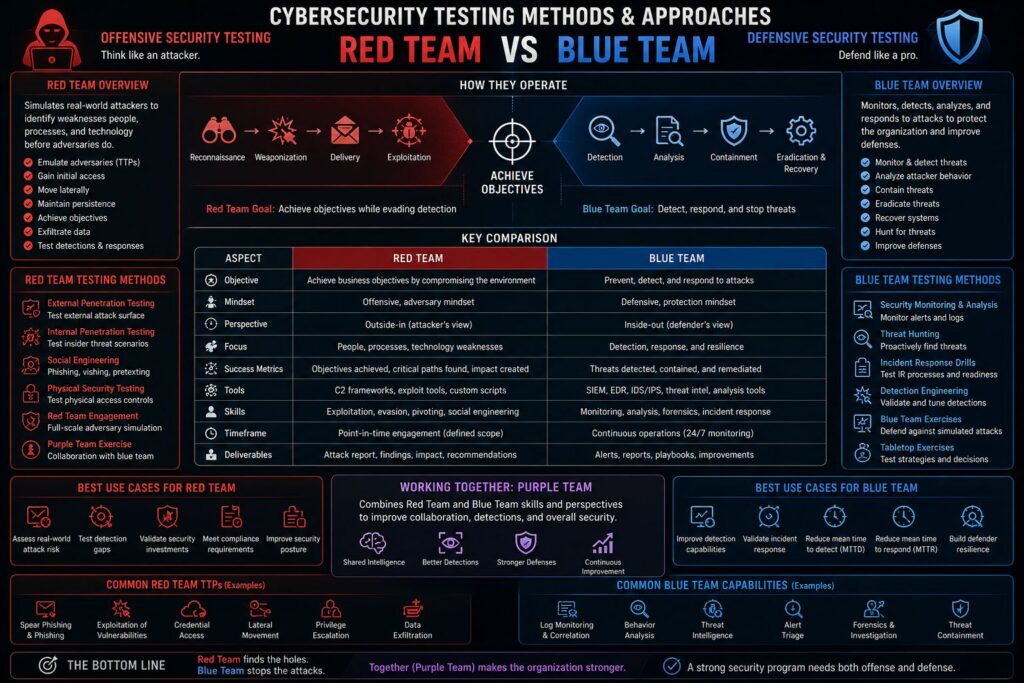
Red Team vs Blue Team: Article At A Glance
- Red teams simulate real cyberattacks to expose hidden vulnerabilities before malicious actors can exploit them.
- Blue teams defend, detect, and respond — they are your organization’s first and last line of cyber defense.
- Neither team is more important; the most resilient organizations use both in coordinated exercises.
- A third team — the purple team — exists specifically to bridge the gap between offensive and defensive operations.
- Choosing the right team structure depends on your organization’s current security maturity, risk profile, and goals.
Your Organization Is Being Tested — Whether You Like It or Not
Every day, threat actors probe networks, test phishing responses, and look for misconfigurations your team hasn’t noticed yet. The only real question is whether the first people to find your weaknesses are on your payroll — or not.
That’s the core tension behind red team vs blue team cybersecurity. One side attacks. The other defends. Together, they replicate the same dynamic that plays out in real breaches — except in a controlled environment where your organization actually learns from it. Companies like Cybrary have built entire training platforms around this adversarial model because it remains one of the most effective ways to build genuine security competence in teams.
This isn’t just theory for large enterprises. Organizations of every size face persistent, sophisticated threats. Understanding how red and blue teams work — and how to use them — is one of the most practical investments a security-conscious organization can make.
What Is a Red Team in Cybersecurity?
A red team is a group of security professionals who simulate real-world cyberattacks against an organization’s infrastructure, people, and processes. They think, act, and operate like genuine threat actors — using the same tools, tactics, and procedures (TTPs) that malicious hackers use in the wild.
Unlike a simple vulnerability scan or automated penetration test, red team engagements are goal-oriented. The team is typically given an objective — access a specific database, compromise an executive’s credentials, exfiltrate a sample data set — and then works to achieve it using any realistic means necessary.
The Core Goal: Find Weaknesses Before Attackers Do
The red team’s job is straightforward: find what’s broken before someone else does. They are tasked with uncovering vulnerabilities across every layer of your security stack — technical, physical, and human. A red team engagement might involve probing a web application for injection flaws, tailgating an employee into a restricted area, or crafting a spear-phishing email so convincing it fools even security-aware staff.
What separates a red team from a standard pen tester is scope and depth. Red team operations are typically longer (weeks to months), broader in attack surface, and specifically designed to test the blue team’s ability to detect and respond — not just to find vulnerabilities in isolation.
Red Team Roles and Who Fills Them
Red teams are usually composed of highly specialized professionals. A typical engagement might include:
- Penetration Testers — focused on exploiting technical vulnerabilities in networks, applications, and systems
- Social Engineers — specialists in manipulating human behavior through phishing, vishing, or physical pretexting
- Exploit Developers — capable of writing custom malware or modifying existing exploits to evade detection
- OSINT Analysts — gathering publicly available intelligence to map attack surfaces and identify targets
In smaller organizations, one or two skilled professionals may wear all of these hats. In larger engagements, these roles are clearly delineated with specific objectives for each.
Common Red Team Techniques and Attack Methods
Red teams pull from an extensive playbook. Common techniques include spear-phishing campaigns, SQL injection, privilege escalation, lateral movement across networks, credential harvesting, and adversarial simulation frameworks like MITRE ATT&CK. They also use purpose-built tools such as Cobalt Strike for command-and-control simulation, Metasploit for exploitation, and BloodHound for Active Directory attack path mapping.
The goal isn’t just to break in — it’s to stay in, move laterally, and achieve the defined objective while remaining undetected for as long as possible. That persistence is what makes red team exercises so revealing about a blue team’s real detection capabilities.
What Is a Blue Team in Cybersecurity?
The blue team is the defensive counterpart. Where the red team attacks, the blue team protects — monitoring systems, analyzing threats, hardening infrastructure, and responding to incidents in real time. They are the people keeping the lights on when something goes wrong.
Blue teams operate continuously, not just during scheduled exercises. They manage security operations day-to-day, which means their work reflects the actual, sustained security posture of your organization — not just a snapshot from a single test.
The Core Goal: Detect, Defend, and Respond
A blue team’s primary mission covers three interconnected pillars. First, detection — identifying malicious activity through log analysis, anomaly detection, and threat intelligence. Second, defense — implementing and maintaining controls like firewalls, endpoint protection, and access management. Third, response — containing and remediating incidents quickly to minimize damage and recovery time.
Their effectiveness is measured not just by whether attacks are blocked, but by how fast they’re detected and how efficiently the team responds. Mean Time to Detect (MTTD) and Mean Time to Respond (MTTR) are two of the most important metrics a blue team tracks.
Key Tools Blue Teams Rely On
Blue teams operate a dense stack of security tooling. Core platforms typically include:
- SIEM platforms (like Splunk or Microsoft Sentinel) for aggregating and correlating log data
- Endpoint Detection and Response (EDR) solutions such as CrowdStrike Falcon or SentinelOne
- Intrusion Detection Systems (IDS) and Intrusion Prevention Systems (IPS) for network-layer threat visibility
- Threat intelligence feeds to stay current on emerging adversary TTPs
- Vulnerability management tools like Tenable Nessus to track and prioritize remediation
Red Team vs Blue Team: 6 Critical Differences
Understanding exactly where red and blue teams diverge is essential for deciding how to structure your security program. The differences go far beyond “one attacks and one defends” — they span mindset, methodology, tooling, and outcome.
1. Objective: Attack vs Defend
The red team’s objective is to compromise. They want to gain unauthorized access, escalate privileges, and exfiltrate data — all while mimicking a real attacker’s behavior. The blue team’s objective is the exact opposite: prevent, detect, and neutralize those same actions before they result in damage. These conflicting objectives, operating simultaneously, are what make the exercise so valuable.
2. Mindset: Think Like a Hacker vs Protect Critical Assets
Red team professionals cultivate an adversarial mindset. They approach every system, application, and employee interaction as a potential attack surface. This means thinking creatively about how controls can be bypassed, how trust can be abused, and how defenses can be evaded — not just where obvious vulnerabilities exist. For instance, understanding the importance of privileged identity access management can be crucial in identifying potential attack vectors.
Blue teamers think differently. Their mindset is one of vigilance and preservation. They ask: what does normal look like, and what deviates from it? Every alert, every log anomaly, and every unusual access pattern is a potential signal worth investigating. Their job is to assume breach is possible at any moment and ensure detection capabilities are always ready.
This fundamental difference in thinking is why cross-training between red and blue teams is so valuable. A blue team analyst who understands how attackers think will write far better detection rules. A red teamer who understands defensive tooling will craft more evasive, realistic attack simulations.
Red Team Mindset: “How can I get in without being noticed?”
Blue Team Mindset: “How would I know if someone was already inside?”These two questions, asked simultaneously by different teams, are the foundation of a mature security program.
Neither mindset is superior — they are complementary. Organizations that cultivate both ways of thinking, even within the same individuals, consistently demonstrate stronger overall security posture than those that operate only in one mode.
3. Primary Activities: Penetration Testing vs Threat Detection
Red teams spend their time planning attack chains, executing exploitation techniques, maintaining persistence in compromised environments, and documenting findings for remediation. Blue teams spend theirs monitoring dashboards, triaging alerts, analyzing packet captures, building detection logic, and running incident response playbooks. The red team produces a report of what broke. The blue team produces a record of what they caught — and what they missed.
4. Tools and Techniques Used
The toolsets each team relies on reflect their opposing roles. While there is some overlap — both teams need to understand the same attack techniques — the primary tools diverge significantly.
| Category | Red Team Tools | Blue Team Tools |
|---|---|---|
| Exploitation | Metasploit, Cobalt Strike | N/A (detection focus) |
| Reconnaissance | Maltego, Shodan, BloodHound | Threat Intelligence Feeds |
| Monitoring | N/A (evasion focus) | Splunk, Microsoft Sentinel |
| Endpoint | Mimikatz, PowerSploit | CrowdStrike Falcon, SentinelOne |
| Vulnerability Mgmt | Nmap, Nessus (offensive use) | Tenable Nessus, Qualys |
| Network Analysis | Wireshark, Responder | Zeek, Snort, Suricata |
It’s worth noting that some tools appear on both sides of the table. Nessus, for example, is used by red teamers to identify exploitable vulnerabilities during reconnaissance and by blue teamers to track unpatched systems in their environment. Context and intent determine whether a tool is offensive or defensive.
Mastery of tooling alone doesn’t make an effective red or blue team member. The most dangerous red teamers are the ones who understand why a tool works — and can replicate its function manually when detection systems flag it. The most effective blue teamers are the ones who understand attacker tooling well enough to build detection rules that catch behavior, not just signatures.
5. Approach: Offensive vs Defensive
Red teams operate in bursts — a defined engagement window with clear objectives, after which they debrief and document. Blue teams operate continuously, maintaining a persistent watch over the environment around the clock. This difference in operational tempo means blue teams must sustain alertness and process discipline over long periods, while red teams must compress maximum impact into a finite engagement window.
6. Outcome: Identifying Gaps vs Strengthening Defenses
At the conclusion of a red team engagement, the primary deliverable is a detailed report mapping every vulnerability exploited, every detection gap identified, and every attack path that led to objective completion. This becomes the red team’s gift to the blue team — a brutally honest assessment of where defenses failed.
The blue team takes those findings and converts them into action. Firewall rules get tightened. Detection logic is rewritten. Incident response playbooks are updated. Patching priorities are reshuffled. The blue team’s outcome is a measurably stronger defensive posture that directly reflects the lessons learned from the red team’s attack.
Together, these outcomes form a continuous improvement loop. Each red team engagement reveals new gaps. Each blue team response cycle closes them. Over time, this iterative process builds the kind of deep, tested security resilience that no checklist-based compliance exercise can replicate.
Benefits of Running Red Team vs Blue Team Exercises
Simulated adversarial exercises deliver insights that no passive security tool can produce. They expose the delta between what your security controls are supposed to do and what they actually do under realistic attack conditions — and that gap is almost always larger than organizations expect.
Why Simulated Attacks Improve Real-World Security
When a red team successfully exfiltrates data from an environment protected by enterprise-grade security tools, it forces an honest conversation about detection coverage. It reveals whether your SIEM rules are actually firing on relevant behavior, whether your EDR solution is tuned correctly, and whether your analysts are interpreting alerts accurately. A finding that your entire Active Directory environment could be compromised via an unmonitored service account — a common red team finding — is exponentially more actionable than a theoretical recommendation from an audit report.
How These Exercises Build Team Experience and Response Plans
Beyond the technical findings, red vs blue team exercises build something harder to quantify: team experience under pressure. Blue team analysts who have worked a live red team engagement — triaging real (simulated) intrusion attempts in real time — develop intuition and pattern recognition that tabletop exercises simply can’t replicate. Incident response playbooks get stress-tested, communication protocols get refined, and individual analysts learn exactly how they perform when the pressure is real. That experiential knowledge stays with the team long after the engagement ends, contributing to a more robust security operations platform.
What Is a Purple Team and When Do You Need One?
A purple team isn’t a separate team — it’s a collaborative operational mode where red and blue work together simultaneously rather than in opposition. Instead of the red team attacking in secret and revealing findings only at the end, the purple team model involves real-time knowledge sharing. The red team executes a technique, the blue team attempts to detect it, and both teams immediately debrief on whether the detection fired, why it did or didn’t, and how the rule should be adjusted. This tight feedback loop dramatically accelerates the blue team’s detection improvement cycle. Purple teaming is especially valuable for organizations that have already run several traditional red vs blue engagements and are ready to move beyond identifying gaps into systematically closing them at speed.
Which Team Does Your Organization Actually Need?
The honest answer is that most mature organizations need both — but where you start depends on where you are in your security journey. If your organization has never had its defenses tested under realistic attack conditions, starting with a red team engagement will reveal more actionable information than any defensive investment alone. If your organization already has a red team program running but struggles with detection and response times, investing in blue team capabilities — better tooling, analyst training, and playbook development — will yield the most immediate return. Organizations with established programs in both areas should be moving toward purple team operations, using adversarial simulation not just to find gaps but to close them in near real time.
When to Choose a Red Team First
If your organization has never had its defenses stress-tested under realistic attack conditions, a red team engagement should come first. You need to know what an attacker can actually do in your environment before you invest heavily in defensive tooling. Red teaming is the right starting point when you have security controls in place but no real evidence they work — firewalls, endpoint protection, and access policies that have never been tested against a determined adversary are assumptions, not guarantees.
When a Blue Team Is the Right Starting Point
If your organization has no formal Security Operations Center (SOC), no incident response playbook, and no centralized log monitoring, you aren’t ready for red team testing yet. You’d essentially be paying someone to confirm what you already know — that there are no defenses to defeat. Build your blue team foundation first: deploy a SIEM, implement EDR across endpoints, establish baseline monitoring, and document your response procedures. Once those fundamentals are in place, red team testing becomes genuinely informative rather than just expensive confirmation of obvious gaps.
Why Many Organizations Benefit From Both
Once a baseline of defensive maturity exists, running red and blue team operations in parallel creates a compounding security improvement effect. The red team continuously surfaces new attack paths as your environment evolves — new cloud deployments, new SaaS integrations, new employees — while the blue team simultaneously hardens detection and response capabilities in real time.
Organizations that commit to both functions, even at modest scale, consistently outperform those that rely exclusively on compliance-driven security checklists. The reason is simple: checklists tell you what controls exist. Adversarial testing tells you whether those controls actually work. That difference is everything when a real threat actor comes knocking.
Start Testing Your Defenses Before an Attacker Does It for You
Every undetected vulnerability in your environment is an open invitation. Red and blue team exercises are how security-mature organizations stop operating on assumptions and start building defenses that are proven under pressure — and Cybrary offers structured training paths for both red and blue team disciplines to help your team develop exactly those skills.
Frequently Asked Questions
Red team vs blue team cybersecurity generates a lot of questions — especially from organizations just beginning to formalize their security testing programs. Below are the most common questions, answered directly.
Quick Reference: Red Team vs Blue Team at a Glance
Red Team — Offensive | Simulates attacks | Finds vulnerabilities | Operates in defined engagement windows | Delivers gap reports
Blue Team — Defensive | Detects and responds | Strengthens controls | Operates continuously | Delivers improved security posture
Purple Team — Collaborative | Real-time feedback loop | Accelerates detection improvement | Best for mature programs
If you’re still unsure which team structure fits your organization’s current needs, use the quick reference above as a starting framework. Most organizations will identify immediately with either the “we’ve never been tested” red team scenario or the “we have no monitoring foundation” blue team scenario.
What is the main difference between a red team and a blue team?
The main difference is their role: the red team attacks and the blue team defends. Red teams simulate real cyberattacks to expose vulnerabilities in an organization’s systems, people, and processes. Blue teams detect those attacks, respond to incidents, and work to continuously strengthen defenses. Both teams are essential — one without the other produces an incomplete security program.
Can a small organization benefit from red team vs blue team exercises?
Yes — and the benefits are often more immediate for smaller organizations because they typically have fewer dedicated security resources and more unexamined assumptions baked into their security posture. A single well-scoped red team engagement can reveal critical gaps that would take years of passive monitoring to surface through defensive tools alone.
Smaller organizations don’t need a large internal red team to get value from adversarial testing. Engaging a reputable third-party red team for a focused assessment — targeting your most critical assets — is a cost-effective way to pressure-test your defenses without the overhead of a full internal program. Pair that with building even a basic blue team capability internally, and the security maturity improvement is substantial.
How often should red team and blue team exercises be conducted?
Red team engagements are typically conducted once or twice per year for most organizations, with more frequent testing for high-value targets such as financial institutions, healthcare systems, or critical infrastructure operators. The frequency should increase any time there is a significant change in your environment — a major cloud migration, a merger or acquisition, a new product launch — because each change introduces new attack surface that hasn’t been tested.
Blue team operations, by contrast, are continuous. There is no “exercise cadence” for the blue team — they are always on. However, formal exercises like tabletop simulations, purple team drills, and incident response rehearsals should be conducted at least quarterly to keep response capabilities sharp and playbooks current.
| Exercise Type | Recommended Frequency | Primary Benefit |
|---|---|---|
| Full Red Team Engagement | 1–2 times per year | Exposes attack paths and detection gaps |
| Penetration Testing | Quarterly or per major change | Targets specific systems or applications |
| Purple Team Drills | Monthly to quarterly | Accelerates detection rule improvement |
| Tabletop Exercises | Quarterly | Tests response coordination and playbooks |
| Blue Team Monitoring | Continuous | Sustained threat detection and response |
Use the frequency table above as a baseline, not a ceiling. Organizations facing elevated threat environments — recent breaches, high-profile industry targeting, or significant regulatory requirements — should compress these timelines and test more aggressively.
What is the difference between a red team and a penetration tester?
A penetration tester focuses on finding and exploiting vulnerabilities within a defined, narrow scope — typically a specific application, network segment, or system — and reports what they found. A red team operates with a much broader mandate: simulate a full adversary campaign against your entire organization, including technical systems, physical security, and human targets, to achieve a specific goal like data exfiltration. Red team engagements are longer, more complex, and specifically designed to test your blue team’s detection and response capability — not just to enumerate vulnerabilities in isolation. Think of a penetration test as a focused diagnostic and a red team engagement as a full-scale war game.
Does a blue team only respond to simulated attacks from red teams?
No — the blue team’s role extends far beyond responding to red team exercises. Blue teams are responsible for the organization’s security posture around the clock, defending against real-world threats that don’t wait for scheduled exercises. Their daily responsibilities include monitoring security alerts across the SIEM, investigating suspicious behavior, managing vulnerability remediation, maintaining security tooling, applying patches, conducting threat hunting, and developing and updating incident response playbooks.
Red team engagements are a training mechanism and a measurement tool for the blue team — they simulate adversary behavior in a controlled context so the blue team can calibrate their detection and response capabilities. But the majority of a blue team’s operational work happens in the space between those engagements, managing real threats in a live environment.
This distinction matters because it underscores a critical point: a blue team that only activates during red team exercises is not a functional security operation. Effective blue teams build detection capabilities, refine alert logic, and conduct proactive threat hunting every single day — treating every shift as if a real adversary might already be present in the environment. That persistent operational mindset is what separates security teams that catch breaches early from those that discover them months later during a forensic investigation.