
Article At A Glance
- The traditional firewall-and-VPN security model is no longer sufficient for remote-first organizations relying on cloud applications.
- Secure Web Gateways (SWG) and Cloud Access Security Brokers (CASB) protect different layers — web traffic and cloud app access respectively — and both are critical for distributed teams.
- CASB’s four core pillars — visibility, compliance, data security, and threat protection — make it uniquely suited to combat shadow IT and cloud data leaks.
- Most remote-first organizations need both SWG and CASB, especially when operating within a SASE framework, and choosing only one leaves serious gaps.
- Keep reading to discover exactly where SWG ends and CASB begins, and why the line between them matters more than most IT teams realize.
Remote work didn’t just change where people work — it completely dismantled the security perimeter that businesses spent decades building.
When every employee worked inside a corporate office, securing the network meant securing a physical boundary. Firewalls sat at the edge, VPNs tunneled remote connections back to headquarters, and the IT team had clear visibility into everything moving across the wire. That model worked because the data, the applications, and the users were all in predictable, controllable locations.
That’s no longer the case. Today, employees connect from home networks, coffee shops, and shared coworking spaces. They access Microsoft 365, Salesforce, Slack, and dozens of other SaaS platforms that live entirely outside the corporate data center. Sensitive files get uploaded, shared, and synchronized across cloud services at a scale that no legacy perimeter tool was ever designed to handle. Organizations focused on building stronger security postures — including those working with modern cybersecurity frameworks — consistently find that the old approach creates more blind spots than it closes.
Your Corporate Perimeter Is Gone — Here’s What Replaces It
The concept of a “network perimeter” assumed that threats came from outside and that insiders were trustworthy by default. Both assumptions are now dangerously outdated. Cloud adoption, remote work, and the explosion of personal devices used for business have effectively dissolved the boundary between “inside” and “outside” the network.
What replaces it is a security model built around identity, context, and continuous verification — not location. Instead of trusting a user because they’re on the corporate network, modern security tools evaluate who the user is, what device they’re on, which application they’re accessing, and whether the behavior matches expected patterns. This is the foundation of frameworks like Zero Trust and SASE (Secure Access Service Edge).
95% of New Workloads Are Cloud-Native by 2025
The shift to cloud infrastructure isn’t a trend — it’s the default. The vast majority of new enterprise workloads are being built and deployed in cloud environments, and legacy on-premise systems are being retired or migrated at an accelerating pace. This means the attack surface for most organizations now lives primarily in the cloud, not in a server room down the hall.
Why the Old Firewall-and-VPN Model Fails Remote Teams
Traditional firewalls are designed to inspect traffic crossing a defined network boundary. When users work remotely and connect directly to cloud applications — bypassing the corporate network entirely — the firewall never sees that traffic. VPNs were designed to backhaul that traffic through headquarters, but this creates latency issues, bottlenecks, and a single point of failure that modern SaaS-heavy workflows simply can’t tolerate.
The result is a security gap that grows wider as cloud adoption increases. Teams using Google Workspace, Zoom, or AWS don’t need to route traffic through a corporate data center — and forcing them to do so degrades performance without meaningfully improving security. A smarter approach requires tools built specifically for cloud and remote environments.
What Is a Secure Web Gateway (SWG)?
A Secure Web Gateway is a security solution that sits between users and the internet, filtering web traffic in real time to block malicious content, enforce acceptable use policies, and prevent data from leaking through web-based channels. Think of it as a security checkpoint for every website request and web-based transaction a user initiates.
How SWG Filters and Monitors Web Traffic
When a remote employee opens a browser and navigates to a website, the SWG intercepts that request before it reaches the destination. It inspects the URL, checks it against threat intelligence databases, scans any content being downloaded or uploaded, and either permits or blocks the action based on configured policies. This happens in milliseconds and is entirely transparent to the end user when working correctly.
Cloud-based SWGs accomplish this without requiring traffic to route through a physical appliance at headquarters. Instead, they operate as a cloud service that remote employees connect through regardless of their location, giving IT teams consistent policy enforcement across every endpoint — whether in the office, at home, or traveling.
URL Filtering, Malware Blocking, and SSL Inspection
The core technical capabilities of a modern SWG include URL and category filtering, which blocks access to known malicious, inappropriate, or policy-violating websites. Malware detection engines scan downloaded files and web content for known threats and behavioral indicators of compromise. Malware delivery often travels over encrypted connections, so SSL/TLS inspection — sometimes called HTTPS inspection — decrypts encrypted web traffic so the SWG can actually see what’s inside, since the majority of modern web traffic travels over encrypted connections.
SWG as a Core Component of SASE Architecture
SWG is one of the foundational components of the SASE framework, which converges networking and security functions into a single cloud-delivered service. Within SASE, the SWG handles internet access security while other components like CASB, Zero Trust Network Access (ZTNA), and SD-WAN handle cloud access, application access, and network connectivity respectively. Organizations adopting SASE typically enable SWG functionality as one of the first layers of their security stack.
What Is a Cloud Access Security Broker (CASB)?
A Cloud Access Security Broker is a security policy enforcement point that sits between users and cloud service providers. Its job is to monitor all activity going to and from cloud applications — enforcing security policies, detecting threats, ensuring compliance, and preventing sensitive data from leaving through unauthorized cloud channels.
Where an SWG focuses on the open internet, a CASB focuses specifically on cloud applications. It understands the difference between a user uploading a file to the company’s sanctioned SharePoint environment versus uploading that same file to a personal Google Drive account. That level of application-layer visibility is something an SWG simply wasn’t built to provide.
CASBs can be deployed in several modes depending on the organization’s infrastructure and the cloud services being protected:
- API mode: Connects directly to cloud services via their APIs to monitor activity, enforce policies, and scan stored data — even for activity that doesn’t pass through the corporate network.
- Proxy mode (forward proxy): Intercepts traffic from the user’s device to the cloud service in real time, allowing inline policy enforcement and blocking.
- Proxy mode (reverse proxy): Sits in front of cloud applications to control access from unmanaged devices without requiring an agent on the endpoint.
- Log analysis mode: Ingests firewall and proxy logs to provide visibility into cloud service usage without inline enforcement capability.
The Four Pillars of CASB: Visibility, Compliance, Data Security, Threat Protection
Every enterprise-grade CASB solution is built around four core capabilities that address the distinct risks created by cloud application adoption.
- Visibility: Discovering every cloud application in use across the organization, including unsanctioned apps employees adopt without IT approval — a problem known as shadow IT.
- Compliance: Enforcing regulatory requirements like GDPR, HIPAA, PCI-DSS, and SAMA by monitoring data handling practices within cloud applications and generating audit-ready reports.
- Data Security: Applying Data Loss Prevention (DLP) policies to cloud-stored and cloud-shared data to prevent sensitive information from being exposed, leaked, or exfiltrated.
- Threat Protection: Detecting compromised accounts, insider threats, and malware spread through cloud file-sharing platforms using behavioral analytics and threat intelligence.
These four pillars work together to give security teams the same level of control over cloud application usage that traditional tools gave them over on-premise systems. Without CASB, much of what happens inside cloud applications is invisible to IT — users can share files, change permissions, and connect third-party integrations without any security oversight.
It’s worth emphasizing that CASB doesn’t just block threats — it provides the forensic visibility needed to investigate incidents after they occur. When a data breach involves a cloud application, the CASB audit log is often the only place where the full sequence of events is recorded.
How CASB Catches Shadow IT and Unauthorized Cloud Apps
Shadow IT — employees using cloud applications that IT hasn’t approved or even knows about — is one of the most persistent and underestimated security risks in modern organizations. A single employee using an unauthorized file-sharing app, AI writing tool, or project management platform can inadvertently expose sensitive company data to third parties with unknown security practices.
CASB addresses this through cloud application discovery, which involves analyzing network traffic, firewall logs, or proxy data to identify every cloud service being accessed from the corporate environment. Once discovered, each application is evaluated against a risk framework that assesses factors like:
- Whether the vendor has a published SOC 2 report or ISO 27001 certification
- Data residency and sovereignty practices
- Encryption standards for data at rest and in transit
- The vendor’s terms of service regarding data ownership and sharing
- Whether the application has known vulnerabilities or a history of breaches
Based on this risk assessment, the security team can classify cloud applications as sanctioned, tolerated, or blocked — and enforce those classifications automatically through the CASB’s policy engine. This transforms shadow IT from an invisible risk into a managed, visible, and controllable element of the security posture.
Real-World Example: Blocking a Sensitive File Upload to Personal Dropbox
Picture a financial analyst at a mid-sized investment firm working from home. She’s preparing a quarterly earnings report containing non-public financial data and decides to upload the file to her personal Dropbox account so she can access it from her tablet later. From her perspective, it’s a convenience decision. From a regulatory standpoint, it’s a potential securities violation and a GDPR breach waiting to happen.
A properly configured CASB catches this in real time. Because the CASB has been deployed in forward proxy mode, it intercepts the upload request before it reaches Dropbox’s servers. It identifies that the destination is a personal, unsanctioned cloud storage account — not the company’s approved SharePoint environment. It detects that the file contains sensitive financial data through DLP content inspection. The upload is blocked, the analyst receives an explanatory notification, and the security team receives an alert with the full context of the attempted transfer. The entire sequence takes milliseconds, and the data never leaves the controlled environment.
SWG vs CASB: Side-by-Side Differences
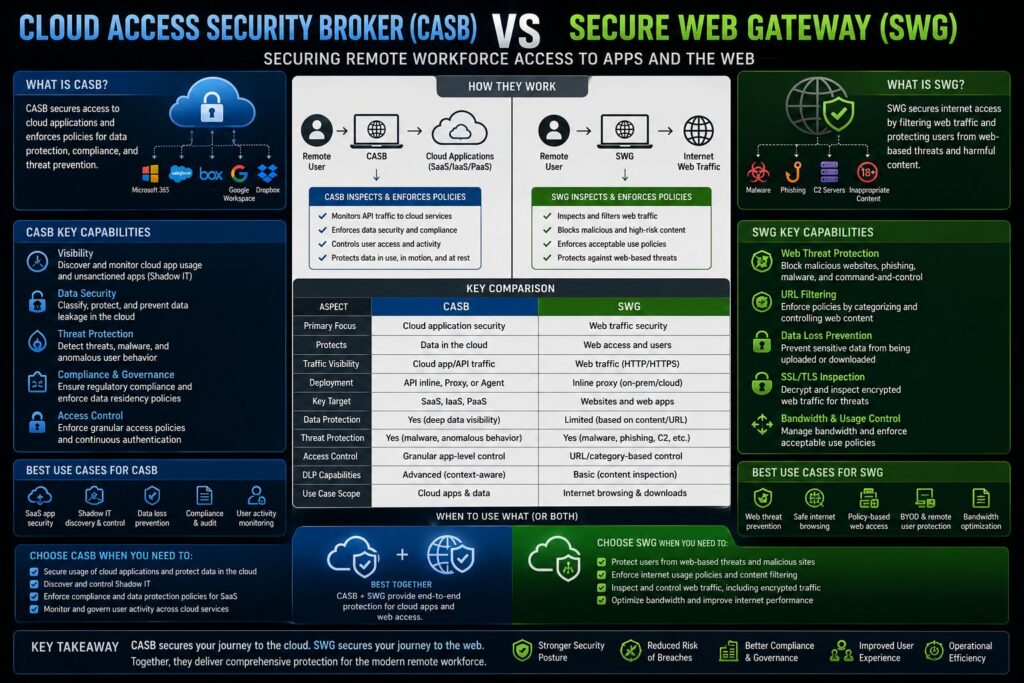
SWG and CASB are complementary tools that protect different layers of the modern IT environment. Understanding exactly where each one operates — and what it can and cannot do — is essential for building a security architecture that leaves no critical gaps.
Deployment Point: Internet Traffic vs. Cloud App Layer
An SWG deploys at the point where users connect to the internet. Every web request — whether it’s a Google search, a news site visit, or an attempt to download a file — passes through the SWG before reaching its destination. The SWG’s visibility is broad but relatively shallow: it sees all web traffic, but it doesn’t understand the internal context of specific cloud applications.
A CASB deploys specifically at the boundary between users and cloud services. It operates at the application layer, which means it understands not just that a user is connecting to Salesforce, but what they’re doing inside Salesforce — which records they’re accessing, whether they’re exporting bulk data, and whether their behavior matches their normal usage pattern. This depth of application-layer visibility is what makes CASB indispensable for organizations with significant SaaS footprints.
Threat Coverage: Phishing and Malware vs. Account Hijacking and Data Leaks
SWGs are purpose-built to stop web-based threats. Phishing pages, drive-by malware downloads, command-and-control callbacks from infected endpoints, and malicious redirects are all squarely within an SWG’s threat coverage. When an employee clicks a link in a phishing email that leads to a credential-harvesting page, the SWG is the tool most likely to catch and block that connection before damage occurs.
CASBs address a fundamentally different threat profile. The threats CASB is designed to catch — compromised cloud accounts, insider data theft, over-privileged third-party app integrations, and ransomware spreading through cloud file sync — happen inside authenticated cloud sessions that an SWG has no visibility into. Once a user is logged into Microsoft 365, everything they do within that application is encrypted, authenticated traffic that an SWG passes without inspection.
This is the critical gap that CASB fills. A threat actor who has compromised a legitimate user’s Office 365 credentials can operate entirely within authenticated cloud sessions, moving laterally, exfiltrating data, and establishing persistence — all without ever triggering an SWG alert. CASB’s behavioral analytics and anomaly detection are specifically designed to identify these types of insider and account compromise threats.
Compliance Role: Web Usage Policies vs. GDPR, HIPAA, and SAMA
SWGs support compliance primarily through web usage policy enforcement — blocking access to categories of websites that violate acceptable use policies, logging web activity for audit purposes, and preventing users from accessing known malicious or legally problematic content. This type of compliance is important, but it operates at a relatively coarse level of granularity.
CASB compliance capabilities go significantly deeper. Regulations like GDPR, HIPAA, and SAMA (Saudi Arabian Monetary Authority) impose specific requirements on how sensitive data — personal health information, financial records, personally identifiable information — is stored, accessed, and shared within cloud environments. CASB enforces these requirements at the data level, scanning cloud-stored files for regulated content, flagging policy violations, restricting sharing permissions, and generating the detailed audit trails that compliance frameworks require.
Where SWG and CASB Overlap
Despite their different deployment points and primary use cases, SWG and CASB share meaningful functional overlap — particularly in the areas of policy enforcement and data loss prevention. Understanding this overlap helps organizations avoid redundant configurations while ensuring the two tools reinforce rather than contradict each other.
Shared Policy Enforcement Across User Sessions
Both SWG and CASB enforce security policies against user activity in real time. An SWG enforces policies against web destinations and content types, while a CASB enforces policies against cloud application behaviors and data actions. When integrated within a SASE platform, these policies can be unified under a single management console, giving security teams a consistent policy framework that applies across web and cloud layers simultaneously — eliminating the inconsistencies that arise when managing two completely separate policy engines.
Data Loss Prevention Capabilities in Both Tools
DLP functionality appears in both SWG and CASB, but with different scopes. An SWG’s DLP capabilities focus on detecting and blocking sensitive data from being uploaded to arbitrary web destinations — preventing an employee from pasting credit card numbers into a web form on an untrusted site, for example. This is effective for web-based data exfiltration attempts but has no visibility into what happens within cloud applications themselves.
CASB’s DLP capabilities extend into the cloud application layer, scanning files stored in SharePoint, Google Drive, Box, and similar platforms for sensitive content — even content that was uploaded before the CASB was deployed. This retroactive scanning capability is something SWG DLP simply cannot provide. Used together, the two tools create a DLP coverage model that addresses data in motion across the web and data at rest and in motion within cloud services. For more insights into security orchestration platforms, explore our detailed comparison review.
How to Choose Between SWG and CASB for Remote Teams
The honest answer for most organizations is that the choice isn’t really between one or the other — but when budget, resources, or deployment timelines require prioritization, the decision framework comes down to where your most significant risk exposure actually lives. For more insights on security architecture, you might consider reading this Zero Trust Network Perimeter Security Architecture Comparison Guide.
Choose SWG If Web-Based Threats Are Your Primary Risk
If your organization has a relatively limited cloud application footprint — primarily using on-premise systems with some basic SaaS tools — and your biggest security concerns are phishing attacks, malware downloads, and web-based data exfiltration, an SWG should be your first priority. It delivers immediate, broad protection for all internet-bound traffic without requiring deep integration with individual cloud applications.
SWG is also the right starting point if your workforce regularly accesses high-risk websites as part of their work — research teams, legal departments doing case research, or marketing teams monitoring competitive landscapes. Industries and scenarios where SWG delivers the clearest immediate value include:
- Organizations with a largely on-premise application environment transitioning to cloud
- Sectors with high web-based threat exposure, such as financial services, legal, and media
- Remote teams where endpoint security is inconsistent and web browsing behavior is uncontrolled
- Organizations that have experienced phishing-driven breaches and need immediate protective coverage
- Businesses operating in regions with high rates of web-delivered malware and nation-state threat activity
A cloud-delivered SWG can typically be deployed and enforcing policy across a fully remote workforce within days, not months. Solutions like Zscaler Internet Access, Cisco Umbrella, and Palo Alto Networks Prisma Access include robust SWG capabilities that scale to enterprise environments without requiring hardware at each location.
The key limitation to keep in mind is that an SWG won’t give you any visibility or control over what happens inside your cloud applications once users are authenticated. If a compromised account starts bulk-downloading records from your CRM, an SWG will see the HTTPS traffic to Salesforce.com — but it won’t understand what’s happening at the application layer. That’s where CASB becomes non-negotiable.
Choose CASB If SaaS Adoption and Cloud Data Exposure Are Your Concern
If your organization has already made significant investments in cloud applications — Microsoft 365, Google Workspace, Salesforce, ServiceNow, AWS, or any combination of enterprise SaaS platforms — and you’re concerned about data governance, regulatory compliance, insider threats, or shadow IT, CASB should be your priority. The security risks that emerge from heavy cloud adoption are fundamentally different from web-based threats, and they require a tool specifically designed to address them.
Healthcare organizations handling PHI in cloud-based EHR systems, financial institutions managing customer data across multiple SaaS platforms, and any organization subject to GDPR or similar data protection regulations will find that CASB’s compliance and DLP capabilities address requirements that no other security tool in the stack can fulfill. The visibility CASB provides into cloud application usage — who accessed what, when, from which device, and what they did with it — is irreplaceable from both a security and a regulatory standpoint.
How Company Size and Cloud Maturity Affect the Decision
Smaller organizations with lean IT teams and limited budgets often ask whether they need both tools or whether one can cover enough ground on its own. The answer depends heavily on cloud maturity — meaning how deeply the organization has integrated SaaS and cloud infrastructure into its daily operations. A 50-person company using primarily on-premise systems with basic email and file sharing has a very different risk profile than a 50-person company running its entire operation across AWS, Salesforce, Slack, and Google Workspace.
For larger enterprises, the question shifts from “which one” to “how do we integrate them effectively.” Organizations with hundreds or thousands of remote employees, complex multi-cloud environments, and strict regulatory requirements almost always need both SWG and CASB working in concert. The operational complexity of managing two separate security layers is significantly reduced when both are deployed within a unified SASE platform — where a single management console, shared policy engine, and unified logging infrastructure eliminate the duplication of effort that comes from managing standalone point solutions.
Why Most Remote-First Organizations Need Both
The simplest way to understand why remote-first organizations need both tools is to think about the two distinct threat surfaces that remote work creates. The first is the open internet — every website, every web application, every download and upload that employees interact with outside of managed cloud platforms. The second is the cloud application layer — every SaaS platform, every file stored in the cloud, every user session inside Microsoft 365 or Salesforce or Google Drive. An SWG secures the first surface. A CASB secures the second. Running one without the other leaves an entire threat surface unprotected.
How SWG and CASB Work Together Inside a SASE Framework
Within a SASE architecture, SWG and CASB are not competing tools — they are complementary layers in a unified security stack. SASE converges wide-area networking and security functions into a single cloud-delivered service, and both SWG and CASB are core components of that convergence. When a remote employee initiates any kind of network activity, SASE routes that traffic through multiple inspection layers simultaneously: the SWG evaluates the web destination, the CASB evaluates any cloud application context, and Zero Trust Network Access (ZTNA) controls whether the user has the right to make that connection in the first place.
Leading SASE platforms — including Zscaler Zero Trust Exchange, Palo Alto Networks Prisma Access, and Netskope Security Cloud — package SWG and CASB functionality together within a single platform. This integration means that a single policy decision can incorporate web threat intelligence from the SWG layer and cloud application context from the CASB layer simultaneously. A user attempting to download a file from an unsanctioned cloud storage service, for example, triggers both SWG URL filtering and CASB application control in a coordinated response — something that two disconnected point solutions would struggle to achieve with the same speed and coherence.
Layered Defense: Stopping Threats at the Web and Cloud Layer Simultaneously
The real security value of combining SWG and CASB is the creation of overlapping defense layers that force attackers to defeat multiple independent controls to succeed. A phishing attack that bypasses endpoint detection still hits the SWG’s URL filtering. Malware that evades the SWG’s signature-based detection may trigger the CASB’s behavioral anomaly detection when it begins attempting to exfiltrate data through a cloud application. Compromised credentials that slip past multi-factor authentication still face CASB’s impossible travel detection and session risk scoring. Each layer catches what the others miss — which is the foundational principle of defense-in-depth security architecture.
SWG and CASB Together Are the New Security Perimeter
The corporate perimeter hasn’t disappeared — it has transformed. It now exists everywhere your users work and everywhere your data lives, enforced not by physical network boundaries but by intelligent, cloud-delivered security services that travel with the user. SWG and CASB, deployed together within a modern SASE framework, are the two most critical components of that new perimeter. SWG controls the internet access layer that remote employees depend on daily. CASB controls the cloud application layer where the organization’s most valuable data lives and moves. Neither tool is optional for any organization that takes remote work security seriously.
Organizations that continue to rely on legacy VPN and firewall architectures while operating cloud-first, remote-first work environments are not just accepting elevated risk — they are operating with a fundamental mismatch between their security tools and their actual IT environment. The organizations that will navigate the evolving threat landscape most effectively are those that recognize this mismatch early and invest in the security architecture that matches how their people actually work.
Frequently Asked Questions
The most common questions about SWG and CASB reflect the genuine complexity of choosing and deploying these tools in real-world remote work environments. Here are direct answers to the questions security and IT teams ask most frequently.
Is SWG or CASB better for a fully remote workforce?
Neither tool is universally “better” — they address different threat surfaces. For a fully remote workforce, both are necessary. SWG protects all internet-bound web traffic from any location, ensuring that employees working from home networks or public Wi-Fi are not exposed to phishing sites, malware downloads, or policy-violating web content. CASB protects the cloud applications that fully remote teams depend on entirely for collaboration, communication, and data storage.
If forced to prioritize one first, the decision comes down to where the most immediate risk lives. Organizations experiencing frequent phishing attacks or web-based malware incidents should deploy SWG first. Organizations dealing with shadow IT proliferation, cloud data governance failures, or regulatory compliance gaps in their SaaS environment should prioritize CASB. In either case, the second tool should follow as quickly as resources allow.
Can a CASB replace a Secure Web Gateway?
No. A CASB cannot replace an SWG because the two tools operate at different network layers and address fundamentally different threat categories. A CASB has no capability to inspect general web traffic, block access to malicious websites, perform SSL inspection on arbitrary internet connections, or enforce web browsing policies across all internet-bound traffic. It is purpose-built for cloud application security — not general internet security.
Conversely, an SWG cannot replace a CASB. An SWG has no visibility into what happens inside authenticated cloud application sessions, cannot enforce data handling policies within SaaS platforms, cannot detect compromised cloud accounts through behavioral analytics, and cannot perform retroactive DLP scanning of cloud-stored data. The two tools are complementary by design, not interchangeable.
Does SWG work without being part of a SASE platform?
Yes. SWG can be deployed as a standalone security solution, and many organizations do exactly that — particularly those in the early stages of modernizing their security stack. Cloud-delivered SWG solutions like Cisco Umbrella and Zscaler Internet Access function independently of a full SASE deployment and deliver meaningful protection for remote workers without requiring the full SASE architecture. However, standalone SWG deployments lack the deep integration with CASB, ZTNA, and SD-WAN components that SASE provides, which means more management complexity and more potential gaps at the seams between tools as the security program matures.
What is the difference between CASB and DLP?
Capability CASB DLP Primary Focus Cloud application security, visibility, and control Preventing sensitive data from leaving controlled environments Deployment Scope Cloud services and SaaS platforms Endpoints, networks, email, cloud, and on-premise storage Data Scanning Scans cloud-stored and cloud-shared data as one of several functions Dedicated, deep content inspection across all data channels Threat Detection Yes — account compromise, insider threats, shadow IT Limited — focused on data movement, not behavioral threats Compliance Reporting Cloud-focused compliance reporting and audit trails Broad compliance coverage across all data environments Retroactive Scanning Yes — can scan existing cloud-stored data via API Depends on deployment mode and platform
CASB and DLP are related but distinct. DLP is a dedicated data protection discipline — a set of technologies and policies specifically designed to detect and prevent the unauthorized movement of sensitive data. CASB is a broader cloud security platform that includes DLP as one of its four core pillars, alongside visibility, compliance, and threat protection. In other words, every enterprise CASB has DLP capabilities built in, but a standalone DLP solution is not a CASB.
The practical implication is that organizations already running a mature enterprise DLP program — using solutions like Symantec DLP or Forcepoint DLP — will find that CASB’s built-in DLP capabilities may overlap with their existing tooling. In these cases, the best approach is typically to integrate the CASB with the existing DLP platform so that policies defined once are enforced consistently across both environments, rather than maintaining two separate sets of DLP rules that may conflict or create gaps. For more insights on cybersecurity strategies, consider exploring the comparison between cloud security solutions and on-premise cybersecurity infrastructure.
For organizations without a dedicated DLP program, CASB’s built-in DLP capabilities often provide sufficient coverage for cloud environments — particularly when combined with the SWG’s DLP capabilities for web-channel data protection. The combination of SWG DLP and CASB DLP covers the two channels — web uploads and cloud application transfers — through which the majority of remote workforce data exfiltration occurs. For more insights on securing modern businesses, check out this comparison of cloud security solutions.
Do small businesses need both SWG and CASB, or just one?
Small businesses are not immune to the threats that SWG and CASB are designed to address — in fact, they are frequently targeted precisely because attackers assume smaller organizations have weaker defenses. The question is how to get the most security value from limited resources, and the answer depends on the specific cloud and web usage profile of the business.
A small business running most of its operations through Microsoft 365 or Google Workspace — which describes the majority of small businesses today — has a significant cloud application attack surface that CASB is specifically designed to protect. Many Microsoft 365 Business Premium and Google Workspace Enterprise plans include basic CASB-like capabilities through Microsoft Defender for Cloud Apps and Google’s built-in security controls, which can provide meaningful protection without requiring a separate enterprise CASB investment. For web security, DNS-layer security solutions like Cisco Umbrella Essentials offer SWG-like protection at price points accessible to small businesses.
The most practical guidance for small businesses is to start with what their existing platforms already provide, identify the gaps, and layer in dedicated SWG or CASB tools to address those gaps specifically. Many modern SASE platforms offer SMB-tier pricing that bundles both SWG and CASB capabilities — making the “choose one” decision less relevant than it was when these tools were only available as expensive enterprise point solutions. The key is to take action rather than assume that small business status makes the organization a low-priority target — because the data strongly suggests otherwise.
For businesses looking to build a stronger cloud security posture across remote teams, working with a cybersecurity partner that specializes in modern cloud security architecture can accelerate the process of identifying gaps and deploying the right combination of SWG, CASB, and complementary tools for your specific environment.