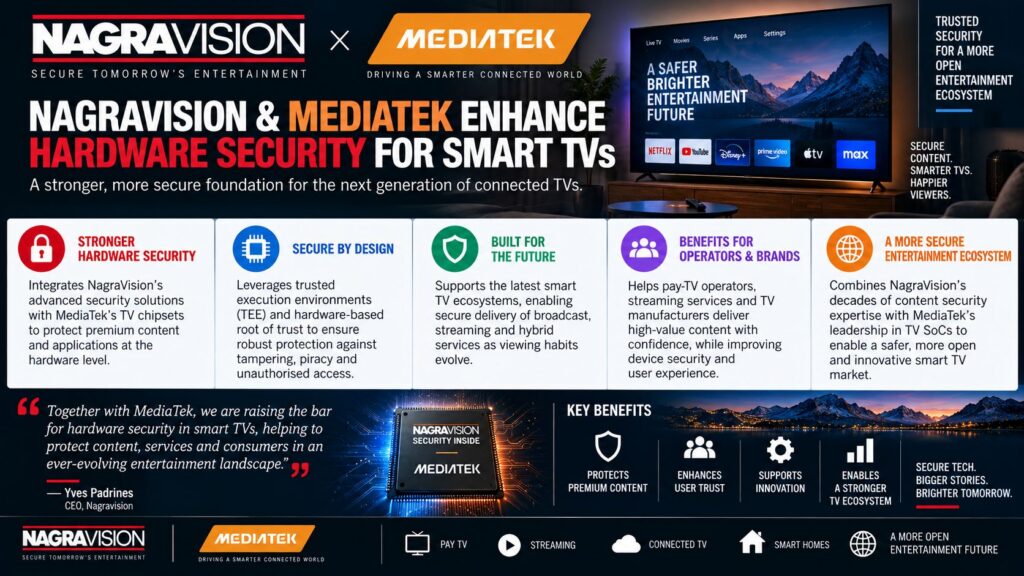
- NAGRAVISION and MediaTek have partnered to embed a secure hardware element directly into all future MediaTek TV System-on-Chips (SoCs), meaning security is baked into the silicon itself rather than patched on through software.
- This shift from software-only to hardware-anchored protection is a direct response to AI and quantum-era piracy threats that are already beginning to challenge existing content security models.
- Operators can now deliver broadcast-grade content protection through retail smart TVs — the same level previously only achievable with dedicated, hardware-secured set-top boxes.
- The partnership gives television manufacturers worldwide a single, consistent security foundation for both OTT streaming and traditional broadcast services, eliminating a long-standing gap in the protection chain.
- For everyday viewers, this means the TV you buy off the shelf could soon carry enterprise-level security without any extra hardware, subscriptions, or setup required — and there’s a bigger reason why this timing matters.
Hardware Security Just Got Built Into Your TV
Your smart TV is now a target, and the industry is finally responding at the hardware level.
NAGRAVISION, a division of the Kudelski Group and a longstanding name in content protection, has announced an extended partnership with MediaTek — one of the world’s leading semiconductor manufacturers — to embed a NAGRAVISION secure element directly into all future MediaTek TV System-on-Chips. This isn’t a software update or a firmware patch. It’s security built into the actual silicon that powers your television.
For those tracking developments in smart home security, NAGRAVISION has been at the forefront of building protection systems for the content distribution ecosystem. This latest move signals a major inflection point: the era of hardware-anchored TV security is no longer coming — it’s already in the pipeline.
What This Partnership Actually Means for Everyday Viewers
Until now, premium content protection on smart TVs has largely relied on software-based systems. These systems, while functional, carry an inherent vulnerability: software can be reverse-engineered, patched around, or exploited. The NAGRAVISION and MediaTek collaboration moves the security foundation into the chip itself, making it exponentially harder to compromise.
What this means practically is that a television purchased from a retail store will carry the same broadcast-grade content protection previously reserved for dedicated set-top boxes provided directly by operators. That’s a meaningful shift — both for content providers worried about piracy and for consumers who benefit from a more secure viewing environment without needing any additional hardware.
Why This Announcement Matters Now
The timing is deliberate. Piracy tools are becoming more sophisticated, with AI-assisted attacks already beginning to challenge traditional protection methods. Quantum computing, while not yet mainstream, poses a credible future threat to encryption-based security systems. By embedding protection at the hardware level now, the industry is building a defense that’s designed to hold up against threats that are still emerging.
What NAGRAVISION and MediaTek Are Building Together
The agreement is straightforward in scope but significant in impact: the NAGRAVISION secure element will be included in every TV SoC on MediaTek’s future roadmap. MediaTek’s chips power televisions across a wide range of global manufacturers, which means this protection will have an enormous footprint almost immediately upon rollout.
As Sam Lee, General Manager of Smart Home BU at MediaTek, put it directly: “This agreement firmly places security in the silicon rather than it being added around it.” That framing is important. Adding security around a system is always weaker than building it into the foundation. The collaboration does exactly that.
The scope of what this partnership addresses is broad. It covers:
- OTT streaming services — protecting on-demand and live streaming content delivered over the internet
- Traditional broadcast services — elevating broadcast protection to a level previously only available through hardware-secured set-top boxes
- Global television manufacturers — providing a single, consistent security layer across all devices using MediaTek TV SoCs
- Operator cost structures — reducing per-household service costs by eliminating the need for separate secure hardware devices
- Future threat preparedness — building a security model capable of addressing AI and quantum-era attack vectors
The Secure Element Explained in Plain English
A secure element is a dedicated, tamper-resistant microchip designed to store sensitive data and execute security operations in an isolated environment. Think of it as a locked vault inside your chip — completely separate from the main processor, operating system, and any apps running on your TV. Even if malware compromises your TV’s software layer, it cannot access or manipulate what’s inside the secure element.
In the context of this partnership, the NAGRAVISION secure element handles cryptographic key storage, content decryption, and rights management — all within that protected environment. This is the same fundamental approach used in banking cards, SIM cards, and modern smartphone secure enclaves. Bringing it to TV chips is a significant upgrade for the entire connected TV ecosystem.
How It Gets Into Your TV: The SoC Integration
What is a System-on-Chip (SoC)?
A System-on-Chip is a single integrated circuit that combines a CPU, GPU, memory interfaces, and other processing components onto one chip. In smart TVs, the SoC is essentially the brain of the device — handling everything from video decoding to app processing to network connectivity. By embedding a secure element directly into this chip, NAGRAVISION and MediaTek ensure that security isn’t an add-on — it’s a core component of the television’s fundamental architecture.
Integrating the secure element at the SoC level means it is physically part of the chip that manufacturers install during production. There’s no secondary module to add, no software license to activate, and no separate hardware for operators to provision. From the moment a TV ships from the factory with a MediaTek SoC, the security foundation is already in place.
This approach also standardizes protection across the board. Stéphane Le Dreau, SVP Product Management & Sales Development at NAGRAVISION, noted that operators can now count on “a single level of protection for broadcast and streaming content alike, and on a security model built to answer threats that are only just starting to be defined.” That standardization is critical for operators managing content distribution across thousands or millions of devices simultaneously.
From a manufacturing perspective, this integration simplifies the supply chain for TV makers. Instead of sourcing and integrating separate security modules — which adds cost and complexity — manufacturers get a complete, secure platform directly from the SoC. The result is faster time-to-market, lower production costs, and a more reliable security implementation.
Which TVs Will Have This Protection
The NAGRAVISION secure element will be embedded across all future TV SoCs on MediaTek’s product roadmap. Since MediaTek supplies chipsets to television manufacturers worldwide, this means the protection will extend across a wide range of brands and price points globally — not limited to premium models or specific regional markets. For those interested in the broader implications of cybersecurity in the tech industry, the GISEC Global 2026 event highlights new digital security orders.
Why Software Alone Can No Longer Protect Premium Content
How Pirates Currently Exploit Software-Only Security
Software-based content protection systems work by encrypting content and storing decryption keys within the TV’s operating environment. The fundamental weakness is that this environment is accessible. A determined attacker with the right tools can extract keys from memory, intercept decrypted streams before they reach the display, or reverse-engineer the software to find exploitable gaps. Once a single device is cracked, the method can be replicated across millions of identical devices running the same software. For more insights into how these vulnerabilities are tested, explore different cybersecurity testing methods.
This is not theoretical. Tools that strip DRM protection from streaming content are widely available online, and piracy networks actively invest in breaking new protection schemes shortly after deployment. Software patches can temporarily close vulnerabilities, but the cycle repeats — attackers find new entry points, operators patch, attackers adapt. It’s a war of attrition that software alone is structurally ill-equipped to win long-term.
The Hardware Advantage: Why Moving Security Into the Chip Changes Everything
When cryptographic keys and security operations live inside a physically isolated secure element, the attack surface shrinks dramatically. There is no software pathway to the protected environment, no memory address to probe, and no operating system call that can reach inside the vault. An attacker would need physical access to the chip itself and highly specialized equipment to even attempt an intrusion — a barrier that eliminates the vast majority of piracy operations that rely on scalable, remote exploitation techniques.
AI and Quantum Threats Are Already on the Horizon
The content security landscape is shifting faster than most people realize. For years, the primary threat model was organized piracy rings using known software exploits. That threat hasn’t gone away, but it’s being joined by something more sophisticated: AI-assisted attacks capable of automating vulnerability discovery at a scale and speed no human team can match.
At the same time, quantum computing is moving from theoretical research into early practical development. While a cryptographically relevant quantum computer doesn’t exist yet, the timeline is compressing. Security architects designing systems today need to account for a world where current encryption standards could be broken — because the infrastructure being deployed now will still be running when that capability arrives.
This is precisely why NAGRAVISION’s framing of their secure element as a solution “built to answer threats that are only just starting to be defined” is more than marketing language. It reflects a genuine engineering requirement: the security model embedded in these chips needs a lifespan measured in decades, not software update cycles.
How AI Is Being Used to Break Content Protection
AI is fundamentally changing the economics of piracy. Tasks that previously required skilled reverse engineers working manually for weeks can now be partially automated using machine learning models trained on known vulnerabilities and protection patterns. This dramatically lowers the barrier to entry for sophisticated attacks.
AI-assisted tools are being used to analyze encrypted traffic patterns, identify timing side-channels in software security implementations, and generate attack variations faster than human analysts can review them. In a software-only security environment, the speed advantage increasingly favors the attacker.
The implications for content owners are significant. A streaming service investing in exclusive sports rights or original programming faces real financial exposure when protection systems can be systematically probed and broken by automated tools. Hardware-level security changes the equation because AI cannot remotely access what is physically isolated inside a chip.
- Automated vulnerability scanning — AI tools rapidly identify exploitable gaps in software DRM implementations across multiple platforms simultaneously
- Side-channel analysis — Machine learning models detect subtle patterns in power consumption and timing to infer cryptographic secrets from software implementations
- Traffic interception at scale — Automated systems capture and analyze decrypted content streams before re-encryption at the display layer
- Credential stuffing and account sharing exploitation — AI-driven bots systematically test stolen credentials to access premium content through legitimate accounts
- Deepfake watermark removal — Emerging AI techniques target forensic watermarks used to trace pirated content back to its source
Why Quantum Computing Poses a Future Risk to Streaming Security
Most content protection systems today rely on encryption algorithms — RSA, ECC, and AES being the most common — that are computationally impractical to break with classical computers. Quantum computers, using algorithms like Shor’s algorithm, could theoretically break RSA and ECC encryption exponentially faster than any classical machine. For AES, the threat is less immediate but still requires larger key sizes to maintain equivalent security.
The practical concern isn’t just about future attacks on future content. It’s about a strategy known as “harvest now, decrypt later” — where adversaries capture and store encrypted content today with the intention of decrypting it once quantum capability is available. For long-lived content libraries and ongoing premium services, this is a credible threat that forward-looking security architectures need to address now.
Quantum Threat Timeline vs. Security Response
Current State: RSA and ECC encryption secure against classical computers — software DRM operates on this assumption
Near-Term Risk: AI-assisted attacks accelerate vulnerability discovery in software security layers — hardware isolation becomes critical
Mid-Term Risk: Early quantum systems begin threatening specific encryption implementations — post-quantum cryptography standards become mandatory
Long-Term Risk: Cryptographically relevant quantum computers capable of breaking current standards — only hardware-anchored, post-quantum-ready systems remain secure
NAGRAVISION/MediaTek Response: Secure element embedded in SoC designed to accommodate post-quantum cryptographic updates at the hardware level
Building a secure element into the SoC now creates the physical foundation needed to support post-quantum cryptographic algorithms as they are standardized and deployed. A software-only system would require a complete architectural overhaul. A hardware-anchored system can be updated at the algorithm level while the secure physical environment remains intact — a critical design advantage when planning for a decade-long deployment lifecycle.
How Hardware-Anchored Security Addresses These Threats
The NAGRAVISION secure element provides a physically isolated execution environment that neither AI-assisted remote attacks nor future quantum-enabled decryption can easily penetrate. Cryptographic operations happen inside the element with no external access to keys or intermediate states, eliminating the side-channel and memory-extraction vectors that AI tools currently exploit. And because the secure element can be updated to support new cryptographic standards — including post-quantum algorithms — without replacing the physical chip, it provides a durable security foundation designed to outlast the threat landscape it was built to counter.
What This Means for Operators, Broadcasters, and Streaming Services
For content operators, this partnership solves a problem that has frustrated the industry for years: how to deliver broadcast-grade security through retail consumer devices without the cost and logistics of provisioning dedicated hardware to every household. The traditional solution was the set-top box — a controlled, hardware-secured device that the operator owns and manages. But as smart TVs have become the primary streaming device in most homes, that model has been showing its age.
Broadcast-Grade Protection Delivered Through Retail TVs
Until this point, the security gap between a hardware-secured operator set-top box and a retail smart TV was substantial. Set-top boxes carried secure elements and hardware-level content protection as standard. Retail TVs relied primarily on software DRM systems like Widevine or PlayReady — effective for standard content tiers, but not meeting the security requirements that premium sports rights holders and major studios increasingly demand for their most valuable content. The NAGRAVISION and MediaTek integration closes that gap directly, bringing the same class of hardware-anchored protection to retail televisions that operators previously could only guarantee through their own managed hardware.
Lower Costs Per Household Without Sacrificing Security
Deploying hardware security through retail TVs rather than operator-managed set-top boxes has a direct impact on cost structures. When an operator provisions a set-top box to a household, they absorb the hardware cost, logistics, installation, and ongoing maintenance of that device. With the NAGRAVISION secure element embedded in retail TV SoCs, the hardware security layer ships with the television itself — funded through the consumer purchase rather than the operator’s deployment budget. Stéphane Le Dreau confirmed this explicitly, noting that the model “lowers household service costs” while maintaining premium-level protection across both broadcast and streaming content.
This cost efficiency doesn’t come at the expense of protection quality. The secure element embedded in MediaTek’s TV SoCs delivers the same class of hardware-anchored content security that operators previously only trusted to their own managed hardware. For operators managing millions of subscribers, the per-household savings compound significantly — and those savings can be redirected toward content acquisition, service improvements, or competitive pricing for end users.
What This Means for You as a Consumer
If you’re buying a smart TV in the coming years, the presence of a MediaTek SoC with the embedded NAGRAVISION secure element means the device has a level of built-in content protection that simply didn’t exist in retail televisions before. You won’t see it in the spec sheet or a feature callout on the box — it operates silently in the background — but its presence has real implications for what services you can access, how reliably premium content is protected, and how future-proof your device’s security architecture is.
For streaming subscribers, better hardware security at the device level means content providers can offer higher-tier content — premium sports, live events, 4K HDR exclusives — with greater confidence that it won’t be compromised. That confidence directly influences what gets offered on retail TV platforms versus locked behind operator-provisioned hardware. In practical terms, the gap between what you can watch on a retail smart TV versus a managed set-top box is set to narrow considerably as this technology rolls out.
Frequently Asked Questions
Here are the most common questions about hardware security in smart TVs and what the NAGRAVISION and MediaTek partnership actually means in practice.
What is a secure element in a smart TV?
A secure element is a tamper-resistant microchip embedded within the television’s System-on-Chip that operates as a physically isolated security environment. It stores cryptographic keys, manages content decryption, and handles digital rights management operations completely separately from the TV’s main processor and operating system.
Because it is physically isolated, the secure element cannot be accessed by software running on the TV — including malware, compromised apps, or exploited operating system vulnerabilities. This is fundamentally different from software-based security systems, where keys and decryption operations exist within a memory space that a sufficiently sophisticated attack can reach.
Does this affect the smart TVs already in homes today?
The NAGRAVISION secure element integration applies to future MediaTek TV SoCs — meaning televisions currently in homes are not affected by this specific partnership announcement. Existing smart TVs will continue operating with whatever security architecture they shipped with, which in most cases means software-based DRM systems like Widevine or PlayReady.
This doesn’t mean existing TVs are immediately at risk, but it does mean they lack the hardware-level isolation that future devices will carry. As premium content providers raise their security requirements over time, older devices may face limitations on the tiers of content they can access — a pattern already familiar to anyone who has noticed older streaming devices losing support for higher-quality content tiers.
Will this hardware security slow down my smart TV?
No. The secure element operates as a dedicated, independent component within the SoC. It handles its specific security functions — key storage, cryptographic operations, rights management — without competing with the main processor for resources. Because these tasks are offloaded to the secure element rather than handled by the CPU, hardware security can actually improve overall system performance compared to software DRM implementations that consume main processor cycles.
How is hardware security different from software DRM like Widevine?
Widevine and similar software DRM systems like PlayReady protect content through encryption and software-enforced access controls running within the TV’s operating environment. They are effective for standard content tiers, but they operate in a shared software environment that is theoretically accessible to sophisticated attackers. Widevine’s security levels range from L1 (hardware-backed, required for 1080p and 4K protected content) to L3 (software-only), and many smart TVs ship without true L1 hardware backing. The NAGRAVISION secure element operates at the physical hardware layer — completely outside the software environment — providing a level of isolation and tamper resistance that software DRM cannot replicate, and meeting the security bar required for the most premium content categories that rights holders are increasingly demanding.
What is a TV System-on-Chip and why does it matter for security?
A TV System-on-Chip is a single integrated circuit that combines the central processor, graphics processor, memory interfaces, video decoding engines, and connectivity components that run your smart TV. Essentially, it is the complete computing brain of the television on a single piece of silicon. MediaTek is one of the largest suppliers of TV SoCs globally, with their chips powering televisions across a wide range of brands and price points worldwide.
Security matters at the SoC level because the chip is the foundation everything else runs on. If security is embedded in the SoC itself — rather than implemented in software that runs on top of the chip — it becomes part of the physical architecture of the device. There is no software layer between an attacker and the chip that can be bypassed, and the secure element’s isolation is enforced by physics and manufacturing, not code.
By embedding the NAGRAVISION secure element across all future MediaTek TV SoCs, the partnership ensures that hardware-level content protection becomes a baseline feature of every television built on this platform — regardless of brand, price tier, or regional market. That global standardization is ultimately what makes this announcement significant for the entire connected TV ecosystem, and for anyone who wants their television to remain capable of accessing premium content well into the future. If you’re looking to stay ahead of smart TV security developments, NAGRAVISION continues to lead the industry in building the protection infrastructure that keeps connected entertainment secure.