Summary
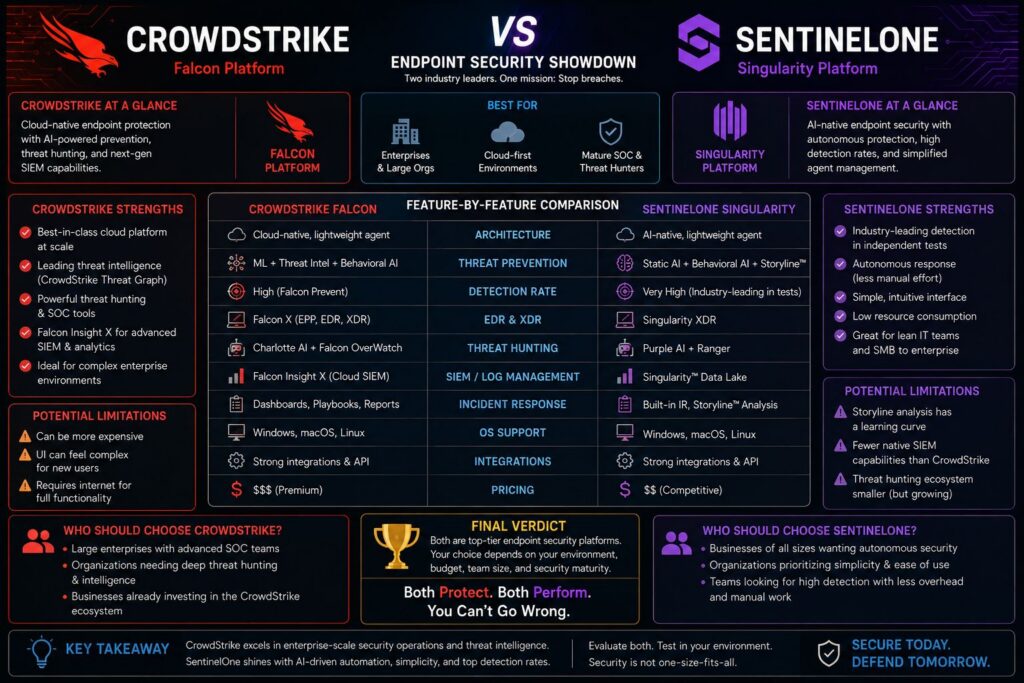
- Both CrowdStrike Falcon and SentinelOne have similar detection rates (4.7/5 stars), but their methods of endpoint security are quite different
- CrowdStrike is superior when it comes to cloud-based threat intelligence and visibility across environments, while SentinelOne has strong on-premises solutions with self-remediation
- SentinelOne’s rollback capabilities offer unique system recovery options that many companies find useful for recovering from ransomware
- The impact on performance varies between platforms, with SentinelOne potentially offering benefits for companies with older systems
- The size of your company, current infrastructure, and specific threat concerns should guide your choice of endpoint security platform
The endpoint security landscape has never been more competitive or more important. With the rapid evolution of cyber threats, choosing the right protection platform can be the difference between business as usual and a devastating breach. CrowdStrike and SentinelOne have emerged as leaders in the industry, each with a unique approach to endpoint protection. Cybersecurity experts at Exabeam point out that while both platforms offer strong protection, understanding their architectural and philosophical differences is key to making an informed choice.
The Clash of Endpoint Security Titans: What You Should Understand
Modern endpoint security solutions are expected to do much more than traditional antivirus ever could. Contemporary platforms meld prevention, detection, response, and hunting capabilities into increasingly complex packages. Both CrowdStrike Falcon and SentinelOne Singularity have made impressive market strides, each earning 4.7-star ratings from thousands of validated users. However, their methods of addressing the endpoint security challenge differ in significant ways that affect implementation, management, and effectiveness in different environments.
Choosing security tools has become more complicated for organizations that need to safeguard a variety of environments, including traditional offices, remote work arrangements, cloud infrastructure, and hybrid deployments. The best choice isn’t just about features and capabilities; it’s about how well the architecture of each platform fits your organization’s security strategy, technical environment, and operational needs.
Comparing Detection Accuracy
In terms of detection capabilities, both platforms have shown to perform at a high level in independent testing. CrowdStrike Falcon uses its cloud-native architecture and extensive threat intelligence network to identify threats across customer environments. This method provides the benefit of numbers, with each new threat detected anywhere improving protection everywhere. SentinelOne, on the other hand, uses an autonomous approach, with AI-driven detection that operates independently at each endpoint, making real-time decisions without needing constant cloud connectivity.
SE Labs recent assessments show that both platforms have high detection and prevention rates against real-world threats. They test security products against the same attacks that criminals and nation-states use, which gives valuable information about real-world performance. Both CrowdStrike and SentinelOne are often top performers, though one platform may have a slight advantage over the other in specific attack scenarios during certain test rounds.
Installation Requirements
When it comes to the installation process, these two platforms couldn’t be more different. CrowdStrike Falcon has adopted a cloud-based approach, meaning it uses lightweight agents that connect to CrowdStrike’s security cloud. This setup reduces the need for on-site infrastructure but does require a reliable internet connection to work properly. This cloud-based approach also makes it easier to quickly install the platform across a large organization and makes updates and management a breeze.
SentinelOne provides a wider range of deployment options, such as fully on-premises setups that can work well even when internet access is inconsistent or unreliable. This deployment versatility could make SentinelOne a better fit for companies with stringent data sovereignty needs or those working in settings where connectivity is not always assured. However, this versatility might require more administrative effort than CrowdStrike’s more simplified cloud-based method.
Integration Abilities of the Platforms
Today’s security needs call for unified defense mechanisms, not standalone point solutions. Both CrowdStrike and SentinelOne understand this and provide broad integration abilities, although they use different methods. CrowdStrike has created a strong marketplace and partner ecosystem that lets businesses expand the platform’s abilities through pre-made integrations with other security tools. They use an API-first method to enable custom integrations when necessary, but their main focus is still on their cloud platform.
SentinelOne focuses on adaptability in its integration strategy, providing support for both cloud-based and on-site security stacks. This could be particularly useful for businesses with substantial investments in current security infrastructure that can’t be easily replaced or moved to the cloud. Both platforms provide SIEM integrations, threat intelligence sharing, and automation features, although specific integration requirements should be thoroughly assessed against each vendor’s existing products and future plans.
Key Protective Features Compared
Both platforms offer multiple levels of protection against a variety of threats. These levels often include signature-based detection, machine learning, behavior analysis, and exploit prevention. Although the promotional materials of both vendors emphasize their unique strategies, the basic protective mechanisms are very similar. The main differences lie in the details of implementation, management interfaces, and the importance of each level in the overall security strategy.
Malware Prevention Technology
Both platforms use advanced malware prevention techniques that are much more sophisticated than traditional signature-based detection. CrowdStrike Falcon uses machine learning algorithms that have been trained on their large threat database. This allows it to identify and block malware based on the characteristics of the file, even if there is no exact signature match. This cloud-based approach allows for quick updates to detection capabilities on all protected endpoints at the same time. This provides a significant advantage in dealing with emerging threats.
Defending Against Ransomware
As ransomware continues to be one of the most destructive threats to organizations, it is vital to have specialized protective measures in place. SentinelOne’s ransomware defense focuses on behavioral detection and autonomous responses, enabling it to detect encryption activities and respond immediately without the need for human involvement. A noteworthy feature of SentinelOne is its ability to rollback, which can automatically revert affected files back to their state before encryption in many ransomware situations.
CrowdStrike provides ransomware protection by using its behavioral protection capabilities and uses specialized ransomware detection logic based on patterns observed across its customer base. Its threat hunting services provide an additional layer of human expertise to identify potential ransomware campaigns before they fully execute. Both platforms perform well against common ransomware variants, though organizations with particular concerns about ransomware should evaluate each solution’s specific capabilities against their risk profile. For example, AI data centres are increasingly being leveraged to enhance cybersecurity measures.
- File-based ransomware detection through machine learning and behavioral analysis
- Fileless attack detection through memory scanning and behavioral monitoring
- Pre-execution prevention to block ransomware before it can start encrypting files
- Automated remediation to restore systems to clean states after detection
Zero-Day Threat Defense
Zero-day threats—those exploiting previously unknown vulnerabilities—represent some of the most challenging security problems. Both CrowdStrike and SentinelOne have invested heavily in capabilities designed to detect and prevent such attacks without relying on prior knowledge of the specific vulnerability being exploited. CrowdStrike leverages its cloud intelligence and cross-customer visibility to identify anomalous behaviors that may indicate zero-day exploitation, even when the specific vulnerability remains unknown.
SentinelOne’s Independent AI Engine
SentinelOne’s strategy is based on its proprietary Behavioral AI engine that runs separately on each endpoint. This independent framework allows for detection and correction even when endpoints are offline or have poor connectivity. Each agent has the complete set of AI models, allowing it to make complex security decisions without depending on cloud lookups for every analysis. This framework is especially beneficial for organizations with dispersed workforces or locations with unstable internet connectivity.
There are also benefits to the autonomous method in terms of response time, as containment and remediation measures can be initiated right away at the endpoint. When threats are detected, SentinelOne’s agents can respond within seconds, potentially preventing attacks from spreading across the network. This distributed intelligence model is a fundamentally different approach than CrowdStrike’s more centralized, cloud-dependent model.
Both platforms use artificial intelligence and machine learning, but SentinelOne focuses more on endpoint autonomy, while CrowdStrike uses collective intelligence across all of its customers. Neither approach is inherently better—it all depends on the specific needs and infrastructure realities of your organization.
How Machine Learning is Used
Machine learning is a feature of both platforms, but they use it differently. CrowdStrike uses several machine learning engines that work both in the cloud and on endpoints. The cloud-based models are updated regularly with new threat intelligence. This method allows for quick adaptation to new threats, but may be limited if the cloud connection is lost.
Methods for Analyzing Behavior
Behavioral analysis is a crucial tool for discovering advanced attacks that manage to slip past conventional methods. CrowdStrike uses its cloud platform to conduct behavioral analysis, which allows it to identify patterns across many organizations. This makes it possible to detect coordinated campaigns or new techniques. When suspicious behaviors are spotted in one environment, protection can be rapidly expanded to all customers.
SentinelOne specializes in thorough process inspection at the endpoint level, keeping an eye on system calls, memory access, and other basic operations to detect harmful behaviors. Its StoryClineTM feature can automatically rebuild attack sequences, providing crucial context for security teams attempting to comprehend complicated incidents. Both methods provide robust protection, but they reveal each firm’s basic architectural decisions. For insights into how companies are leveraging technology to enhance their operations, read about why Wall Street expects AI to power stocks higher.
Tools for Responding to and Remedying Incidents
If prevention doesn’t work, the ability to respond is crucial. Both platforms provide tools for responding to incidents, but they focus on different areas and offer different capabilities. These differences could greatly affect how quickly an organization can contain and remedy incidents, especially in complex enterprise environments with thousands of endpoints.
The best response capabilities strike a balance between automation and human control, offering instant protection while also providing security teams with the flexibility to handle complex scenarios. Organizations should consider not only the technical capabilities but also how these tools fit with their security team structure and incident response processes.
Modern security tools are becoming more and more automated. CrowdStrike offers automated responses that you can configure to specific threats and levels of severity. These automations can isolate endpoints that are infected, terminate processes that are malicious, and prevent lateral movement. The platform’s Real-Time Response capabilities allow security teams to script custom remediation actions that can be deployed across the environment.
With its Storyline Active Response (STAR) technology, SentinelOne takes automation to the next level by automatically reversing harmful changes, restoring encrypted files, and removing persistence mechanisms. This method reduces the need for manual intervention in many common attack scenarios, potentially lowering incident response costs and reducing the average time to remediation. For more insights on how technology is advancing, check out how Nvidia’s Spectrum-X is boosting AI data centers.
With every update, both companies continue to develop their automation features. However, SentinelOne currently offers more comprehensive self-remediation features, while CrowdStrike provides more detailed control over response actions.
The Rollback Feature of SentinelOne
SentinelOne stands out with its rollback feature that can bring systems back to their pre-attack condition without needing a full reimage. This feature uses continuous system monitoring to keep track of changes made by applications and processes. If it detects harmful activity, SentinelOne can automatically bring back affected files and registry keys to their previous condition, effectively reversing the damage from malware including ransomware.
Real-Time Response from CrowdStrike
| Feature | Capability | Benefit |
|---|---|---|
| Remote Shell | Command execution on remote endpoints in a secure manner | No physical access required for investigation |
| Real-Time Response Scripts | Deployment of custom Python and PowerShell scripts | Remediation tailored for specific threats |
| File Operations | Remote retrieval, deletion, or quarantine of files | Removal of malware and collection of evidence |
| Network Containment | Endpoint isolation while retaining management access | Prevention of lateral movement while remediation is enabled |
The Real-Time Response capabilities of CrowdStrike equip security teams with a potent toolkit for remediation and incident investigation. The platform lets analysts set up secure remote shells to endpoints that are affected, run scripts, execute commands, and gather forensic evidence without needing physical access to the device. These capabilities are especially useful for organizations with remote offices or distributed workforces.
Security orchestration platforms can be integrated with the Real-Time Response API, enabling organizations to create automated workflows that utilize CrowdStrike’s remediation abilities. This approach provides flexibility for security teams that need to tailor their response procedures to specific threats or compliance needs. For more insights on cloud infrastructure, read about Netflix’s $1B virtual infrastructure.
SentinelOne has more automatic fixes, while CrowdStrike has more comprehensive tools for manual investigation and custom response actions. Organizations with advanced security teams may prefer CrowdStrike’s approach, while those with limited security resources may benefit more from SentinelOne’s automation.
Active Threat Containment Choices
Both platforms have the ability to contain network threats, which helps to isolate compromised endpoints and stop lateral movement during active attacks. CrowdStrike’s network containment allows for management communication while blocking all other traffic, which means that security teams can continue to investigate and remediate activities on isolated endpoints. SentinelOne offers similar features, with options for full isolation or selective containment that allows for specified network connections.
User Interface and User Experience
The user interface is the main point of contact between security teams and their endpoint protection platform. A user-friendly, efficient interface can greatly improve security results by reducing alert fatigue, speeding up investigations, and making management tasks easier. Both CrowdStrike and SentinelOne have put a lot of resources into their user interfaces, although they reflect different design philosophies and priorities.
As security teams grapple with escalating alert volumes and increasing complexity, the usability of the console becomes even more critical. The best interface strikes a balance between providing comprehensive information and clarity, enabling analysts to quickly pinpoint critical issues while also providing the detailed data necessary for a thorough investigation. For instance, companies that continue to excel in crushing their earnings often rely on effective security interfaces to maintain their competitive edge.
Impact on System Performance and Requirements
Endpoint protection shouldn’t come at the expense of system performance. Both vendors promise a low impact on performance, but the actual impact can differ depending on the specifics of the environment. Businesses need to test the performance across a range of hardware configurations, especially for endpoints with fewer resources or for important production workloads where any delay could affect operations. For insights on how cloud infrastructure can support these needs, explore how Nutanix Cloud Clusters on OVHcloud can be leveraged.
Our research has found that there are differences in the amount of resources used by each platform, but both have made great strides in recent updates. The effect on performance is particularly important in large-scale deployments, as even a small amount of overhead per endpoint can lead to large infrastructure costs.
Endpoint agent efficiency is crucial for companies that support remote work, as it directly affects user experience and productivity. If a solution uses too many resources, it can lead to user complaints and even risky situations where users try to turn off security tools.
“
SentinelOne’s architecture is designed to support hybrid environments, even those that include legacy systems. The agents operate autonomously, reducing the impact on performance while still effectively protecting a wide variety of environments.”
Endpoint Resource Consumption
With a lightweight agent architecture, CrowdStrike Falcon is designed to consume as few endpoint resources as possible. The agent takes care of basic security functions and sends intensive analysis to the cloud platform. This design results in a small disk footprint and modest memory requirements, making it a good fit for a variety of endpoint types. For more insights into how cloud platforms are transforming technology, check out how Xbox Cloud uses 400,000 virtual machines.
System Load
SentinelOne’s agent is smarter, so it can operate on its own, but this means it needs more resources than CrowdStrike. This is a good thing when the endpoint has a weak or no connection to the cloud because the endpoint is still fully protected. The latest versions are much more efficient, so the difference in performance between the two platforms is getting smaller.
Working with Outdated Systems
Companies that are still using older operating systems may struggle with endpoint security. SentinelOne is generally more supportive of outdated systems. They have agents available for older Windows versions and specialized deployments. CrowdStrike mainly focuses on modern operating systems. This fits in with their cloud-centric approach, but could pose a problem for companies with a lot of outdated infrastructure.
Deployment and Scalability
Being able to deploy and scale security solutions across an enterprise quickly and effectively is a key to success. Both platforms offer a smooth deployment process, but their methods vary in ways that show their overall architectures. The best choice heavily depends on an organization’s current infrastructure, IT resources, and growth path.
Deployment difficulties frequently arise in complex environments with a variety of endpoint types, multiple operating systems, and different levels of connectivity. Both suppliers offer tools to overcome these difficulties, albeit with different focuses and abilities.
Implementation at the Enterprise Level
Where CrowdStrike really shines is in its ability to manage large-scale deployments via the cloud. Its streamlined architecture minimizes the need for on-site infrastructure. Because it’s designed to be cloud-native, it can be deployed quickly across distributed environments, with centralized policy management and automatic updates. This is especially useful for organizations with limited IT infrastructure or those that are pursuing a cloud-first strategy.
SentinelOne provides adaptable deployment alternatives that can cater to a variety of enterprise structures, including hybrid and on-site environments. The platform’s management console can be deployed in the cloud or on-site, offering choices for companies with particular infrastructure needs or compliance restrictions. This adaptability can be beneficial for businesses with intricate regulatory requirements or specialized deployment situations, similar to how Nvidia’s Spectrum X is boosting AI data centers.
Cloud versus On-Premises Deployment Options
While CrowdStrike’s architecture is fundamentally cloud-based, there are limited options for organizations that require fully on-premises solutions. Although this approach simplifies management and provides consistent protection, it may not be compatible with the security requirements of organizations in highly regulated industries or those with strict data sovereignty requirements.
SentinelOne provides the option for its management console to be deployed both on the cloud and on-premises, which offers more flexibility for organizations that have specific infrastructure needs. The autonomous feature of SentinelOne’s agents also allows for effective protection even in environments that have limited or inconsistent cloud connectivity, which can be beneficial for organizations that have remote locations or air-gapped networks.
Variations in Multi-OS Support
Both platforms are compatible with major operating systems such as Windows, macOS, and different Linux distributions. CrowdStrike has historically put more emphasis on Windows environments, but they have greatly increased their coverage of other platforms in recent years. SentinelOne has prioritized platform parity, providing consistent capabilities across operating systems and offering more robust support for specialized Linux environments often used in server infrastructures.
Support and Managed Services
Both CrowdStrike and SentinelOne understand that not all companies have the resources or expertise to manage advanced security platforms in-house. Therefore, they offer managed services to supplement the abilities of their customers. These services can be as simple as basic monitoring and alert management or as comprehensive as full-scale managed detection and response (MDR) offerings that provide 24/7 threat hunting and incident response.
Support quality and managed services can greatly affect security results, especially for organizations with limited internal security resources. When assessing these offerings, organizations should take into account not only the technical abilities but also the cultural fit, communication processes, and escalation procedures.
Falcon Complete by CrowdStrike
Falcon Complete by CrowdStrike offers a full suite of managed security services, including round-the-clock monitoring, threat hunting, and incident response. This service essentially acts as an extension of the customer’s security team, providing specialized skills and expert resources without the need for extensive internal staffing. Falcon Complete uses CrowdStrike’s threat intelligence and hunting expertise to detect and respond to advanced threats that might otherwise go unnoticed.
Vigilance by SentinelOne
Vigilance MDR service, a product of SentinelOne, provides similar features with tiered choices to fit different organizational requirements and budgets. The service includes alert monitoring, investigation, and response guidance. It also offers options for active threat hunting and custom detection rules. SentinelOne stresses transparency in its managed services, giving customers detailed information about detection methods and response procedures.
Reaction Speed Metrics
Each provider boasts impressive reaction speed metrics for their managed services, often pledging first triage within minutes after an alert is created. That said, actual experiences can differ depending on the volume, complexity, and seriousness of the alert. Companies should ask for comprehensive service level agreements (SLAs) and, if feasible, talk to current clients to get a sense of typical performance under different circumstances.
Cost and ROI Assessment
When considering security investments, it’s important to look beyond just the technical aspects. Total cost of ownership and return on investment are also key factors. Both CrowdStrike and SentinelOne utilize subscription pricing models, with costs usually determined per endpoint each year. The base price includes essential endpoint protection features, and additional modules can be purchased for specific capabilities such as vulnerability management, device control, and managed services.
To accurately calculate true ROI, it’s necessary to look beyond the costs of the license and take into account the operational impacts, security outcomes, and potential cost avoidance. The total value proposition is made up of factors such as staff efficiency, the effectiveness of incident responses, and the prevention of breaches.
Companies also need to take into account hidden costs like the work needed to deploy the solution, the ongoing need for management, and any potential impacts on productivity. A solution that seems cheaper but requires a lot of admin or causes performance issues regularly could end up costing more than a more expensive alternative that is more efficient.
| Cost Factor | CrowdStrike Considerations | SentinelOne Considerations |
|---|---|---|
| License Model | Per-endpoint subscription with tiered modules | Per-endpoint subscription with feature bundles |
| Infrastructure Requirements | Minimal on-premises infrastructure needed | Varies based on deployment model chosen |
| Administrative Overhead | Lower for cloud-focused deployments | May be higher for on-premises implementations |
| Training Costs | Moderate learning curve for advanced features | Intuitive interface may reduce training needs |
When calculating total cost of ownership, organizations must look beyond the initial per-endpoint license price to include all associated costs throughout the security lifecycle. These include deployment resources, training requirements, infrastructure needs, and ongoing management effort. The optimal solution from a cost perspective is one that aligns with existing infrastructure, staff capabilities, and operational processes.
Comparing Licensing Models
CrowdStrike uses a modular licensing model with different feature packages known as “Falcon modules.” Businesses can begin with basic endpoint protection features and then add specialized functions as necessary, such as threat intelligence, vulnerability management, or identity protection. This model provides flexibility, but the cost can increase significantly as more modules are added.
Other Costs to Keep in Mind
Aside from licensing fees, there are several other potential costs that organizations should keep in mind when evaluating endpoint security platforms. These include the infrastructure requirements for on-site components, the amount of bandwidth consumed by cloud communications, the need for training, and the effort required to integrate with existing security tools. SentinelOne’s on-site deployment options may require a larger infrastructure investment, while CrowdStrike’s focus on the cloud could result in higher bandwidth costs in some environments.
Additional Features by Level
Both providers structure their products in levels with more features at higher price points. CrowdStrike’s pricing model puts a lot of advanced capabilities in higher levels, including threat hunting and IT hygiene features. SentinelOne also offers level pricing, but with somewhat different feature distribution across levels. Organizations should carefully evaluate which capabilities are crucial for their security posture to avoid overpaying for unnecessary features or underinvesting in critical protections.
Actual Test Results and Recognition in the Industry
Independent testing gives crucial unbiased data when comparing security platforms. Both CrowdStrike and SentinelOne are part of major testing programs and have received substantial recognition in the industry. These evaluations test different aspects of security effectiveness, including protection against typical malware, advanced persistent threats, and zero-day exploits.
Even though test results can provide helpful data, it’s important to remember that no test can perfectly replicate the real world. Every testing method will have its own limitations and biases, and these may favor certain types of architecture or detection methods. The most useful insights usually come from combining multiple test results with the experiences of your peers and proof-of-concept evaluations in your own environment.
Performance in MITRE ATT&CK Evaluations
The MITRE ATT&CK evaluations are a widely recognized measure of a platform’s ability to detect advanced threats. Both CrowdStrike and SentinelOne have a strong track record in these evaluations, showing that they can identify complex attack methods at every stage of the kill chain. In recent evaluations, both platforms have shown a high level of visibility into attack behaviors, although there were some differences in how they detect threats and the amount of detail they provide in their alerts.
AV-TEST and SE Labs Scores
Traditional security testing labs such as AV-TEST and SE Labs regularly perform evaluations that concentrate on the effectiveness of protection, the impact on performance, and usability. Both CrowdStrike and SentinelOne frequently receive high scores in these tests, usually ranking at or near the top of enterprise endpoint protection rankings. These tests primarily focus on malware detection and blocking abilities, providing useful data on basic security functions.
Rankings by Gartner and Forrester
Analysts from industries such as Gartner and Forrester frequently assess endpoint security vendors. They consider more than just technical abilities, taking into account market position, strategy, and customer experiences. Both CrowdStrike and SentinelOne are considered leaders in the endpoint protection field, though each has different strengths. CrowdStrike is often acknowledged for its established platform and threat intelligence capabilities. SentinelOne, on the other hand, is commended for its innovation and autonomous protection features.
Choosing the Best Option for Your Company
Choosing between CrowdStrike and SentinelOne means matching the capabilities of the security platform with the specific needs, limitations, and priorities of your organization. There is no one-size-fits-all “best” choice— the best decision will depend on your unique security situation, team skills, and business goals.
Companies should carry out comprehensive assessments that include proof-of-concept deployments if feasible. These practical evaluations often bring to light practical considerations that might not be evident from vendor demonstrations or documentation. Focus on integration with existing tools, management workflows, and alert quality in your specific environment.
Optimal Fit by Organization Size
CrowdStrike’s cloud-native architecture and extensive managed service options often make it a good fit for large enterprises with complex environments spanning multiple geographies. The platform’s scalability and centralized management can be particularly valuable for organizations with limited security staff relative to their endpoint footprint. The robust API capabilities also enable integration with sophisticated security ecosystems commonly found in larger enterprises.
Medium-sized businesses may find that CrowdStrike’s scalable approach enables them to begin with basic features and grow as their security programs develop. The option to use managed services like Falcon Complete can effectively extend the capabilities of security teams without the need for significant hiring or training.
SentinelOne is an attractive choice for companies that prioritize flexible deployment and autonomous operation. It’s an ideal choice for distributed companies with remote locations or inconsistent network infrastructure due to its ability to operate effectively with limited connectivity. The more intuitive management interface may not require as much specialized expertise, which can be a boon for companies with smaller security teams.
For smaller companies with limited security resources, SentinelOne’s streamlined management and automated remediation features may lessen the operational load. The platform’s all-inclusive pricing model may also appeal to companies looking for budget predictability without giving up advanced features.
- Large enterprises typically benefit from CrowdStrike’s scalability and threat intelligence capabilities
- Organizations with distributed or remote locations may prefer SentinelOne’s autonomous protection model
- Regulated industries often value SentinelOne’s flexible deployment options
- Organizations with limited security staff may benefit from SentinelOne’s automation or CrowdStrike’s managed services
Industry-Specific Considerations
Certain industries face unique security challenges that may influence platform selection. Healthcare organizations often deal with legacy systems and specialized medical devices, potentially making SentinelOne’s broader OS support and lower resource requirements advantageous. Financial services firms typically require sophisticated threat hunting capabilities and integration with complex security ecosystems, areas where CrowdStrike’s mature platform often excels.
Compatibility with Current Security Infrastructure
Endpoint security is rarely implemented in a vacuum. The vast majority of environments have a range of security tools that need to work together to provide effective protection. Both vendors offer strong integration capabilities, but each takes a different approach and works with a different set of partners. CrowdStrike has built a large marketplace of ready-made integrations and places a strong emphasis on its platform approach, positioning Falcon as a base for wider security operations.
Like CrowdStrike, SentinelOne offers a variety of integrations. However, their focus is more on adaptability and openness, rather than on building an all-inclusive platform. This might be more appealing to companies that already have security tools in place that they’d like to keep, rather than replace. When looking at integration capabilities, companies should consider not just the number of connectors available, but also the level of integration and how well information is shared between systems.
Common Questions
When comparing endpoint security platforms, most organizations have the same questions and concerns. Answering these questions head-on can help highlight the differences between CrowdStrike and SentinelOne, and can guide decision-making based on the organization’s specific needs.
Which platform is more effective at protecting against ransomware attacks?
Both platforms offer robust protection against ransomware through various detection methods, such as behavior analysis, machine learning, and exploit prevention. SentinelOne has an edge in remediation due to its automatic rollback capabilities, which can recover encrypted files without backups in many cases. On the other hand, CrowdStrike offers comprehensive threat intelligence that could detect ransomware campaigns earlier in the attack cycle. Organizations that are especially worried about ransomware should assess both platforms’ specific anti-ransomware features in comparison to their recovery capabilities and backup strategies.
When comparing endpoint security solutions, it’s essential to evaluate the key differences between leading providers. In this regard, understanding the differences between CrowdStrike and SentinelOne can provide valuable insights for businesses seeking to enhance their cybersecurity measures. Both companies offer robust protection, but their approaches and features vary, making it crucial to assess which aligns best with your organization’s needs.
CrowdStrike was the forerunner in the EDR category, focusing on a method that combines cloud-based data analysis and human-driven threat hunting. The platform gathers a significant amount of endpoint telemetry and sends it to the cloud for analysis, allowing for advanced threat detection across customer environments. This method offers valuable visibility across customers, but it necessitates dependable cloud connectivity for full functionality.
SentinelOne offers a more independent method to EDR by incorporating advanced detection abilities into each endpoint agent. This structure allows detection and response even when endpoints are offline or have limited connectivity. The platform’s StoryCline feature automatically reconstructs attack sequences, reducing the analytical burden on security teams investigating incidents.
The basic architectural difference doesn’t just affect technical capabilities, but also operational considerations such as bandwidth requirements, offline functionality, and analytical workflows. Organizations should consider their specific environmental constraints and the structure of their security team when evaluating these different approaches.
Does either solution work effectively without constant internet connectivity?
SentinelOne is better suited to environments with limited connectivity due to its autonomous architecture. Each endpoint agent contains the full suite of protection capabilities, allowing it to detect and respond to threats even when completely offline. While periodic connectivity is still required for updates and reporting, SentinelOne maintains complete protection functionality during disconnected periods. This capability is crucial for companies aiming to reduce the real cost of cloud computing by minimizing dependency on constant internet access.
How do the pricing models of CrowdStrike and SentinelOne differ?
CrowdStrike employs a modular pricing model that provides different levels of capabilities and optional add-ons. While this model offers flexibility, it can also result in increasing costs as more capabilities are added. The basic price usually includes essential endpoint protection, with additional fees for more advanced features such as vulnerability management, device control, and threat hunting.
When it comes to pricing, SentinelOne uses a simpler structure with less tiers and more inclusive feature bundles. This could provide better price predictability, but there may be less control over which features are licensed. Companies should carefully consider which features they absolutely need for their security program to make sure they aren’t paying for unnecessary features with either provider.
How do both platforms cater to legacy operating systems and hardware?
SentinelOne typically provides superior support for older operating systems and hardware with limited resources. The platform’s agent architecture is built to work efficiently across various environments, including legacy systems with limited resources. This feature can be especially beneficial for organizations in sectors such as healthcare, manufacturing, or critical infrastructure where specialized or older systems are operational for long durations. For more insights, you can explore the key differences between CrowdStrike and SentinelOne.
CrowdStrike mainly concentrates on contemporary operating systems and generally requires more substantial endpoint resources. Although the platform’s agent is intended to be lightweight, its efficacy may be diminished on significantly resource-limited systems. Companies with a lot of legacy infrastructure should thoroughly examine the system requirements of both platforms and consider conducting performance tests on representative endpoint samples.
Both vendors provide network-based protection options that are able to offer some level of security without the need for on-endpoint software. This is particularly useful for environments with very outdated systems that can’t support modern agents. Although these solutions typically offer less comprehensive protection than agent-based approaches, they may be the only viable option for some legacy systems.