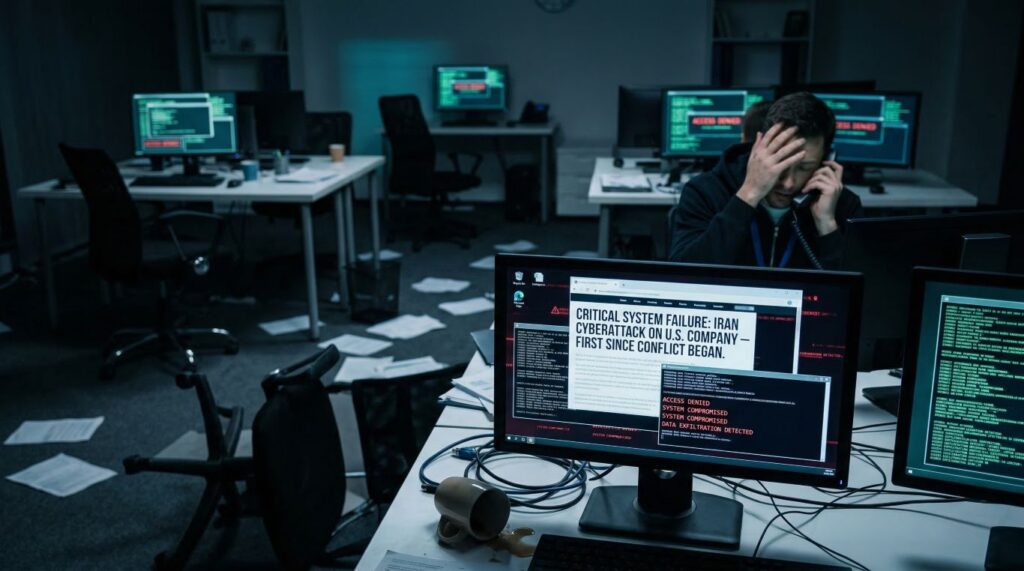
- Iran-linked hackers carried out a significant cyberattack on Stryker, a major U.S. medical device company — marking the first major attack on an American company since the Iran-U.S. conflict began on February 28, 2026.
- The hacker group Handala, tied to Iran’s Intelligence Ministry, claimed responsibility — publicly announcing the attack on Telegram and X as retaliation for U.S. military strikes.
- Stryker’s Microsoft environment was disrupted globally, causing a network outage that impacted operations across the company’s infrastructure.
- Iran’s cyber activity has escalated sharply since the war began — targeting cameras, data centers, and industrial facilities in addition to U.S. companies.
- CrowdStrike and other cybersecurity firms are warning that Western organizations face heightened risk — and the Stryker attack may be just the beginning of a broader cyber campaign.
Iran Just Hacked a U.S. Company — Here’s What You Need to Know
A confirmed cyberattack hit Stryker — and it’s not a drill.
On March 12, 2026, pro-Iranian hackers struck Stryker, a Michigan-based medical technology giant, in what cybersecurity analysts are calling the first significant cyberattack on a U.S. company since the Iran-U.S. war began. The attack caused a global network disruption across Stryker’s Microsoft environment, sending shockwaves through the cybersecurity world and beyond. Stryker’s stock dropped more than 3% immediately following news of the breach.
For businesses relying on Microsoft infrastructure — which is most of corporate America — this attack is a direct signal that no organization is too large, too specialized, or too far removed from geopolitics to be a target. Understanding what happened, who did it, and why is the first step to protecting your own organization.
The Attack That Changed the Cyber Threat Landscape
Before the Stryker attack, Iran’s cyber activity since February 28 had been measured — mostly espionage, reconnaissance, and probing. This was different. Disrupting a major U.S. medical device company’s global network is a deliberate escalation, moving from intelligence gathering to operational damage. It signals that Iran-linked hackers are now willing to cause real, tangible harm to American business infrastructure.
Why This Attack Is Different From Previous Iranian Cyber Activity
Prior Iranian cyber campaigns, as tracked by Google and email security company Proofpoint, focused heavily on espionage related to the war — collecting intelligence, monitoring communications, and mapping systems. The Stryker attack broke that pattern entirely. It was disruptive, public, and claimed loudly across social media platforms. That shift from quiet espionage to loud disruption is exactly what makes this moment a turning point for every U.S. business’s cybersecurity posture.
Stryker: The U.S. Company at the Center of the Attack
Stryker is one of the world’s largest medical technology companies, headquartered in Kalamazoo, Michigan. The company makes surgical equipment, orthopedic implants, and hospital infrastructure products used in facilities across the globe. With operations spanning dozens of countries and deep integration into hospital supply chains, Stryker represents exactly the kind of high-impact, high-visibility target that makes geopolitical hackers pay attention.
What Stryker Does and Why It Was a Target
Stryker’s global footprint and critical role in healthcare made it a high-value target. Attacking a company embedded in hospitals and surgical centers sends a message that goes far beyond a data breach — it threatens the continuity of medical care. For a hacker group trying to maximize psychological and political impact, few targets carry more symbolic weight than a company supplying operating rooms.
How the Attack Disrupted Stryker’s Microsoft Environment
Stryker confirmed in a public statement that the cyberattack disrupted its “Microsoft environment,” causing what the company described as a global network disruption. While Stryker did not immediately disclose the full technical scope of the breach, disruptions to a Microsoft environment typically affect email systems, cloud-based operations, identity management through Azure Active Directory, and internal communications — essentially the nervous system of a modern enterprise. For more on recent breaches, see the Telus digital data breach.
Employees’ Work Phones Stopped Working Mid-Attack
One of the most telling signs of how deep the disruption went: employee work phones stopped functioning during the attack. This kind of impact points to a compromise at the identity or mobile device management layer — the kind of access that cascades across every connected system in an organization.
When phones go dark, it means the attack didn’t just hit servers. It hit the authentication and device management systems that keep an entire enterprise connected. For security teams, that’s one of the most alarming indicators of a sophisticated, multi-layer intrusion.
Who Carried Out the Attack
The group behind the attack didn’t hide — they bragged about it.
The Pro-Iranian Hacker Group That Claimed Responsibility
Handala Team — a pro-Iranian, pro-Palestinian hacker group — publicly claimed responsibility for the Stryker attack on both Telegram and X. Multiple cybersecurity companies have identified Handala as having direct ties to Iran’s Intelligence Ministry, making this not just a hacktivist operation but a state-linked cyber strike. The group routinely publicizes its attacks on social media, though both Telegram and X have taken down some of their posts in recent days.
Handala’s willingness to operate openly — claiming attacks, posting targets, and announcing intentions — makes them particularly dangerous from a threat intelligence standpoint. Their transparency is strategic: it amplifies fear, maximizes political impact, and forces organizations to react even when an attack hasn’t happened yet.
Why Hackers Said They Targeted Stryker
Handala’s stated justification was direct retaliation. In a social media post published on Wednesday, the group said the Stryker hack was a response to a U.S. missile strike on an elementary school in Iran — an incident that Iranian state media claimed killed at least 168 children. The Pentagon confirmed it is investigating that incident. Whether or not that specific justification holds up to scrutiny, it reveals how Iran-linked hackers are now using civilian casualties as public recruitment and motivation tools to escalate cyber operations against American targets.
How Russian Hackers Joined the Pro-Iranian Cyber Campaign
The Stryker attack didn’t happen in isolation. According to reporting, Russian-linked hacker groups have also been observed aligning with pro-Iranian cyber campaigns since the conflict began, broadening the threat landscape considerably. While the operational details of that collaboration remain limited, the convergence of Russian and Iranian cyber actors targeting U.S. interests simultaneously is a pattern that security teams cannot afford to ignore. Two of the world’s most capable state-linked hacking ecosystems operating in the same threat space, at the same time, against the same targets — that’s a compounding risk that changes how organizations need to think about their defenses.
Iran’s Cyber Activity Since the War Began February 28
Since the conflict between Iran and the U.S. officially began on February 28, 2026, Iranian-linked hackers have been systematically probing and attacking targets across multiple domains. The activity started with reconnaissance and espionage — quiet, methodical, and largely under the public radar. The Stryker attack marks the moment that changed.
What makes this escalation particularly concerning is the speed at which it happened. Within weeks of the war’s start, Iran-linked groups moved from passive intelligence collection to active disruption of a Fortune 500 company’s global network. That timeline is faster than most enterprise security teams can adapt their defenses.
Iran-Linked Cyber Activity Timeline Since February 28, 2026
Activity Type Target Purpose Camera Penetration Middle Eastern countries Improve Iran’s missile targeting Data Center Attacks Regional data centers Disrupt communications infrastructure Industrial Facility Targeting Industrial facilities in the region Operational disruption Espionage Campaigns U.S. and allied organizations War-related intelligence gathering Stryker Network Attack U.S. medical device company Retaliation, political messaging
Each item on that list represents a distinct attack vector — and together, they paint a picture of a coordinated, multi-front cyber campaign that is actively expanding in scope and ambition.
Previous Attacks Were Minor — Until Now
In the early weeks of the conflict, Iranian cyber activity was described by analysts as largely minor — probing attempts, small-scale intrusions, and espionage operations that didn’t rise to the level of significant disruption. The Stryker attack shattered that baseline. It’s now the benchmark against which all future Iran-linked attacks on U.S. companies will be measured, and it demonstrates that the restraint shown in early weeks was likely strategic patience, not limited capability.
Cameras, Data Centers, and Industrial Facilities Already Targeted
Before hitting Stryker, Handala and affiliated groups were already working to compromise physical infrastructure. They attempted to penetrate surveillance cameras in Middle Eastern countries — not for surveillance in the traditional sense, but specifically to improve Iran’s missile targeting accuracy. That’s a direct integration of cyber operations into kinetic warfare, and it’s a level of sophistication that goes well beyond typical hacktivist activity.
Data centers in the region were also targeted, alongside industrial facilities. Attacks on data centers can cascade quickly — disrupting cloud services, knocking out communications, and severing the connectivity that modern businesses depend on entirely. Industrial facility targeting, meanwhile, raises the specter of operational technology attacks that can cause physical damage. For more information on recent vulnerabilities, see the CISA alert on n8n RCE bug.
The breadth of these targets — cameras, data centers, factories, and now a global medical technology company — reveals a threat actor that is not fixated on a single sector. Any organization with significant digital infrastructure and U.S. ties needs to treat itself as a potential target right now.
What Google and Proofpoint Found Tracking Iranian Hacker Groups
Both Google and Proofpoint — two of the most capable cyber threat intelligence organizations in the world — have been actively tracking Iranian hacker groups since the conflict began. Their findings, shared with NBC News, indicate that Iranian hackers have been primarily focused on espionage related to the war. They’ve been mapping networks, intercepting communications, and gathering intelligence — the kind of groundwork that typically precedes more aggressive action. The Stryker attack suggests that groundwork phase may now be over for at least some of those groups.
The Broader Cyber Threat to U.S. Infrastructure
The Stryker attack is not a one-off event — it’s an opening move in what cybersecurity experts expect to be an escalating campaign against U.S. interests. The real question isn’t whether more attacks are coming. It’s which sectors get hit next and how prepared those organizations are when it happens.
Adam Meyers, head of counter adversary operations at CrowdStrike, stated directly that the timing of the Stryker attack confirms hackers were targeting U.S. interests because of the war in Iran. That’s not a theory — it’s an assessment from one of the most respected threat intelligence teams in the industry, and it means the threat is tied directly to geopolitical events that show no signs of cooling down.
Defense Contractors, Power Stations, and Water Plants at Risk
While a medical device company was the first confirmed major target, the sectors facing the highest risk extend well beyond healthcare. Defense contractors, power generation facilities, water treatment plants, and financial institutions all represent the kind of high-impact targets that align with Iran’s strategic interests. Disrupting any one of these sectors creates cascading effects that go far beyond the targeted organization.
Water treatment plants in particular have historically been a focus of Iranian cyber actors — a fact documented in previous U.S. government advisories. Power grid attacks could affect millions of civilians. Defense contractor breaches could compromise sensitive military supply chains. The threat is not hypothetical — it’s a pattern that has played out before, and the current conflict creates fresh motivation to execute it again at scale. For example, a recent data breach highlights the ongoing vulnerabilities in digital infrastructures.
How Pro-Iranian Hackers Are Openly Planning Attacks on Telegram
One of the most unusual and dangerous aspects of this threat environment is how openly it operates. Handala and affiliated groups use Telegram and X to announce targets, claim attacks, and recruit supporters — essentially running a public-facing cyber warfare campaign. While both platforms have removed some of this content, the posts continue to surface, giving threat intelligence teams a rare window into planned operations. Organizations that aren’t actively monitoring these channels — or partnering with firms that do — are flying blind on threat intelligence that is, in some cases, being handed out for free. For example, a recent data breach highlights the importance of staying informed.
Why Iran Is Targeting Easy Vulnerabilities First
Iran-linked hackers are following a well-documented playbook: start with accessible targets, exploit known vulnerabilities, and build toward higher-impact operations as capabilities and intelligence improve. The camera penetration attempts, the data center probes, and now the Stryker Microsoft environment attack all follow a logical escalation path. Organizations that have deferred patching known Microsoft vulnerabilities, left remote access tools exposed, or failed to implement multi-factor authentication are the low-hanging fruit that gets picked first — and right now, that fruit is being actively harvested.
CrowdStrike’s Warning: Western Organizations Must Stay on High Alert
Adam Meyers, head of counter adversary operations at CrowdStrike, has been unambiguous: the Stryker attack is directly tied to the ongoing war, and Western organizations need to treat the current threat environment as fundamentally different from anything they’ve navigated before. CrowdStrike’s assessment isn’t based on speculation — it’s grounded in active threat tracking of Iranian cyber actors whose behavior has shifted measurably since February 28. The message from CrowdStrike is simple: assume you are a potential target, and act accordingly.
What This Means for Cybersecurity Right Now
The Stryker attack rewrote the rules of engagement for corporate cybersecurity in 2026. If a company of Stryker’s size — with dedicated IT and security resources — can have its entire global Microsoft environment disrupted by a pro-Iranian hacker group, the question every business leader needs to ask is brutally honest: are we actually prepared?
How to Protect Your Organization From Iran-Linked Threats
The threat is real, active, and expanding — but it’s not undefendable. The following steps directly address the attack vectors Iran-linked groups have been exploiting since the conflict began:
- Patch Microsoft vulnerabilities immediately. The Stryker attack targeted the Microsoft environment specifically. Any unpatched vulnerabilities in Microsoft 365, Azure Active Directory, or Exchange are open doors. Run a full audit now.
- Enforce multi-factor authentication (MFA) across every account. No exceptions — not for executives, not for contractors, not for service accounts. MFA is the single most effective control against the credential-based attacks Iran-linked groups favor.
- Audit and lock down remote access tools. VPNs, RDP endpoints, and remote management tools that aren’t strictly necessary should be disabled. Those that remain must require MFA and should be monitored for anomalous login patterns.
- Implement mobile device management (MDM) hardening. The fact that Stryker employees’ work phones stopped functioning mid-attack points to an MDM or identity layer compromise. Verify your MDM policies enforce device compliance, remote wipe capability, and conditional access.
- Subscribe to active threat intelligence feeds. Organizations like CrowdStrike, Google’s Threat Intelligence Group, and Proofpoint are actively tracking Iranian hacker groups. Subscribing to their feeds gives your security team advance warning on tactics, techniques, and procedures (TTPs) being used right now.
- Monitor Telegram and open-source threat channels. Handala publicly announces targets. Threat intelligence teams monitoring these channels have early warning before attacks launch — this is actionable intelligence most companies are leaving on the table.
- Run a tabletop exercise simulating a Microsoft environment disruption. Your team needs to know exactly what to do in the first 30 minutes of a network-wide outage. If you haven’t rehearsed it, you will be making decisions under pressure with no playbook.
Speed matters here. Iranian-linked groups are moving fast, and the gap between reconnaissance and execution — as the Stryker timeline shows — can be measured in days, not months. Every week that security hardening is deferred is a week of compounding exposure.
Why Microsoft Environments Are a Prime Target
Microsoft’s ecosystem — Microsoft 365, Azure, Teams, SharePoint, Exchange, and Intune — is the operational backbone of most mid-to-large enterprises worldwide. That ubiquity is precisely what makes it the preferred attack surface for state-linked hackers. A single successful intrusion into an Azure Active Directory tenant can give attackers lateral movement across an entire organization’s cloud infrastructure. The Stryker attack demonstrated this isn’t theoretical — it’s happening now, in the real world, against real companies. Organizations running Microsoft environments need to treat their Azure AD configuration, conditional access policies, and privileged identity management settings as frontline security controls, not background IT housekeeping.
Frequently Asked Questions
These are the questions organizations and security professionals are asking most right now about the Iran cyberattack on a U.S. company — answered directly.
What company did Iran-linked hackers attack?
Iran-linked hackers attacked Stryker, a Michigan-based medical technology company and one of the world’s largest makers of surgical equipment, orthopedic implants, and hospital infrastructure products. The attack caused a global network disruption across Stryker’s Microsoft environment and was claimed by the pro-Iranian hacker group Handala Team.
When did the Iran cyberattack on Stryker happen?
The cyberattack on Stryker occurred on Wednesday, March 12, 2026. It was reported the same day by The Wall Street Journal, and Stryker subsequently published a public statement confirming the global network disruption.
Stryker’s shares fell more than 3% following the initial reports of the breach, reflecting the immediate market impact of a confirmed cyberattack on a major publicly traded company.
Why did the hackers target a medical device company?
Handala Team stated the attack was direct retaliation for a U.S. missile strike on an elementary school in Iran, which Iranian state media claimed killed at least 168 children — an incident the Pentagon confirmed it is investigating. Targeting a medical technology company maximizes symbolic impact, connecting the attack to healthcare and human life in a way that amplifies the political message. The attack also highlights vulnerabilities in critical sectors, similar to the CISA alert on n8n RCE bug that exposed thousands of instances.
Beyond the stated justification, Stryker also represents a high-visibility, high-impact U.S. company with deep integration into global hospital supply chains — exactly the kind of target that generates maximum disruption and media attention, which aligns with Handala’s strategy of publicizing every attack for psychological and political effect. This approach is similar to tactics seen in other cyber incidents, such as the Telus digital data breach, where hackers aim to maximize psychological impact.
Is this the first Iranian cyberattack on a U.S. company since the war started?
Yes. The Stryker attack is confirmed as the first significant cyberattack on a U.S. company by Iran-linked hackers since the Iran-U.S. conflict began on February 28, 2026. Prior activity since the war’s start had been largely focused on espionage, reconnaissance, and attacks on regional infrastructure — not direct, disruptive strikes on American corporations.
What U.S. infrastructure is most at risk from Iranian hackers?
Based on Iran’s documented attack history and current threat intelligence, the sectors facing the highest risk include defense contractors, power generation facilities, water treatment plants, financial institutions, and healthcare organizations. Each of these sectors has appeared in previous Iranian cyber campaigns or represents a strategic target given the current conflict. For instance, recent alerts from CISA highlight vulnerabilities that could be exploited by hackers.
Industrial control systems and operational technology environments — the systems that run physical infrastructure like power grids and water treatment plants — are particularly vulnerable because they often run outdated software and lack the layered defenses found in enterprise IT environments. Iran-linked hackers have previously targeted water facilities, making that sector an especially high-priority area for immediate security review.